This is Renogy’s Rover 40 A MPPT with the Bluetooth module included, BT-2 or BT-1 depending on version. It connects to the DC Home app, and its RJ45 port links it to other Renogy devices. At $179.99, it costs $11 more than the Rover without the module.
Silent
An integrated heat sink replaces the cooling fan, so the controller makes no noise. In a van or bedroom-adjacent cabinet, that matters.
Charging
Four stages for lead-acid, two for lithium, lithium reactivation and the ability to begin charging at 0 V. Lithium mode is set manually; AGM, gel and flooded are detected automatically. The PV limit is 100 V.
Price on Amazon.com
Amazon.com listed it at $179.99 on November 2, 2026, with a three-year warranty.
Prices quoted in this text were read on November 2, 2026. The live price is at the top of the page.
What it gets right, and what it leaves out
Strengths
The Bluetooth module is in the box, for $11 more than the plain Rover
Fanless: silent at night
Can start charging a lithium battery at 0 V
Compromises
Lithium mode is set manually; lead-acid types are automatic
12 and 24 V only
4.2 stars from 488 ratings, below the plain Rover’s 4.4
Specifications
Charge current
40 A
Battery voltage
12/24 V
PV input
100 V
Efficiency
99% tracking, 98% peak conversion
Connectivity
BT-2 (or BT-1) Bluetooth module included; DC Home app; RJ45 communication port
Charging
4-stage lead-acid, 2-stage lithium, lithium reactivation, charges from 0 V
Cooling
Integrated heat sink, no fan (0 dB)
Dimensions
6.81 × 2.85 × 9.37 in
Warranty
3 years
Amazon reference
B079JRNFY6
Questions owners ask about this one
What module comes with it?
A Renogy BT-2 (version 2) or BT-1 (version 1) Bluetooth module, for the DC Home app.
Is it noisy?
No. It uses an integrated heat sink instead of a fan.
What does charging at 0 V mean?
It can begin charging a lithium battery whose BMS has disconnected it, a common state after deep discharge.
Our score
7.6/ 10
The Rover with Bluetooth included and a fanless case. Worth the extra $11 if you want the app.
Set beside the neighboring portable power units
Same category, nearby prices, between portable power units. What remains is the specifications every one publishes — half empty, a column is no use.
Model
Price
Charge current
Connectivity
Renogy Rover 40 A with Bluetooth
$180
40 A
BT-2 (or BT-1) Bluetooth module included; DC Home app; RJ45 communication port
Where the models are not equal, in portable power units
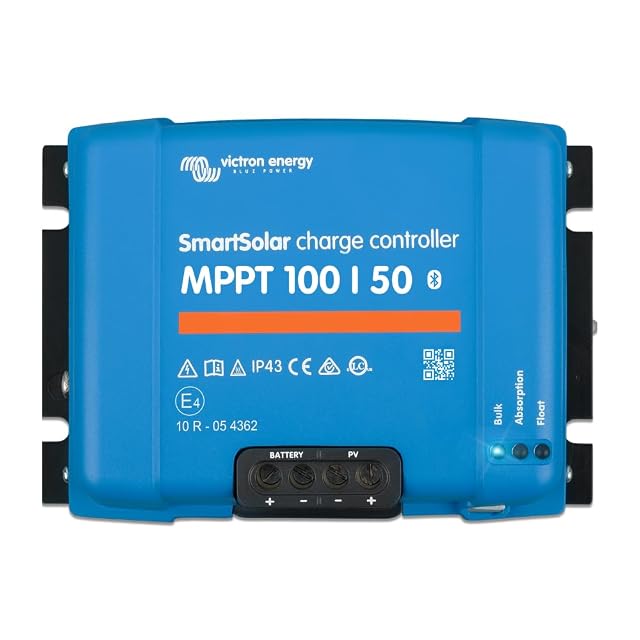
If price decides: Victron Energy SmartSolar MPPT 100/50, at $138.
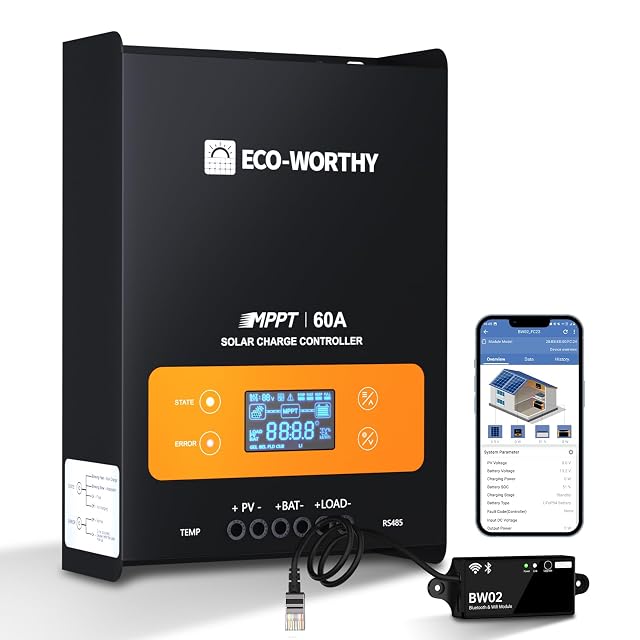
Highest Charge current in the table: ECO-WORTHY 60 A MPPT with Bluetooth and Wi-Fi (60 A).
Who this one is for, among portable power units
Silent RV and van installations that want the app without buying parts
Sources
Specifications: the manufacturer sheet for portable power gear and the matching Amazon product page. Prices and availability: Keepa. Every figure on this page names its source.
Victron SmartSolar MPPT 100/50 solar charge controller: 100 V PV input, 50 A charge current, 12/24 V, built-in Bluetooth, VictronConnect with 30-day history, certified to UL1741, 1.5 kg
Victron’s SmartSolar 100/50: 50 A of charge for 12 or 24 V banks, built-in Bluetooth and UL1741, for $138.08 with 2,539 ratings.
Best for: Van and RV systems of 600 W to 1,400 W of panels
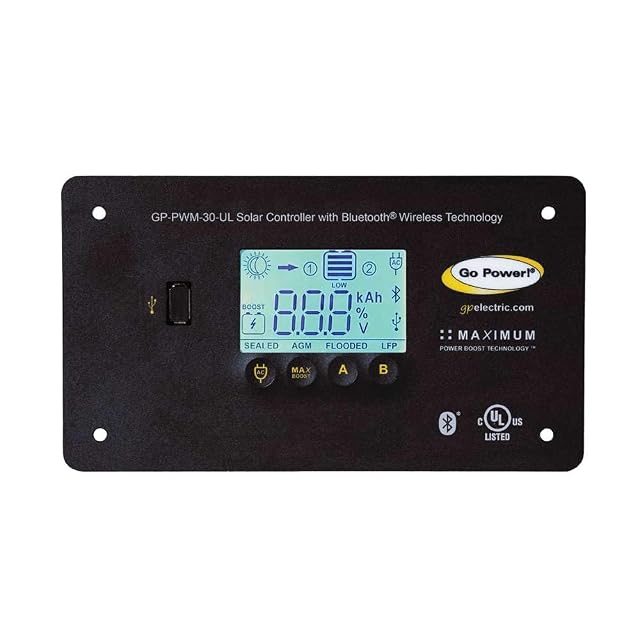
Go Power! GP-PWM-30-UL Bluetooth 30 A PWM solar regulator, up to 570 W of solar, full 4-stage charging with equalize, displays voltage, amperage and battery state of charge, UL in the model name, 5-year warranty
Go Power’s RV-standard 30 A PWM regulator with Bluetooth, 4-stage charging and a five-year warranty, rated for up to 570 W of solar, at $167.37.
Best for: RVs pre-wired for Go Power, where it replaces or upgrades a factory unit
ECO-WORTHY 60 A MPPT solar charge controller, 150 V PV, 12/24/36/48 V auto, Bluetooth (33 ft) and Wi-Fi, 99.5% tracking and 98% peak efficiency, three load modes, lithium activation, backlit LCD
A 60 A MPPT controller with both Bluetooth and Wi-Fi, 150 V of PV input and 12 to 48 V support, for $159.99: the most capacity per dollar here.
Best for: Cabins and sheds where the system should be checked from home