A lead-acid charger never finishes a lithium battery · review
YDBAO 10 A, 12 V, LiFePO4 and AGM selectable review
A 10 A vehicle battery charger with selectable LiFePO4 and AGM modes, an LCD showing voltage, current, progress and temperature, and a pulse repair mode for sulphated lead batteries.
The bottom line A capable dual-chemistry charger with temperature on its display and eight named protections. It publishes neither absorption nor float voltage, which are the two numbers that describe what it actually does to a battery.
A 10 A charger for a garage with two kinds of battery in it.
Two chemistries, selectable
LiFePO4 and AGM, chosen at the charger. That covers a starter battery and a leisure battery from one unit, which is the practical case in most garages.
The display
Voltage, charge current, progress, battery status, temperature, and the summer or winter mode. Temperature on the display is unusual and it connects to the mode selection: lead-acid charging voltage should fall as the battery warms.
The mode without a threshold
Summer and winter are named; no temperature is given for either. Three LiFePO4 batteries in this catalogue publish their own cold cut-offs at 0 °C and −7 °C. A charger that offers a winter mode without a temperature leaves the two halves unconnected.
The numbers that are not there
Absorption voltage. Float voltage. Those are what a charger applies and what a battery maker specifies. This charger names its chemistries and never says what voltage it gives them.
The repair mode
Pulse repair for sulphation and acid stratification, on lead batteries. Reported as published; it has no application to a lithium pack.
Availability
German, French, Italian and Spanish Amazon stores quoted 20 € to 22 € when this page was compiled.
American and British Amazon catalogues carry an entry for it, with nobody selling.
These figures are what Keepa reported on the day this page was last updated. Availability and pricing move without notice.
Prices quoted in this text were read on 16 September 2026. The live price is at the top of the page.
What it gets right, and what it leaves out
Strengths
The display shows temperature alongside voltage, current and progress
Separate summer and winter modes, which acknowledge that charging voltage should follow temperature
A pulse repair mode for sulphation and acid stratification on lead batteries
Compromises
No absorption or float voltage published, on a charger whose whole job is applying them
The winter mode has no temperature threshold attached
No connectors described — clamps, ring terminals or otherwise
Specifications
Charge current
10 A, first bullet, described as 30 % faster than 8 A or 6 A models
Absorption
Nowhere in the listing — no absorption voltage is published
Float voltages
Nowhere in the listing
Profiles
LiFePO4 and AGM selectable, from the title, with separate summer and winter modes shown on the display
Low-temperature behaviour
A winter mode is named on the display, second bullet; no temperature threshold is published
Connectors
Nowhere in the listing
Protections
Eight: reverse polarity, short circuit, over-charge, over-current, over-heating, over-voltage and spark prevention, third bullet
Amazon reference
B0G7HPRFQK (same reference on 6 Amazon marketplaces)
EAN
6978545731106
Questions owners ask about this one
What is a pulse repair mode?
It applies short high-voltage pulses intended to break down sulphate crystals on lead plates. Its effectiveness is debated and it applies only to lead-acid; on a LiFePO4 battery it has no role, and the charger’s lithium mode should not use it.
Why do summer and winter modes exist?
Because a lead-acid battery’s correct charging voltage falls as temperature rises. Two fixed modes are a coarse version of the temperature compensation better chargers do continuously, and it is more than most chargers here offer.
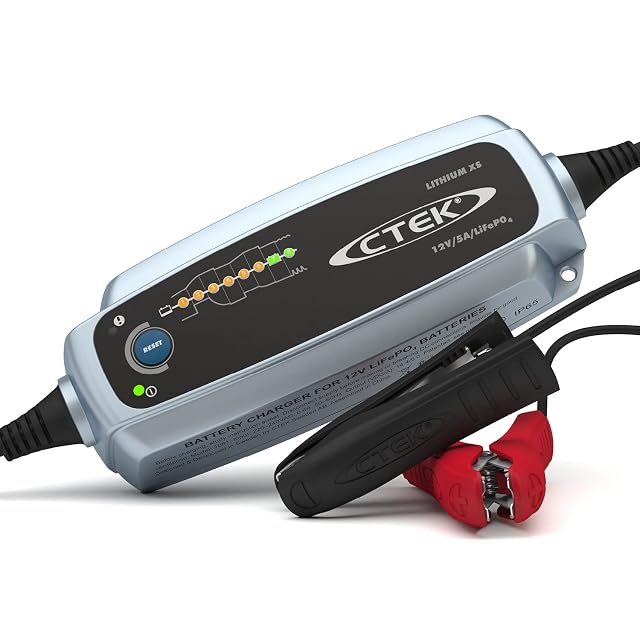
5 A charge · absorption not published · float not published, a patented maintenance stage is named · LiFePO4 only, 5–60 Ah charging and up to 120 Ah maintenance · low-temperature behaviour not published · connectors not described · test sequence before charging
A 5 A charger dedicated to 12 V LiFePO4 batteries, charging packs from 5 to 60 Ah and maintaining up to 120 Ah, with a test sequence that assesses the battery before charging.
Best for: A motorcycle, a classic car or a small leisure pack that spends months unused.
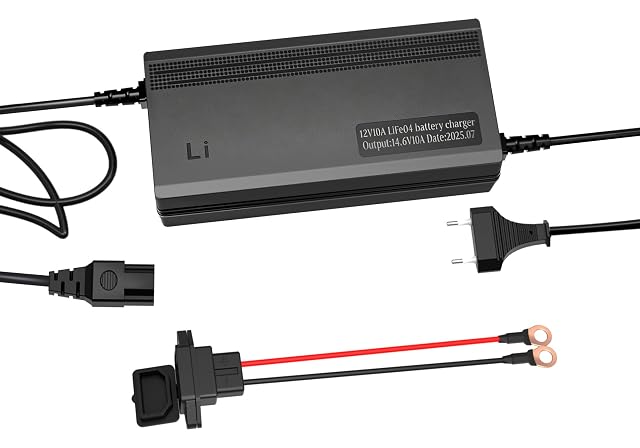
10 A charge · 14.6 V constant voltage published · float not published · LiFePO4 only, 12 V/12.8 V · low-temperature behaviour not published · connectors not described · over-temperature, output over-voltage, over-current, reverse polarity, output short circuit, overload
A 14.6 V 10 A charger built only for 12 V LiFePO4 batteries, using a three-stage constant current, constant voltage and full charge sequence with a side cooling fan.
Best for: A 12 V LiFePO4 bank that wants a charger doing one thing correctly.
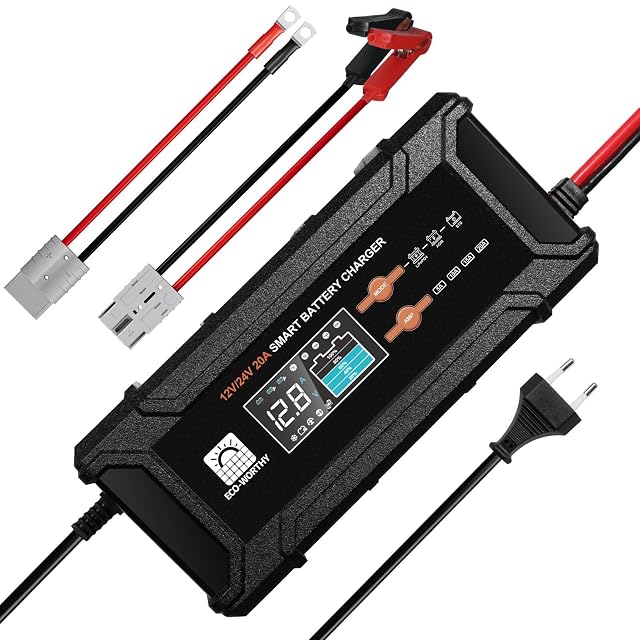
5, 10, 15 or 20 A selectable · absorption not published · float not published · LiFePO4, AGM, gel and lead-acid with automatic voltage detection · 0 V activation for LiFePO4, low-temperature lead charging named · connectors not described · reconditioning mode for lead
A 20 A charger for 12 V and 24 V systems with four selectable currents, automatic voltage detection, a 0 V activation function for lithium packs and a lead reconditioning mode.
Best for: A workshop dealing with both chemistries, and with lithium packs that have been left too long.