Simple, cheap, and honest about what it cannot recover · review
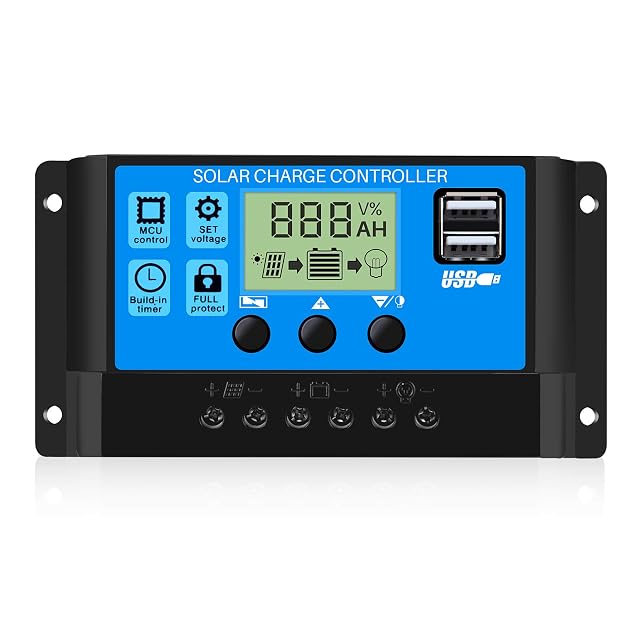
Depvko 30 A PWM, 12 V/24 V, with timer review
A 30 A PWM controller for 12 V and 24 V systems with a timer, whose third bullet states in capitals that it must NOT be used with lithium or nickel batteries.
The bottom line A simple PWM controller that states its chemistry limit in capitals and describes every protection as self-recovering. It publishes no PV ceiling and no terminal capacity, which are the two figures an installation needs.
A 30 A PWM controller for lead-acid batteries, and it says so.
The capitalised exclusion
The third bullet: suitable only for lead-acid batteries, including flooded, sealed and colloidal — and do NOT charge lithium or nickel cells. Stated plainly, in capitals, in the middle of the listing. Two other PWM controllers in this catalogue name lithium among their compatible types; this one draws the line.
Automatic recovery
All six protections are described as automatically recovering types. On a controller in a shed or on a gate, that is the difference between a fault that clears itself and a journey with a screwdriver.
The two figures missing
Maximum PV input voltage, and terminal capacity. The first decides whether an array can be connected at all; the second decides what cable fits. At 30 A both matter.
PWM, honestly
No claim to track anything. This is a pulse-width controller and the listing does not dress it up, which after two controllers in this catalogue that describe their MPPT in terms that are not tracking, is worth noting.
Availability
German, French, Italian and Spanish Amazon stores quoted 12 € to 16 € when this page was compiled.
American and British Amazon stores carry it too, priced in their own currency, which the euro range above deliberately omits.
These figures are what Keepa reported on the day this page was last updated. Availability and pricing move without notice.
Prices quoted in this text were read on 16 September 2026. The live price is at the top of the page.
What it gets right, and what it leaves out
Strengths
The exclusion of lithium is stated in capitals rather than left to be discovered
All six protections are described as automatically recovering, which matters on an unattended installation
The cheapest controller in this catalogue
Compromises
No maximum PV input voltage
No terminal capacity, so cable size at 30 A cannot be checked
PWM rather than MPPT, which costs yield on a mismatched panel
Specifications
Charge current
30 A, from the title
Panel voltage matching
Automatic 12 V and 24 V system detection with no manual adjustment, second bullet; no PV voltage ceiling is published
Battery profiles
Lead-acid only — open, sealed and colloidal — with lithium and nickel batteries explicitly excluded in the third bullet
Load output
Present, with a timer and automatic parameter setting, from the title
Control
Built-in industrial microcontroller automatically managing panels and battery, first bullet
Display
LCD, from the title
Protections
Over-current, short circuit, open circuit, reverse connection, low voltage and over-charge, all with automatic recovery, fourth bullet
Terminals
Nowhere in the listing
Amazon reference
B08NFSCZ4V (same reference on 6 Amazon marketplaces)
EAN
0713484981245
Questions owners ask about this one
Why does it matter that lithium is excluded?
Because a lead-acid charging profile applied to a lithium pack is wrong in both voltage and termination. The pack’s management system will defend itself, but the charging will not work properly. This listing says so in capitals, which two of the four PWM controllers here do not.
What does PWM cost against MPPT?
PWM ties the panel to the battery voltage and discards the difference; MPPT converts it. On a 12 V battery with a panel whose maximum power voltage is well above that, the difference is real. On a small, well-matched system it is modest, and PWM is cheaper and simpler.
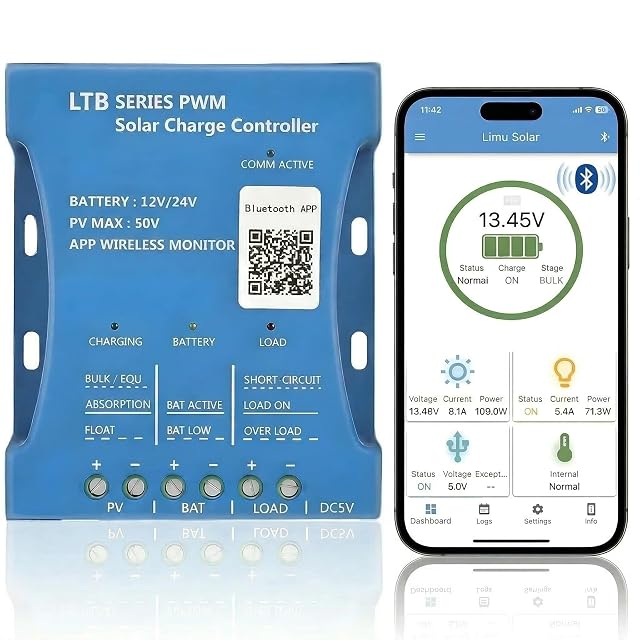
20 A charge · 12 V/24 V lead-acid · five standard battery types including LiFePO4 · USB output · Bluetooth with mobile application · display present · over-voltage, over-current, charge short circuit, short circuit · terminals not described
A 20 A PWM controller with Bluetooth and charge statistics, offering five standard battery types including lithium iron phosphate, with a named iOS application.
Best for: A small lithium bank on a PWM budget, where the statistics matter more than the current.
30 A charge · automatic 12 V/24 V identification · lead-acid only · USB output 5 V/2 A · industrial microcontroller with adjustable charge and discharge parameters · no display stated · short circuit, open circuit, reverse, overload · dual MOS reverse-current protection
A 30 A PWM controller with published dimensions and weight, a 5 V 2 A USB output, adjustable charge and discharge parameters and three-stage PWM management.
Best for: A tight enclosure where the controller has to fit a measured space and nobody will be reading a screen.
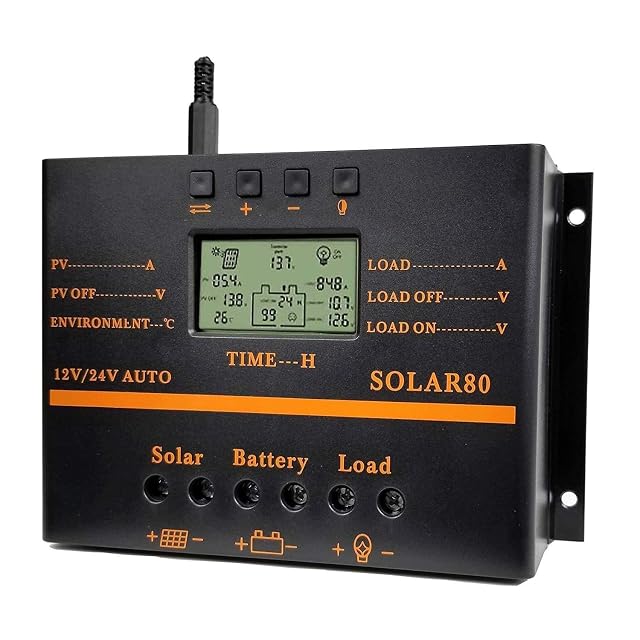
80 A charge · 12 V/24 V · battery profiles not published · load output not described · control not described · LCD display · protections not published · terminals not described
An 80 A solar charge controller for 12 V and 24 V systems with an LCD display, whose listing consists of a single bullet repeating the title.
Best for: Nothing this page can identify, which is the finding rather than a judgement on the product.