A smart alternator will not fill a second battery on its own · review
Victron Energy Orion-Tr Smart 12/12 V 18 A 220 W, isolated review
An isolated 18 A DC-DC charger with an adaptive three-stage algorithm and integrated Bluetooth, which can be paralleled without limit to raise the output.
The bottom line The only isolated charger in this family, which on a boat is the deciding feature, and the only one that can be paralleled without limit. It describes no engine detection and has no solar input, which two of its cheaper neighbours both offer.
An 18 A isolated DC-DC charger, and the smallest output in this family.
What isolation is for
Input and output electrically separate. On a vehicle that matters less; on a boat it matters a great deal, because a shared connection between circuits is a corrosion path. This is the only isolated unit in the family and it is priced accordingly.
Scaling
The fourth bullet states that unlimited units can be paralleled to increase output. That is an unusual approach — most makers sell a bigger unit — and it means a system can grow in 18 A steps rather than by replacement.
The question it does not answer
Engine detection. Modern vehicles vary their alternator output, and a DC-DC charger has to know when the engine is running. Two chargers in this family name an ACC cable or a detection method; this listing names neither, and refers the question to the manual.
No integrated solar tracking
A solar input. Four of the six chargers here accept panels as well as the alternator, which removes a separate controller. This one is a DC-DC charger and nothing else.
Availability
German, French, Italian and Spanish Amazon stores quoted 127 € to 153 € when this page was compiled.
American and British Amazon stores carry it too, priced in their own currency, which the euro range above deliberately omits.
These figures are what Keepa reported on the day this page was last updated. Availability and pricing move without notice.
Prices quoted in this text were read on 16 September 2026. The live price is at the top of the page.
What it gets right, and what it leaves out
Strengths
Galvanic isolation, which separates the starter and service circuits entirely
Unlimited units can be paralleled to raise the output, stated in the fourth bullet
Bluetooth with VictronConnect for monitoring and control, not only monitoring
Compromises
No engine detection or ignition input described, which is the question a modern vehicle raises
No solar input, unlike four of the six chargers in this family
The lowest output current here at the second-highest price
Specifications
Output current
18 A at 220 W, from the title
Input range
12 V to 12 V, isolated, from the title; no voltage range is published
Engine detection
Nowhere in the listing — no ignition signal or alternator detection is described
Profiles
Adaptive three-stage charging for lead-acid and lithium, first and fourth bullets
Solar input
None — this is a DC-DC charger only
Cable
Nowhere in the listing
Fuse requirements
Nowhere in the listing
Heat management
Absent as a description; galvanic isolation is named in the title
Amazon reference
B0851TPKV7 (same reference on 6 Amazon marketplaces)
EAN
8719076046066
Questions owners ask about this one
What does galvanic isolation buy?
The input and output share no electrical connection, so a fault or a difference in earth potential on one side does not reach the other. On a boat, where corrosion between circuits is a real problem, that is the reason to choose an isolated unit over a cheaper one.
Does it work with a variable-output alternator?
A DC-DC charger accepts whatever the alternator offers and produces its own profile, which is the general answer. This listing describes no ignition input or engine detection, so how it decides when to start is a question for the maker’s manual.
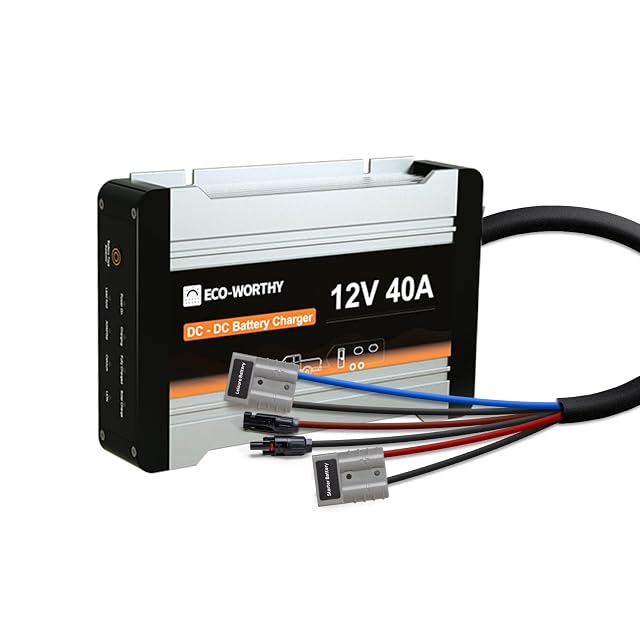
40 A output · 12 V dual input · engine detection not described · multi-stage with charge memory · MPPT solar input at 99 % tracking · cable not specified · fuse requirements not published · IP65
A 40 A DC-DC charger with two inputs — alternator and solar — an integrated MPPT controller at 99 % tracking efficiency, and an IP65 housing.
Best for: A motorhome locker where the charger will be exposed to damp and has to handle both the alternator and a roof panel.
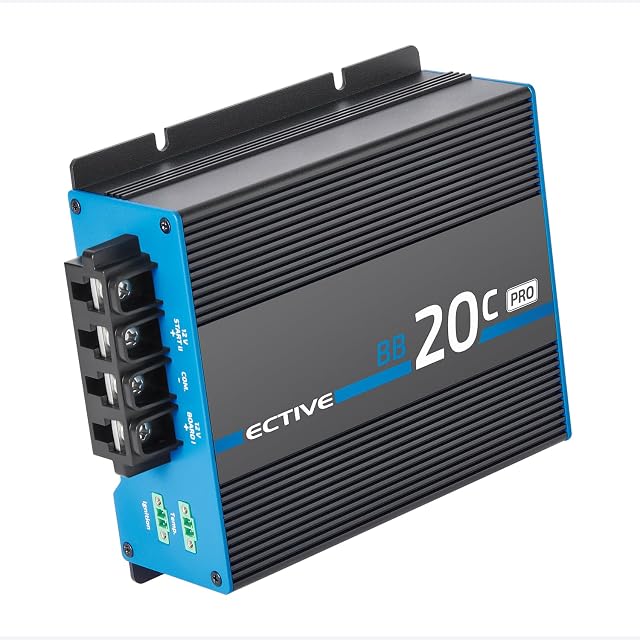
5, 10, 15 or 20 A selectable · 12 V to 12 V · engine detection not described · AGM, gel, flooded and LiFePO4, for 10–200 Ah banks · no solar input · cable not specified · fuse requirements not published · Bluetooth, CI-Bus and CAN-Bus
A 20 A DC-DC charger with the output current selectable at 5, 10, 15 or 20 A, Bluetooth monitoring and both CI-Bus and CAN-Bus interfaces for integration into a caravan system.
Best for: A caravan with an existing bus system, where the charger should report into it rather than stand alone.
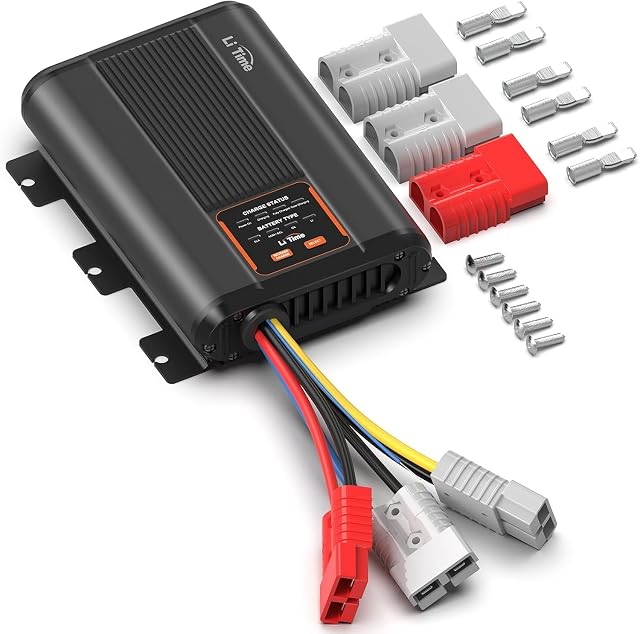
40 A output · 14.6 V output voltage published · ACC cable for smart and conventional alternators · LiFePO4, AGM, gel, SLA and calcium · MPPT solar at 99 % tracking · cable not specified · fuse requirements not published · NOT waterproof, stated
A 40 A DC-DC charger with a published 14.6 V output, an ACC cable for both smart and conventional alternators, an integrated MPPT input, and a warning that it is not waterproof.
Best for: A van with a recent engine, where the alternator is variable and the unit will live inside the habitation space.