A smart alternator will not fill a second battery on its own · review
VEVOR 40 A, 520 W, dual input, four voltage modes review
A 40 A dual-input charger at a stated 94 % efficiency, supporting four input and output voltage combinations set by DIP switches, with emergency reverse charging.
The bottom line The most flexible charger in this family — four voltage combinations, five chemistries, a published efficiency and DIP switch configuration. Its power station compatibility claim is a percentage with nothing behind it.
A 40 A charger that steps voltage in four directions.
The four modes
12 V to 12 V. 12 V to 24 V. 24 V to 12 V. 24 V to 24 V. Set by two DIP switches, which means no application and no configuration lost to a firmware problem. Six chargers in this family and one offers a step-up.
The efficiency
Up to 94 %, published in the first bullet. Six chargers, one figure. Efficiency on a 520 W unit is the difference between a warm locker and a hot one, and it is the number every maker measures and almost none states.
Five chemistries
LiFePO4, lead-acid, gel, AGM and calcium. Named individually, which is the useful form.
The claim to set aside
Compatibility with over 95 % of common power stations. A station’s solar or DC input has a voltage window and a connector, both of which vary between models. A percentage is not a compatibility statement, and this page does not carry it into the specification lines.
What is missing
Engine detection, a cable specification and a fuse requirement — the same three absences as most of this family.
Availability
American Amazon store had it listed when this page was compiled, with no euro amount attached to the offer.
German, British, French, Italian and Spanish Amazon catalogues carry an entry for it, with nobody selling.
These figures are what Keepa reported on the day this page was last updated. Availability and pricing move without notice.
What it gets right, and what it leaves out
Strengths
An efficiency figure is published — up to 94 % — which nothing else in this family gives
Four voltage combinations including 12 V to 24 V, which suits mixed systems
Two DIP switches for configuration, which needs no application
Compromises
The claim of compatibility with over 95 % of power stations is unverifiable as written
No engine detection described
No price recorded on the German store at the time of writing
Specifications
Output current
40 A at up to 520 W with an efficiency of up to 94 %, first bullet — the only charger here to publish an efficiency
Input range
Four modes: 12 V to 12 V, 12 V to 24 V, 24 V to 12 V and 24 V to 24 V, fourth bullet
Engine detection
Nowhere in the listing
Profiles
LiFePO4, lead-acid, gel, AGM and calcium, plus a stated compatibility with over 95 % of common power stations, third bullet
Solar input
Dual input for a solar panel or an alternator, from the title
Cable
Nowhere in the listing
Fuse requirements
Nowhere in the listing
Heat management
Nowhere in the listing
Amazon reference
B0GRGYGZ3D (same reference on 6 Amazon marketplaces)
EAN
0197988375555
Questions owners ask about this one
Why does 12 V to 24 V matter?
Because a vehicle runs at 12 V and a larger habitation bank may run at 24 V, which halves the current for the same power and thins the cable. A charger that steps up removes the need for a separate converter, and only this unit here offers it.
What does “over 95 % of power stations” mean?
Nothing checkable. Compatibility with a power station depends on its input voltage window and its connector, both of which vary. The claim is reported as published and this page does not repeat it as a specification.
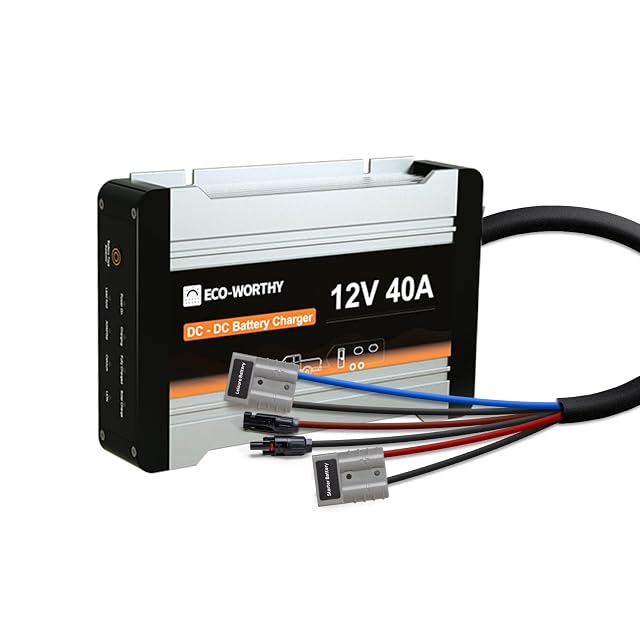
40 A output · 12 V dual input · engine detection not described · multi-stage with charge memory · MPPT solar input at 99 % tracking · cable not specified · fuse requirements not published · IP65
A 40 A DC-DC charger with two inputs — alternator and solar — an integrated MPPT controller at 99 % tracking efficiency, and an IP65 housing.
Best for: A motorhome locker where the charger will be exposed to damp and has to handle both the alternator and a roof panel.
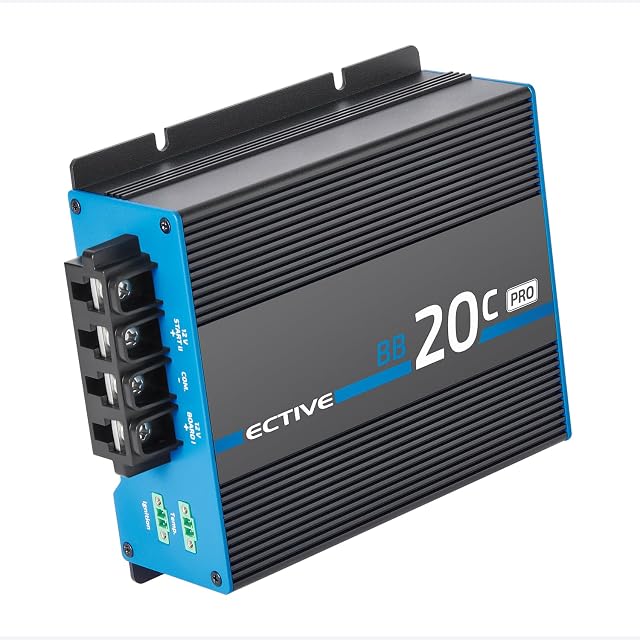
5, 10, 15 or 20 A selectable · 12 V to 12 V · engine detection not described · AGM, gel, flooded and LiFePO4, for 10–200 Ah banks · no solar input · cable not specified · fuse requirements not published · Bluetooth, CI-Bus and CAN-Bus
A 20 A DC-DC charger with the output current selectable at 5, 10, 15 or 20 A, Bluetooth monitoring and both CI-Bus and CAN-Bus interfaces for integration into a caravan system.
Best for: A caravan with an existing bus system, where the charger should report into it rather than stand alone.
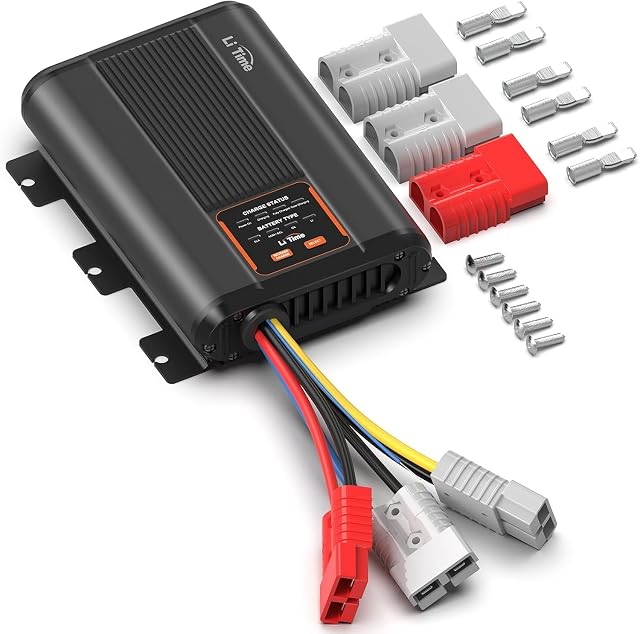
40 A output · 14.6 V output voltage published · ACC cable for smart and conventional alternators · LiFePO4, AGM, gel, SLA and calcium · MPPT solar at 99 % tracking · cable not specified · fuse requirements not published · NOT waterproof, stated
A 40 A DC-DC charger with a published 14.6 V output, an ACC cable for both smart and conventional alternators, an integrated MPPT input, and a warning that it is not waterproof.
Best for: A van with a recent engine, where the alternator is variable and the unit will live inside the habitation space.
A price quoted in the text of a PowerVerdict page dates from the day that page was written; the live figure beside each product is fetched while you read and replaces it.