A 1,000 W pure sine wave inverter certified to UL 458 and CSA C22.2, with GFCI, a hardwire terminal, 4 AWG cables and a 16.4 ft remote, sold by Amazon.
Renogy’s P2 is a 1,000 W, 12 V to 120 V pure sine wave inverter with a 2,000 W surge and over 90% efficiency. It is certified to UL 458 and CSA C22.2 No. 107.1, the US and Canadian standards for inverters in vehicles and RVs. Among the 1,000 W inverters here, it is the one with the most explicit safety certification.
Installation-ready
Two AC outlets, an AC terminal block for hardwiring into an RV or van circuit, and a GFCI. Two 3 ft 4 AWG cables and a 16.4 ft wired remote are in the box. At 1,000 W from 12 V, current is around 90 A, which is why the cable gauge matters.
Protections
LED indicators for under-voltage, over-voltage, over-temperature, overload and short circuit, with cooling fans and a metal housing.
Price on Amazon.com
Amazon.com listed it at $175.99 on November 2, 2026. It weighs 6 lb.
Prices quoted in this text were read on November 2, 2026. The live price is at the top of the page.
What it gets right, and what it leaves out
Strengths
UL 458 and CSA C22.2 No. 107.1, the vehicle and RV inverter standards
A hardwire terminal block for an RV or van circuit, plus GFCI protection
4 AWG cables in the box, the right size for 1,000 W at 12 V
Compromises
Costs about twice the HQST, which also has GFCI
A single 2.1 A USB-A port
No app or display
Specifications
Continuous output
1,000 W, 2,000 W peak surge
Input / output
12 V DC to 120 V AC, pure sine wave
Efficiency
Over 90%
AC
2 outlets and 1 AC terminal block (hardwire)
USB
5 V/2.1 A
Safety
GFCI; under/over-voltage, over-temperature, overload and short-circuit indicators
Certification
UL 458 and CSA C22.2 No. 107.1
In the box
Two 3 ft 4 AWG cables, 16.4 ft wired remote
Weight
6 lb
Dimensions
12.9 × 6.8 × 3.3 in
Amazon reference
B07JMQ27WJ
Questions owners ask about this one
Why does UL 458 matter?
UL 458 is the US safety standard for power inverters used in vehicles, RVs and boats. Renogy also cites CSA C22.2 No. 107.1, the Canadian equivalent.
What cable do I need?
At 1,000 W and 12 V the inverter draws roughly 90 A. Renogy includes two 3 ft 4 AWG cables sized for that; add a fuse near the battery.
Can I hardwire it?
Yes. An AC terminal block lets it feed an RV circuit directly.
Our score
7.8/ 10
A certified, properly cabled 1,000 W inverter for permanent installation. You pay for the certifications; the HQST matches the GFCI for half the money.
Set beside the neighboring portable power units
Same category, nearby prices, between portable power units. What remains is the specifications every one publishes — half empty, a column is no use.
Specifications: the manufacturer sheet for portable power gear and the matching Amazon product page. Prices and availability: Keepa. Every figure on this page names its source.
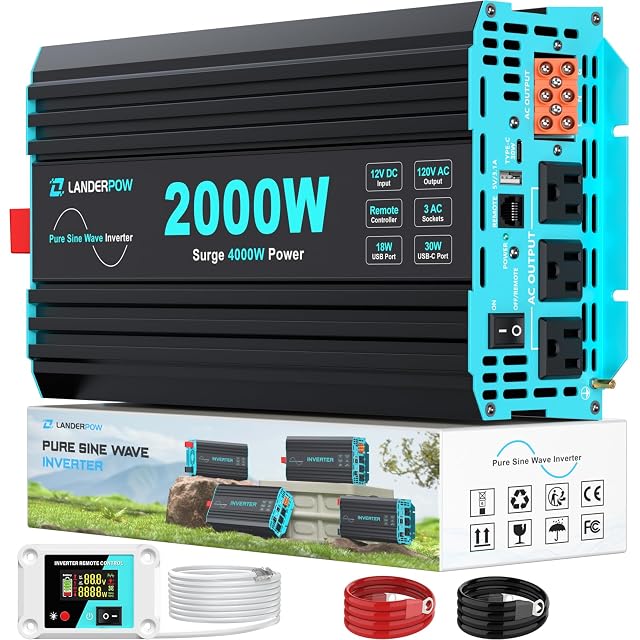
2,000 W 12 V to 120 V pure sine wave inverter, 4,000 W surge, over 91% efficiency, three AC outlets and a hardwire terminal, 5 V/3.1 A USB and 30 W PD, two 2 ft 2 AWG cables, 15 ft LED remote, full metal shell, 3-year coverage
A 2,000 W pure sine wave inverter with 2 AWG cables, a hardwire terminal, 30 W USB-C and a 15 ft remote with a screen, and three years of cover.
Best for: RVs and work trucks with a large 12 V bank that must run a microwave or tools
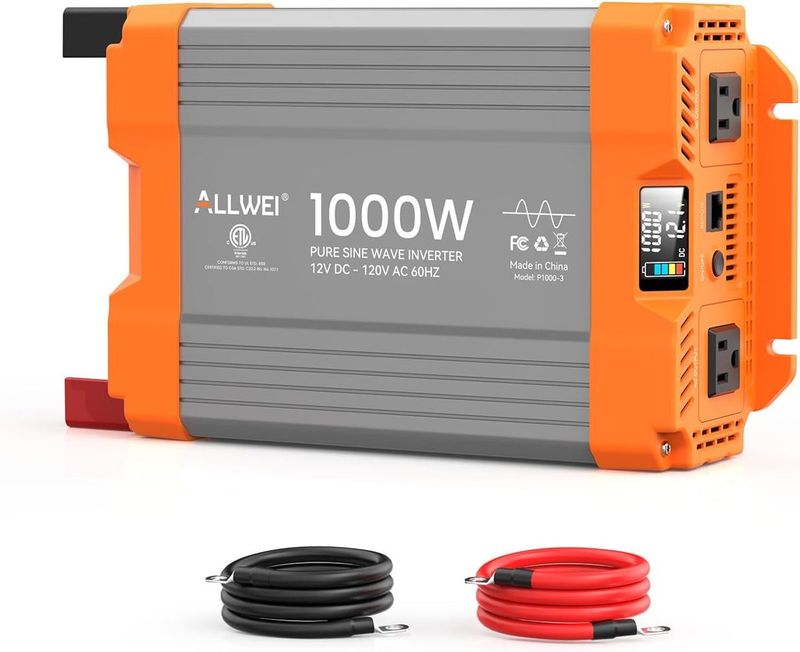
1,000 W 12 V to 120 V pure sine wave inverter, 2,000 W peak, ETL listed to UL 458, 8 protections including under-temperature, load- and temperature-controlled fans, 14–104 °F operation, two 2 ft 6 AWG cables, 3.5 lb, 18-month warranty
A 1,000 W pure sine wave inverter ETL-listed to UL 458, with an under-temperature cut-off and a 14–104 °F rating, the lightest here at 3.5 lb.
Best for: Vehicle and RV installs that need a UL 458 listing on a budget
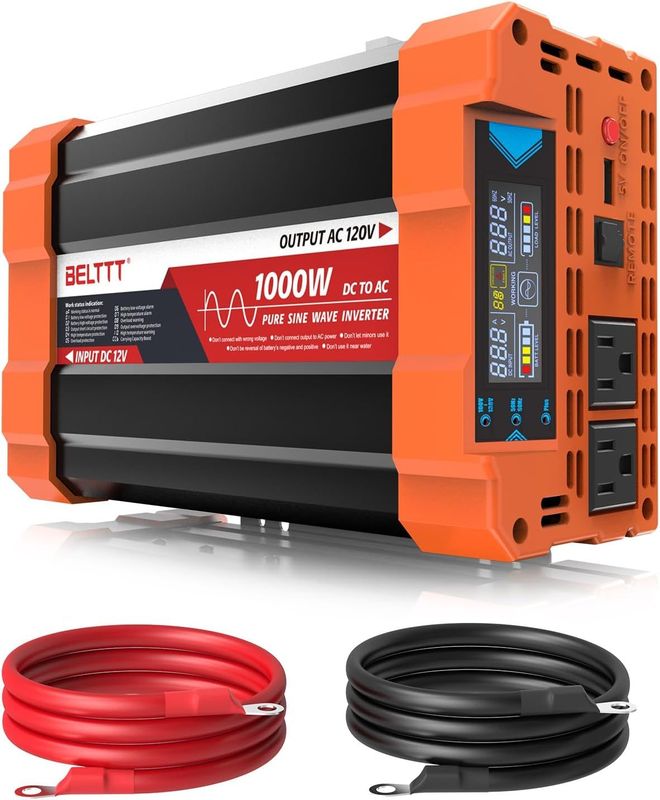
1,000 W 12 V to 120 V pure sine wave inverter, 2,000 W peak, over 90% efficiency, LCD showing input/output voltage and load, two AC outlets, 5 V/2.1 A USB, two 3 ft 5 AWG cables and three 40 A fuses, 4.4 lb
A 1,000 W pure sine wave inverter with a live LCD of voltages and load, 5 AWG cables and spare 40 A fuses in the box, at 4.4 lb and $119.99.
Best for: Portable 12 V setups where seeing the battery voltage matters