The Solar Generator 1000 v2 bundles Jackery’s Explorer 1000 v2 with a 200 W panel. The station holds 1,070 Wh of LFP cells, rated to keep over 70% of capacity after 4,000 cycles, and delivers 1,500 W with a 3,000 W surge through three pure sine wave outlets. It weighs 23.8 lb.
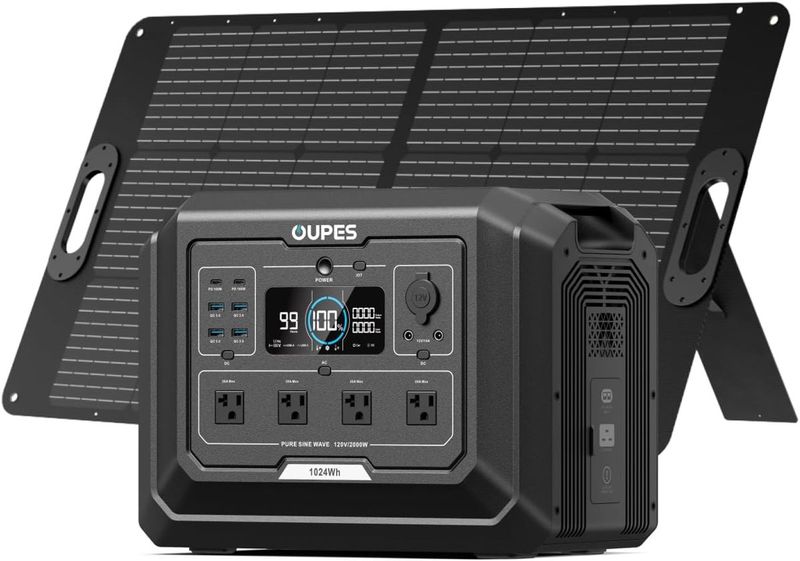
A 200 W panel for 1,070 Wh is a sensible ratio. The OUPES Mega 1 kit pairs 100 W with 1,024 Wh, which is a token panel by comparison.
Charging on your terms
By default the station charges from the wall in 1.7 hours, which Jackery says is gentler on the battery. The one-hour emergency charge is available, but it has to be enabled in the app before each charge. A third mode charges at 30 dB overnight. That arrangement is unusual: most fast-charging stations default to their fastest rate.
Outputs
Beside the three AC outlets come two USB-C ports with 100 W PD, a USB-A port, a car port and LED lights. The listing names AC units, fridges and electric pots among the loads; at 1,500 W continuous, a small window air conditioner is plausible, a large one is not.
Where the listing disagrees with itself
The bullets promise five years of coverage; the spec table says a two-year manufacturer warranty. Jackery also notes that orders cannot ship to a PO Box and that station and panel ship separately.
Price on Amazon.com
Jackery Inc. listed the kit at $879.00 on November 2, 2026. The Explorer 1000 v2 alone was $559.00 the same day, so the 200 W panel accounts for $320 of the bundle. One line in the station’s own listing matters for anyone planning to add panels: the Explorer 1000 v2 is compatible only with Jackery solar panels for solar charging.
Prices quoted in this text were read on November 2, 2026. The live price is at the top of the page.
What it gets right, and what it leaves out
Strengths
A 200 W panel for a 1,070 Wh station, the strongest panel-to-battery ratio among the 1 kWh kits here
A default charging rate chosen for battery health, with the one-hour charge kept as an option
A 30 dB overnight charging mode
Compromises
Jackery says the station charges from Jackery solar panels only, so a second panel must be a Jackery too
One-hour charging must be enabled in the app before each charge
The bullets promise five years of coverage while the spec table says two
No delivery to a PO Box, and the station and panel ship separately
Specifications
Station
Explorer 1000 v2 (JE-1000D), 1,070 Wh, LFP
AC output
1,500 W, 3,000 W surge, 3 pure sine wave outlets
Other outputs
2 USB-C (100 W PD), 1 USB-A, 1 car port, LED light
Panel in the box
200 W solar panel
AC recharge
1 hour with emergency charging enabled in the app; 1.7 hours by default
Charging modes
Emergency, 30 dB quiet overnight, energy efficiency
Cycle rating
4,000 cycles to over 70% capacity
Station weight
23.8 lb
Coverage
5 years per the bullets
Amazon reference
B0D2L1G66J
EAN
0810105523041
Questions owners ask about this one
Why does it default to 1.7 hours?
Jackery says the Explorer 1000 v2 charges in 1.7 hours by default to optimize battery health. The one-hour emergency charge has to be enabled in the Jackery app before each charge.
How much does the 200 W panel add per day?
Under good sun, a 200 W panel delivers several hundred watt-hours a day, which is a meaningful share of 1,070 Wh. Clouds, angle and season reduce it.
What does the warranty cover?
The bullets list five years of coverage; the spec table says two years. Ask Jackery which applies before relying on the longer term.
Our score
8.1/ 10
A 1,070 Wh, 1,500 W station with a 200 W panel, and a charging scheme that favors the battery by default. The panel is the right size for the station.
Set beside the neighboring portable power units
Same category, nearby prices, between portable power units. What remains is the specifications every one publishes — half empty, a column is no use.
300 W rated, 375 W peak, pure sine wave; 2 outlets (two-prong and three-prong)
60 W foldable, 21.5–23.5% cell efficiency
Where the models are not equal, in portable power units
If price decides: MARBERO M823 237 Wh with 60 W panel, at $230.
Highest AC output in the table: OUPES Mega 1 with 100 W panel (2,000 W pure sine wave, 4,500 W surge, four 120 V outlets).
Highest Panel in the box in the table: this model (200 W solar panel).
This model holds the table’s highest figure for Panel in the box.
Who this one is for, among portable power units
A home outage kit that can also go camping, with a panel big enough to matter
Sources
Specifications: the manufacturer sheet for portable power gear and the matching Amazon product page. Prices and availability: Keepa. Every figure on this page names its source.
Solar generator kit: Mega 1 LiFePO4 station (1,024 Wh, expandable to 5,120 Wh; 2,000 W, 4,500 W surge; 0–80% in 36 minutes on AC; 800 W solar input; 13 ports) with a 100 W panel
A 1,024 Wh, 2,000 W LiFePO4 station that reaches 80% in 36 minutes on AC and expands to 5,120 Wh, sold with a 100 W panel for $649.
Best for: A home backup station that may need more capacity later, bought with a starter panel
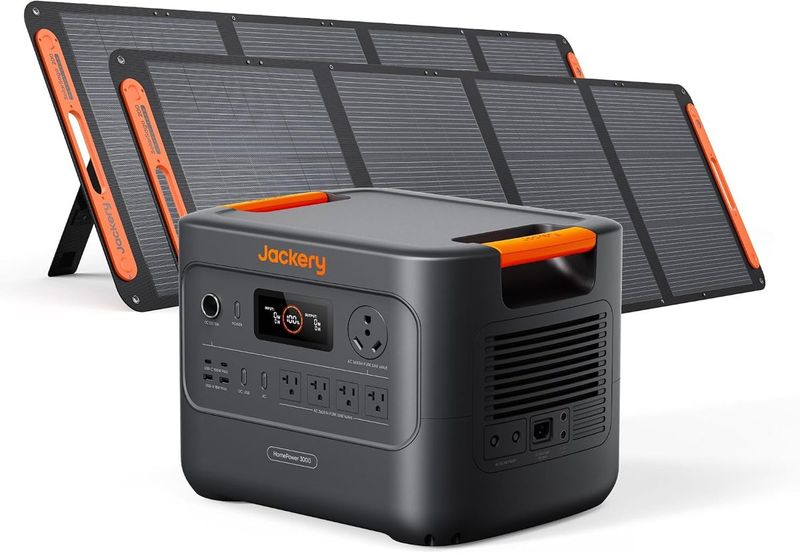
Solar generator kit: HomePower 3000 LiFePO4 station (3,072 Wh, 3,600 W, 7,200 W surge, UL-certified UPS ≤20 ms, TT-30 RV port, 59.5 lb) with two SolarSaga 200 W panels
A 3,072 Wh, 3,600 W home station with a UL-certified 20 ms UPS and a TT-30 RV port, sold with two 200 W panels; 80% from solar takes about 9 hours.
Best for: A household backup for a fridge, lights and Wi-Fi, or an RV hookup without a generator
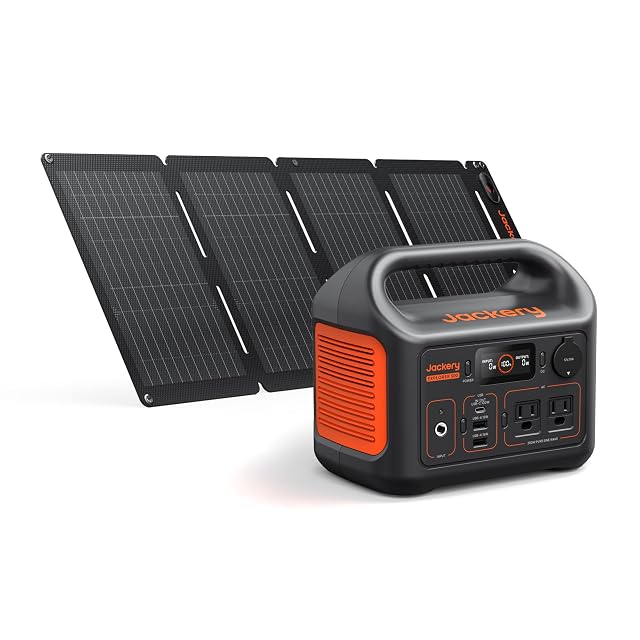
Solar generator kit: Explorer 300 LiFePO4 power station (292 Wh, 300 W, 600 W peak, 7.5 lb) with a 40 W Air solar panel; 80% from the panel in about 7.5 hours
The Explorer 300 (292 Wh, 300 W, 7.5 lb) with a 40 W Air panel that refills 80% in about 7.5 hours: a light kit sized for phones, cameras and drones.
Best for: Hiking, hunting and day trips where the station charges cameras and phones, not appliances