Skip to content

What to measure before you buy anything

Most power purchases are made on an estimate that turns out to be wrong by a factor of two. These five instruments replace the estimate with a reading, and between them they cost less than the mistake.

The estimate that is always wrong

How much does the fridge use. How much is the van drawing when everything is off. How much did the solar actually make today.

Every one of those gets answered with a guess, and the guess sizes a battery, a panel or an inverter. A reading costs less than the second purchase.

1. The plug-in meter

Start here. No installation, no risk, and it answers the appliance question directly.

The figure that separates a useful one from a useless one is the lower end of its range. Standby draw sits between a third of a watt and a couple of watts, and a meter with a one-watt floor reports most of it as zero.

Resolution and accuracy are different things, and a good listing publishes both.

2. The DC clamp meter

For everything the plug meter cannot reach: a battery feed, a solar string, a parasitic drain.

Around a conductor rather than in series, so nothing gets disconnected. The three figures that matter are the DC range, the jaw opening — a battery cable with a lug is thicker than it looks — and whether there is a zero function.

Not one clamp meter in this catalogue publishes a safety category, which is the rating that says which circuits an instrument may go on.

3. The DIN rail meter

For a circuit rather than an appliance. A heat pump, a workshop, a charger, a solar feed.

If the reading has to divide a bill, MID certification is what gives it standing. If it only has to inform you, it does not matter at all, and the cheaper meter measures just as well.

A pulse output with a published rate is what gets the reading into software.

4. The USB power meter

Small, cheap, and it settles arguments about chargers, cables and power banks.

Four values at once — volts, amps, elapsed time, accumulated capacity — is what makes a charge legible while it happens. Running a power bank flat through one gives a real figure to set against the number printed on the case.

5. The battery monitor

A shunt in the negative lead, counting amp-hours in and out.

That is the only honest state-of-charge measurement. On lithium in particular, voltage is nearly flat from 20 % to 90 % and a voltmeter tells you almost nothing.

Install it once, and every other number in the system becomes checkable.

The order these get bought in

One and four on a whim. Two when something is wrong. Three and five when the system is big enough to have questions that last longer than an afternoon.
The picks, and why each one is here

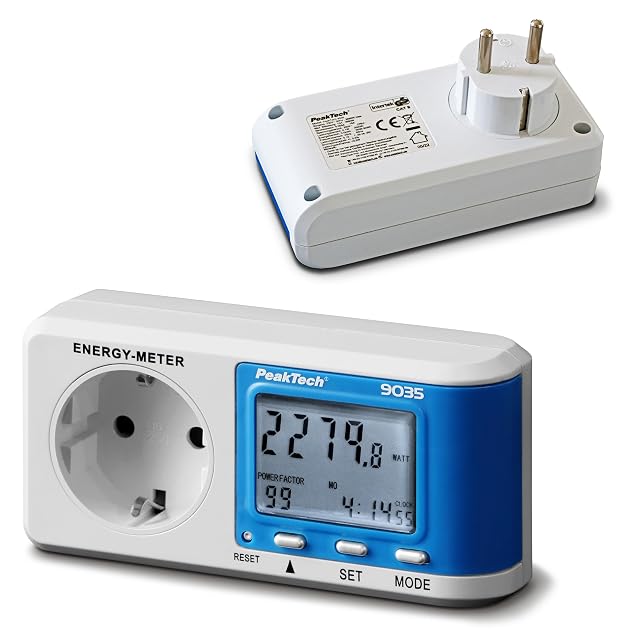
  1. PeakTech 0.1 W resolution, 0.005 A resolution, ±0.5 % base accuracy

    power factor displayed from about 1 W · 0.1 W RESOLUTION, 0.005 A current resolution, BASE ACCURACY ±0.5 % · maximum current not published · cost in euros, energy in kWh, mains voltage, mains frequency, load current and power factor · memory retention not published · a cost readout in euros · socket type not published

    A plug-in energy cost meter with 0.1 W resolution, 0.005 A current resolution and ±0.5 % base accuracy, showing cost, energy, voltage, frequency and power factor.

    Best for: Measuring small loads where the difference between one watt and two matters.

    ≈ €11

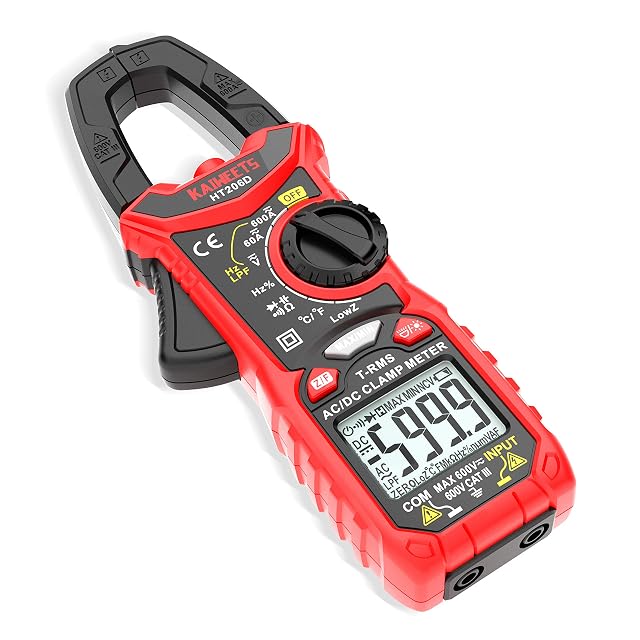
  2. KAIWEETS 600 A AC/DC, 31 mm jaw, ZERO function, LoZ and LPF, double insulated

    0–600 A DC · 6000 counts, auto-ranging, TRMS · a ZERO FUNCTION FOR DC — the only one in this family · 31 mm jaw opening · safety category not published; double insulation is stated · TRUE RMS · voltage to 600 V, frequency, capacitance, continuity, resistance, temperature, and non-contact voltage detection

    A true RMS auto-ranging clamp meter measuring 0 to 600 A AC and DC through a 31 mm jaw, with a DC zero function, low impedance mode and a low-pass filter.

    Best for: Fault-finding on a DC installation where the small readings have to be right.

    ≈ $48 / £42 / €50

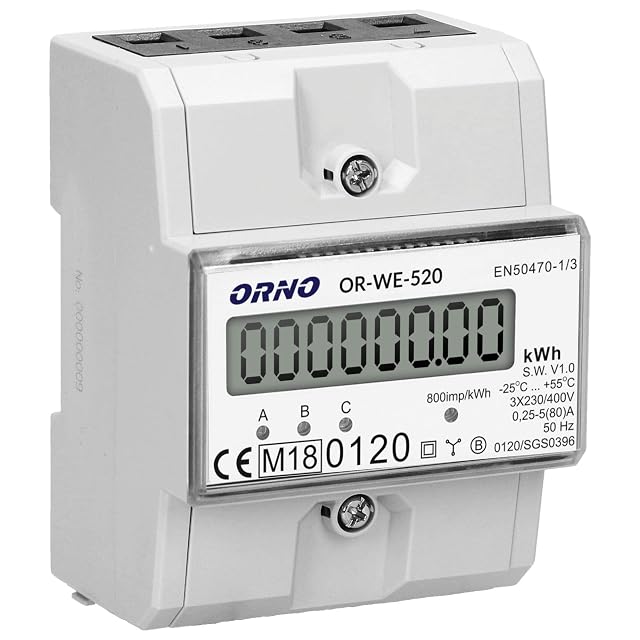
  3. Orno OR-WE-520 three-phase, 0.25–80 A, MID certified, 800 imp/kWh

    0.25–80 A · direct measurement · three phase, 3 × 230/400 V · MID 2014/32/EU, to EN 50470-1:2006 and EN 50470-3:2006 · 800 pulses/kWh with an LED indicator · M119 · reset behaviour not published · active and reactive energy, positive and negative, three measuring modes

    A three-phase DIN rail energy meter from 0.25 to 80 A, MID certified to EN 50470-1 and EN 50470-3, measuring active and reactive energy in both directions.

    Best for: Sub-metering a tenancy or a shared supply where the reading has to be defensible.

    ≈ €48

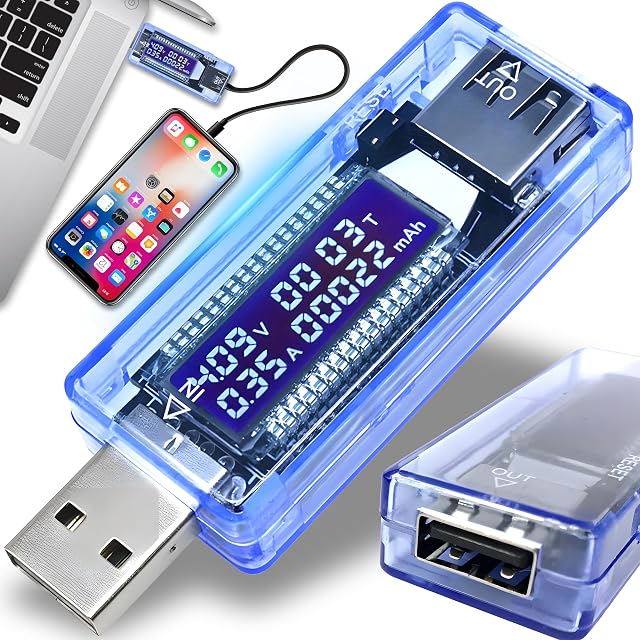
  4. Retoo USB tester, 4–20 V, 0–3 A, capacity to 99999 mAh

    4–20 V DC, 0–3 A · resolution not published · no protocol identification · no trigger function · USB 2.0 pass-through, plug and play with no driver · LCD showing voltage, current, elapsed time and capacity · a memory for running or completed measurements, with reset

    A USB 2.0 power meter measuring 4 to 20 V and 0 to 3 A with a capacity counter to 99999 mAh, showing voltage, current, time and capacity on an LCD.

    Best for: Checking what a power bank actually holds and what a charger actually delivers.

    ≈ €5

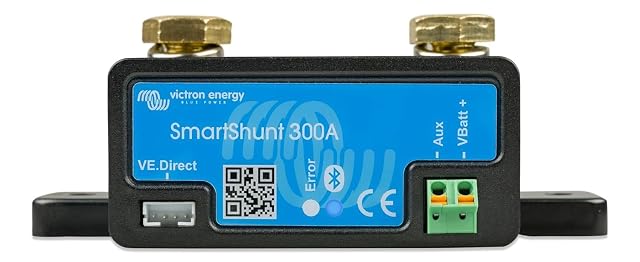
  5. Victron Energy SmartShunt 300 A 50 mV, Bluetooth, no display

    shunt-based counting · 300 A, 50 mV shunt · accuracy not published · chemistries not named · NO display — the phone is the display · VictronConnect over Bluetooth · alarms not described · self-consumption not published · VE.Direct plus a second connection for a second battery, midpoint or temperature sensor

    A 300 A shunt monitor with no display of its own, reading out over Bluetooth to VictronConnect, with a VE.Direct port and an input for a second battery or a temperature sensor.

    Best for: An installation already using Victron equipment, where one application covers everything.

    ≈ $70 / £60 / €67

Questions this guide gets asked

Which one should I buy first?

The plug-in meter, almost always. It is the cheapest, it needs no installation, and it answers the question most people actually have: what is this appliance costing me. Everything else on this list answers a question you only get to once the first one is settled.

Why does a DC clamp need a zero function?

Because a Hall-effect sensor reads a small offset with no current flowing, and that offset drifts with temperature. On a battery feed carrying 200 A it is noise; on a parasitic drain of half an amp it is the entire reading. One clamp meter in this catalogue names a zero function.

Is a battery monitor a measurement instrument?

More than a voltmeter is. A shunt counts what actually went in and out over time, which is what tells you state of charge. Battery voltage is a poor proxy for that on lead-acid and close to useless on lithium, where it stays almost flat across most of the discharge.

A price quoted in the text of a PowerVerdict page dates from the day that page was written; the live figure beside each product is fetched while you read and replaces it.

The tool we use ourselves

Decided which one? Then do not overpay for it.

Power stations and solar kits are discounted over and over through the year, and a struck-through figure on its own says nothing whatever about what the same model was charged at four weeks ago. UniverTrack holds a week-by-week record for every retailer, so a reduction is measured against a price somebody actually paid rather than one written for the sale — and it says when the moment to buy has genuinely arrived.

Real price historyBuy-now alertsAI buying assistant
Try free for 14 days →
No commitment · Cancel in one click · 5 languages