Most 300 W stations are sold on their AC outlets. The SOLIX C300 is better read the other way round. Its two USB-C ports deliver 140 W each, which is enough for a large laptop, and they are two-way: the same port can recharge the station from a USB-C power supply. A third USB-C port gives 15 W and a USB-A port 12 W.
The AC side is modest and the listing is clear about it: three outlets sharing 300 W, with a 600 W surge, and a 120 W car socket.
Recharge and solar
The wall charger takes it to 80% in 50 minutes. For solar, Anker recommends its own 100 W or 60 W panel and names three panels that will not work: the PS30 and other 5 V, 3 A USB-C panels, plus the PS200 and PS400. That kind of exclusion is rare in a listing and worth respecting before buying a panel second-hand.
Quiet, compact, five years of cover
Anker publishes 25 dB at 3.3 ft. Only the EcoFlow RIVER 3 publishes a noise figure here, under 30 dB at 1.5 ft. At 9.1 lb and 6.46 × 6.34 × 9.45 in, the C300 is a little heavier than the RIVER 3 (7.8 lb) and the DARAN 288 Wh (8.2 lb).
The warranty is five years, and the cells are LiFePO4 rated for 3,000 cycles, though the listing does not say to what remaining capacity.
What the price buys
At $429.99 it is the costliest station per watt-hour here, about 0.67 Wh per dollar. The BLUETTI Elite 30 V2 has the same 288 Wh, twice the AC output (600 W) and costs $289.99; the DARAN offers 288 Wh and 350 W for $139.99. The Anker’s case rests on the 140 W two-way USB-C pair, the warranty and the noise figure.
Price on Amazon.com
AnkerDirect listed it at $429.99 on November 2, 2026. The shoulder strap in the photos is not in the box.
Prices quoted in this text were read on November 2, 2026. The live price is at the top of the page.
What it gets right, and what it leaves out
Strengths
Two 140 W USB-C ports that work in both directions: a laptop charges from it, and a USB-C charger can refill it
A five-year warranty on a 288 Wh unit, the same term Anker gives its 1 kWh station
A published noise figure, 25 dB at 3.3 ft, useful in a tent or a bedroom
Compromises
At $429.99 it is the most expensive per watt-hour on this shelf, about 0.67 Wh per dollar
The shoulder strap shown in the listing is sold separately
Three Anker panels are explicitly not compatible: PS30, PS200 and PS400
Specifications
Capacity
288 Wh, LiFePO4 cells
Continuous AC output
300 W total across three AC outlets, 600 W surge
USB-C
Two ports at 140 W each, two-way (they charge the station too), plus one 15 W port
Other outputs
One car socket (120 W), one USB-A (12 W)
AC recharge
80% in 50 minutes
Solar input
100 W or 60 W Anker panel recommended; not compatible with PS30, PS200 or PS400 panels
Cycle rating
3,000 cycles (end capacity not stated)
Noise
25 dB at 3.3 ft
Weight
4.13 kg (9.1 lb)
Dimensions
6.46 × 6.34 × 9.45 in
Warranty
5 years
Amazon reference
B0D62GMQ3F
Questions owners ask about this one
Can it be charged from a USB-C laptop charger?
Yes. The two 140 W USB-C ports are listed as two-way, and the listing names the PD 3.1 USB-C port among its recharge options alongside the wall, the car and solar.
Why is it not compatible with some Anker panels?
The listing excludes the PS30 and other 5 V, 3 A USB-C panels, plus the PS200 and PS400. Anker recommends its 100 W or 60 W panel instead. It does not explain the reason; the safe reading is to stay with the two recommended panels.
Will 300 W run a small appliance?
Up to 300 W in total across the three AC outlets, with a 600 W surge. That covers a small TV, a fan or a CPAP. A kettle, a hair dryer or a microwave is beyond it.
Our score
8.3/ 10
A compact 288 Wh station whose real strength is two 140 W two-way USB-C ports and a quiet 25 dB. Expensive per watt-hour, and honest about which panels it refuses.
Set beside the neighboring portable power units
Same category, nearby prices, between portable power units. What remains is the specifications every one publishes — half empty, a column is no use.
Model
Price
Capacity
AC recharge
Solar input
Anker SOLIX C300
$430
288 Wh, LiFePO4 cells
80% in 50 minutes
100 W or 60 W Anker panel recommended; not compatible with PS30, PS200 or PS400 panels
1,600 W, full in 49 minutes once HyperFlash is enabled in the Anker app
600 W, 60 V maximum; full in 1.8 hours
Where the models are not equal, in portable power units
If price decides: this model, at $430.
Highest Capacity in the table: BLUETTI AC180 (1,152 Wh, LiFePO4).
Who this one is for, among portable power units
Laptop-heavy camping and travel, where USB-C matters more than the AC outlets
Sources
Specifications: the manufacturer sheet for portable power gear and the matching Amazon product page. Prices and availability: Keepa. Every figure on this page names its source.
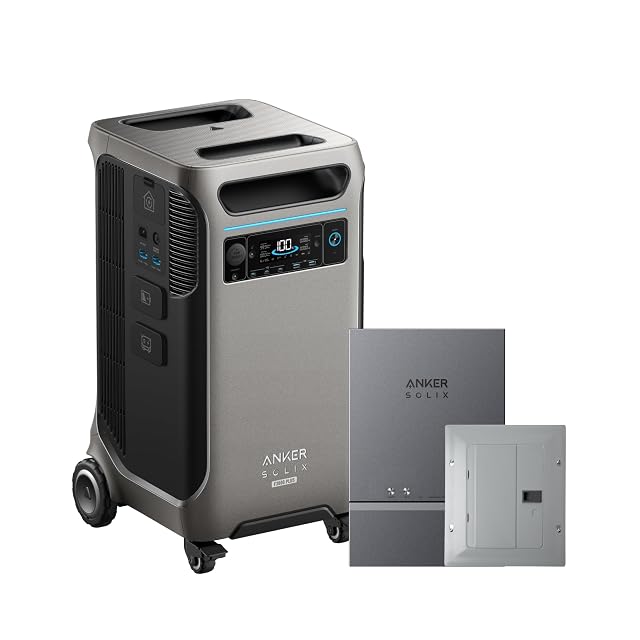
Anker SOLIX F3800 Plus: 3,840 Wh LFP power station with Home Power Panel, 6,000 W output, 120/240 V dual voltage, 3,200 W solar input, expandable to 26.9 kWh with six batteries, 5-year warranty
A 3,840 Wh LFP station with 6,000 W and 120/240 V output, sold with a Home Power Panel and expandable to 26.9 kWh with six add-on batteries.
Best for: A house that wants 240 V circuits on battery during an outage, with room to grow
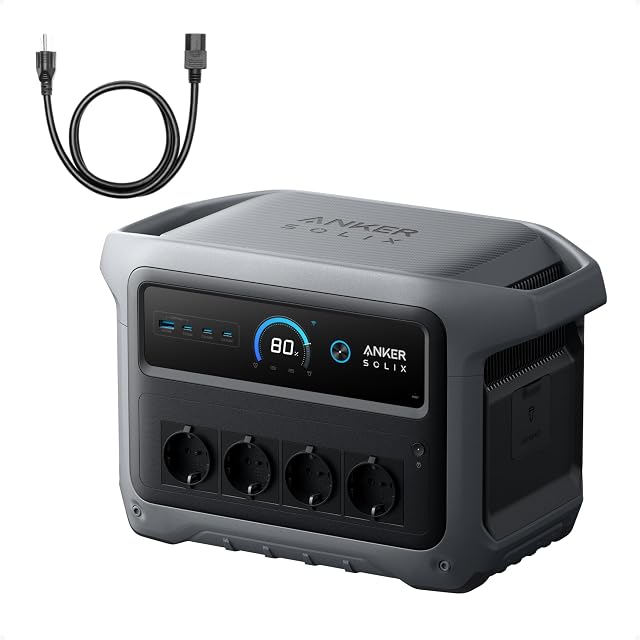
1,024 Wh LiFePO4 power station, 2,000 W continuous (3,000 W peak), 1,600 W wall recharge in 49 minutes, 600 W solar input, under 10 ms UPS switchover, 5-year warranty
A 1,024 Wh LiFePO4 station with a 2,000 W inverter, a 49-minute wall recharge at 1,600 W and a sub-10 ms UPS switch, at 24.9 lb.
Best for: Home outage backup and RV weekends where the station must refill fast between uses
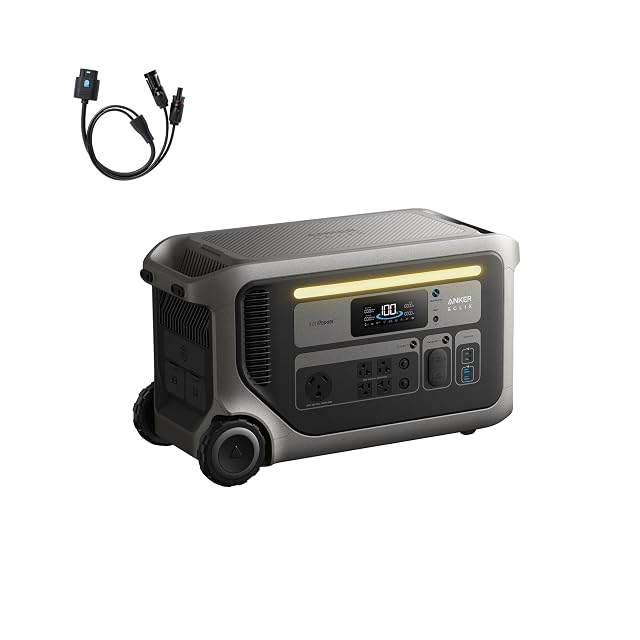
Anker SOLIX F3000: 3,072 Wh power station, 6,000 W in the title, 3,600 W pass-through from a 120 V generator, 2,400 W solar on 165 V or 60 V ports, 240 V with two units, expandable to 24 kWh
A 3,072 Wh station with 3,600 W pass-through from a generator, 2,400 W of solar input and 240 V when paired, expandable to 24 kWh.
Best for: A 120 V home backup that will be recharged from a generator during long outages