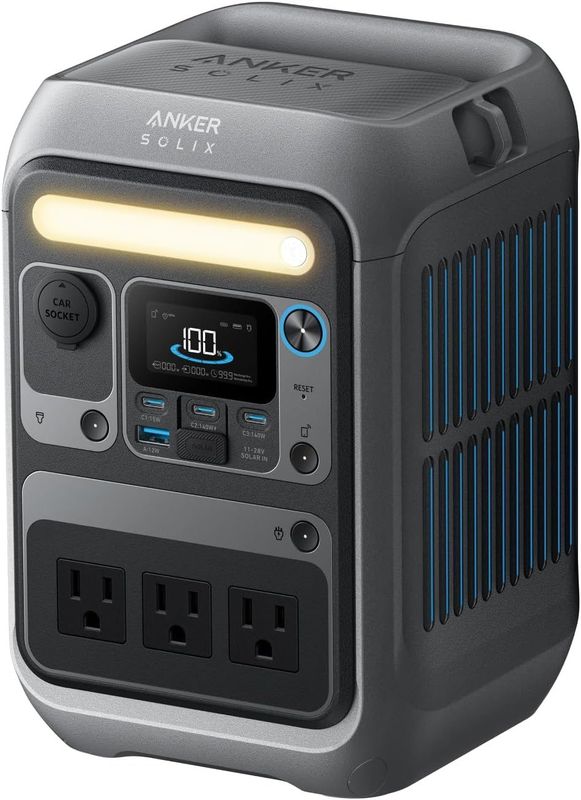
A 1 kWh station that refills in under an hour
Anker’s listing for the SOLIX C1000 Gen 2 leads with recharge speed rather than capacity, and that is the right order for a home backup unit. A 1,024 Wh battery behind a 1,600 W charger goes from empty to full in 49 minutes, so a station drained overnight can be ready again before lunch. The figure comes with a condition the listing states plainly: HyperFlash has to be enabled in the Anker app.
The rest of the electrical package is in proportion. The inverter is rated 2,000 W continuous and 3,000 W peak at 120 V, and the cells are LiFePO4, rated for 4,000 cycles with at least 80% of capacity left at the end. That end point matters: a cycle count without one is not comparable, and this listing gives it.
UPS switchover and time-of-use mode
The C1000 Gen 2 switches to battery in under 10 ms when the grid drops, which Anker positions for CPAP machines and laptops. Only the EcoFlow DELTA 3 Classic and the BLUETTI Elite 30 V2 publish a comparable 10 ms figure on this shelf; the EBL Acc2400 states 0.1 second, ten times slower.
The listing also describes a TOU mode in the app, meant to run the house from the battery during peak-rate hours and recharge off-peak. Whether that saves money depends on the utility’s rate plan, which no listing can tell you.
Solar: 600 W, but watch the 60 V ceiling
Up to 600 W of panels can recharge it in 1.8 hours. The ceiling to respect is the voltage: 60 V maximum. Two typical 100 W, 12 V-class panels in series sit well under it; four in series do not. The listing does not say whether parallel strings are supported, so read the manual before wiring more than two panels.
Where it sits among the stations here
At 1,024 Wh it shares its capacity with the DELTA 3 Classic. The Anker costs more ($529.99 against $462.00 at the time of reading) and buys a higher inverter rating (2,000 W against 1,800 W), the faster published recharge and a stated cycle end point. The Dabbsson 2000L holds twice the energy for $649.00, at 41 lb instead of 24.9 lb.
One inconsistency to note: the bullets promise 10 ports and the spec table counts 9 outlets. The difference probably lies in how a car socket or a USB port is counted, but the listing does not settle it.
Price on Amazon.com
AnkerDirect was asking $529.99 when this page was written on November 2, 2026, with a five-year warranty listed. Prices on this category move with sales events, so the live price shown on this page is the one to trust.
Prices quoted in this text were read on November 2, 2026. The live price is at the top of the page.