Skip to content

Charging an electric car at home

There are three ways to charge a car at home and they differ by a factor of six in speed. The right one depends less on the car than on the wiring already in the wall.

Three routes, one bottleneck

The car has an onboard charger with a ceiling. The wall has a circuit with a ceiling. Whichever is lower is what you get, and for almost every home the wall is lower.

1. A fixed wallbox

Eleven kilowatts on three phases, typically. That needs a dedicated circuit, usually an electrician, and often a notification to the network operator.

What it buys is time: a full charge overnight without thinking about it, on a cable that lives on the wall rather than in the boot.

What to check: whether it needs a separate residual current device or carries its own, and whether access control matters — RFID, if more than one person charges there.

2. A portable charger with a household plug

Three point seven kilowatts, single phase, no installation at all.

The safety questions are sharper here, because the socket was never designed for eight hours at its rating. Two things are worth insisting on: adjustable current, so the draw can be turned down on old wiring, and a temperature sensor in the plug.

Charging from a household socket for a whole night is the commonest way a home setup fails — old wiring, a worn contact, nobody watching.

3. A Type 2 cable for public posts

The one most people need first, and the one most people buy last.

Length is the decision: five metres covers a drive, ten covers most public bays, fifteen covers the ones laid out badly. Amperage decides the ceiling — 16 A is 11 kW three-phase, 32 A is 22 kW, and both are useless if the post or the car is lower.

Every Type 2 cable in this catalogue cites IEC 62196-2, which is the connector standard. Not one publishes a conductor cross-section or a weight, and a ten-metre 32 A cable is a heavy object carried daily.

4. The meter, if someone else pays

MID certification is the whole question. It is what allows the reading to support a bill rather than merely being accurate.

What none of these pages will tell you

What your wiring can take. That comes from an electrician looking at the consumer unit, and it is the figure everything above is sized against.
The picks, and why each one is here

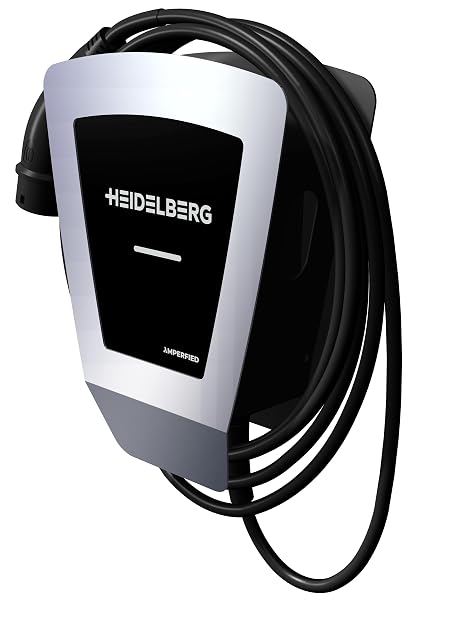
  1. HEIDELBERG Energy Control Plus, 11 kW, § 14a compliant, 7.5 m, no app

    11 kW · phases not stated · 7.5 m cable · load management across up to 16 networked units, § 14a EnWG compliant with two control options · no solar surplus charging · metering not described · stainless steel front, indoor and outdoor · 5-year warranty

    An 11 kW charger with a stainless steel front and no application, compliant with the German § 14a EnWG requirement for grid operator power reduction, networkable across sixteen units.

    Best for: A German installation subject to grid operator control, or a building with several charging points.

    ≈ €412

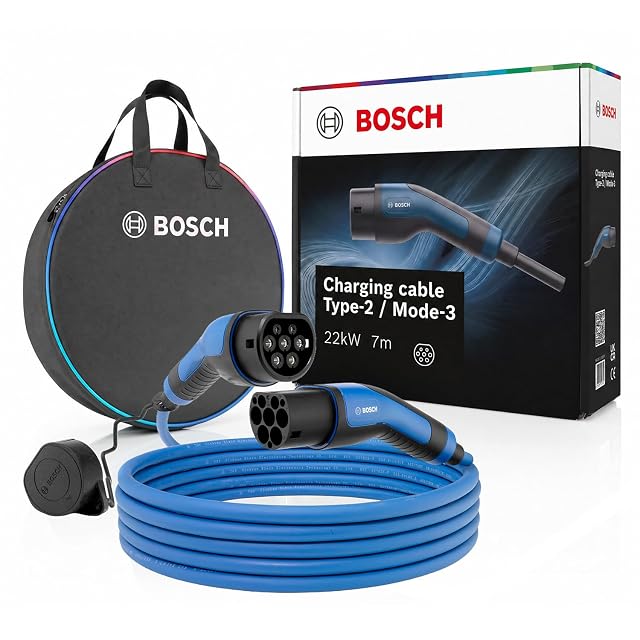
  2. Bosch Mode 3, 11 kW, 20 A, 5 m, IP54, −40 °C to +50 °C, 10 000 cycles

    20 A · Type 2 to Type 2, Mode 3 · three phase, 11 kW · 5 m · cross-section not published · flexibility not published · weight not published · A ROUND CARRYING AND STORAGE BAG is supplied · IP54, −40 °C to +50 °C, OVER 10 000 INSERTION CYCLES, silvered contacts, PFAS-free with no halogen flame retardants

    A Mode 3 Type 2 charging cable rated 11 kW at 20 A, in polycarbonate designed for over 10 000 insertion cycles, IP54 from −40 °C to +50 °C.

    Best for: A cable that will be plugged in and out every day for years.

    ≈ £123 / €95

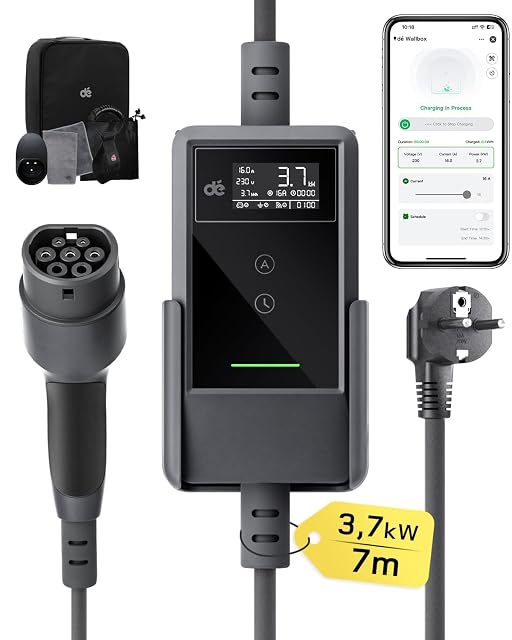
  3. Schuko to Type 2, 3.7 kW, 7 m, 6–16 A, app control, DEKRA certified

    6–16 A adjustable · IEC 62196-2 · single phase, 3.7 kW · 7 m · cross-section not published · flexibility not published · weight not published · no bag mentioned · TYPE A 30 mA AND DC 6 mA residual current protection, dual temperature sensors on plug and control box, IP66 control box, IP55 Type 2 plug, DEKRA certified, sunlight-readable LCD, OTA updates

    A seven-metre Schuko to Type 2 charging cable adjustable from 6 to 16 A, with app scheduling, Type A and DC residual current protection and dual temperature sensors.

    Best for: Charging from a household socket where the wiring is old and the tariff varies.

    ≈ €105

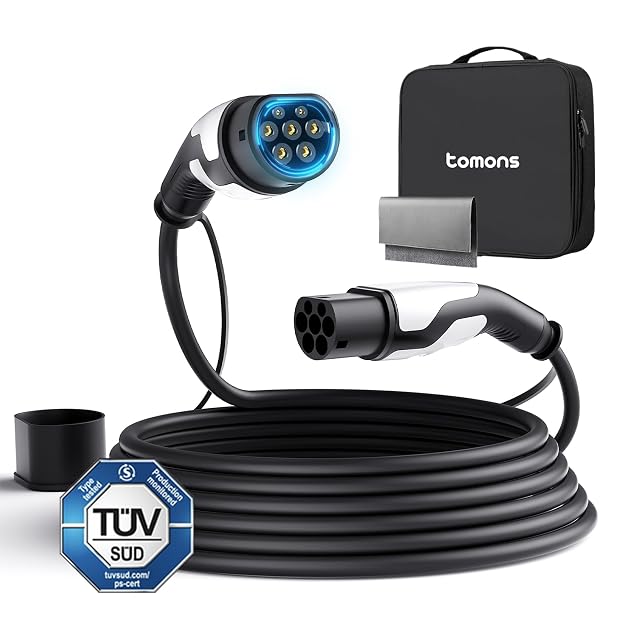
  4. tomons 22 kW, 32 A, three-phase, 5 m, IP55, −30 °C to +50 °C, TÜV mark

    32 A — the highest in this family · IEC 62196-2 · three phase, 22 kW · 5 m · cross-section not published · flexibility not published · weight not published · A STORAGE BAG, a cleaning cloth and a manual are supplied · IP55, −30 °C to +50 °C, TÜV mark, CB, CE, RoHS, UKCA and Reach

    A three-phase Type 2 charging cable rated 22 kW at 32 A to IEC 62196-2, IP55 from −30 °C to +50 °C, supplied with a storage bag and cleaning cloth.

    Best for: A three-phase wallbox or public post that can actually deliver 22 kW.

    ≈ €81

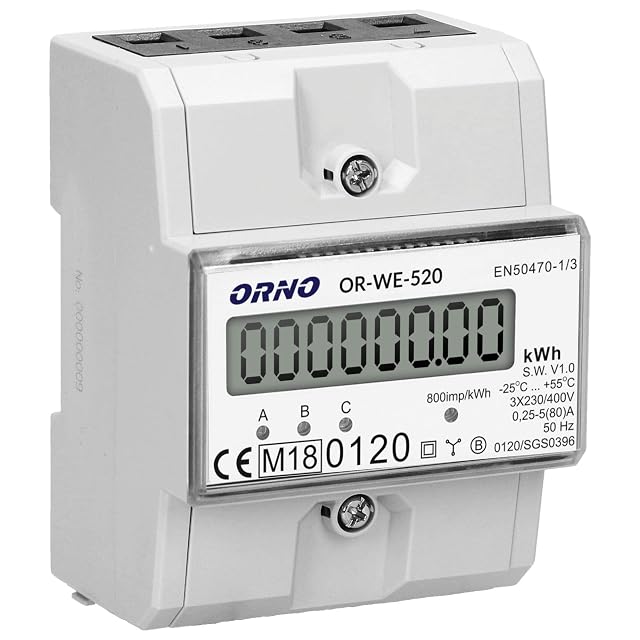
  5. Orno OR-WE-520 three-phase, 0.25–80 A, MID certified, 800 imp/kWh

    0.25–80 A · direct measurement · three phase, 3 × 230/400 V · MID 2014/32/EU, to EN 50470-1:2006 and EN 50470-3:2006 · 800 pulses/kWh with an LED indicator · M119 · reset behaviour not published · active and reactive energy, positive and negative, three measuring modes

    A three-phase DIN rail energy meter from 0.25 to 80 A, MID certified to EN 50470-1 and EN 50470-3, measuring active and reactive energy in both directions.

    Best for: Sub-metering a tenancy or a shared supply where the reading has to be defensible.

    ≈ €48

Questions this guide gets asked

Why is charging from a household socket so slow?

Because a domestic socket circuit is rated 16 A at 230 V, which is 3.7 kW. A three-phase wallbox delivers 11 kW or 22 kW. The car is rarely the limit; the wall is. Six hours against one is the practical difference.

What is DC residual current protection and why does it come up here?

An electric vehicle can leak a small direct current, and a standard Type A residual current device in the consumer unit is blinded by DC — it stops protecting. A portable charger with its own 6 mA DC detection covers what the house cannot. One cable in this catalogue publishes both types.

Do I need a meter?

If someone else is paying — a landlord, an employer, a shared drive — then yes, and it has to be one whose reading is defensible. That means MID certification, which is what allows a figure to be used for billing. An ordinary sub-meter measures just as well and settles no argument.

A price quoted in the text of a PowerVerdict page dates from the day that page was written; the live figure beside each product is fetched while you read and replaces it.

The tool we use ourselves

Decided which one? Then do not overpay for it.

Power stations and solar kits are discounted over and over through the year, and a struck-through figure on its own says nothing whatever about what the same model was charged at four weeks ago. UniverTrack holds a week-by-week record for every retailer, so a reduction is measured against a price somebody actually paid rather than one written for the sale — and it says when the moment to buy has genuinely arrived.

Real price historyBuy-now alertsAI buying assistant
Try free for 14 days →
No commitment · Cancel in one click · 5 languages