iSunergy’s M2420P connects through SAE plugs, the common connector on portable panels and battery leads, and comes with two 170 mm SAE extensions. An LCD and LED indicators show panel and battery status. It weighs 350 g.
The voltage rule
iSunergy puts it in its first bullet: on a 24 V battery, panel open-circuit voltage must not exceed 60 V; on a 12 V battery, 30 V. A typical 12 V-class panel has a Voc around 22 V, so on 12 V this controller takes one panel, or several in parallel, never two in series.
About 600 W
The title says “Max PV 600W”. At 20 A, that is a 24 V figure; on 12 V the controller tops out around 290 W.
Price on Amazon.com
iSunergy listed it at $47.69 on November 2, 2026, with a 24-month warranty.
Prices quoted in this text were read on November 2, 2026. The live price is at the top of the page.
What it gets right, and what it leaves out
Strengths
SAE plug-and-play connectors, handy with portable panels
A clear statement of the open-circuit limits by battery voltage
A 24-month warranty at $47.69
Compromises
On 12 V, panel Voc must stay under 30 V: one 12 V-class panel, no series strings
The “600 W” headline applies to 24 V; on 12 V, 20 A is about 290 W
Only 43 ratings
Specifications
Charge current
20 A
Battery voltage
12 or 24 V
PV input
Up to 600 W; Voc no more than 30 V on 12 V batteries, 60 V on 24 V
Connectors
SAE, plus two 6.7 in (170 mm) SAE extensions
Display
LCD and LED indicators
Charging
3-stage (bulk, float, boost)
Batteries
AGM, gel, LiFePO4
Protection
Overheat, overcharge, reverse polarity
Weight
350 g (12.35 oz)
Warranty
24 months
Amazon reference
B0CP6RMFSP
EAN
0772168462098
Questions owners ask about this one
Can I put two panels in series?
Not on a 12 V battery: iSunergy says the panel open-circuit voltage must not exceed 30 V. On a 24 V battery the limit is 60 V.
Is 600 W real?
Only on 24 V. At 20 A, a 12 V battery takes about 290 W of panels.
What connectors does it use?
SAE, with two 170 mm SAE extension leads in the box.
Our score
7.7/ 10
A handy portable MPPT with SAE plugs. Respect its 30 V limit on 12 V systems, which rules out panels in series.
Set beside the neighboring portable power units
Same category, nearby prices, between portable power units. What remains is the specifications every one publishes — half empty, a column is no use.
Where the models are not equal, in portable power units
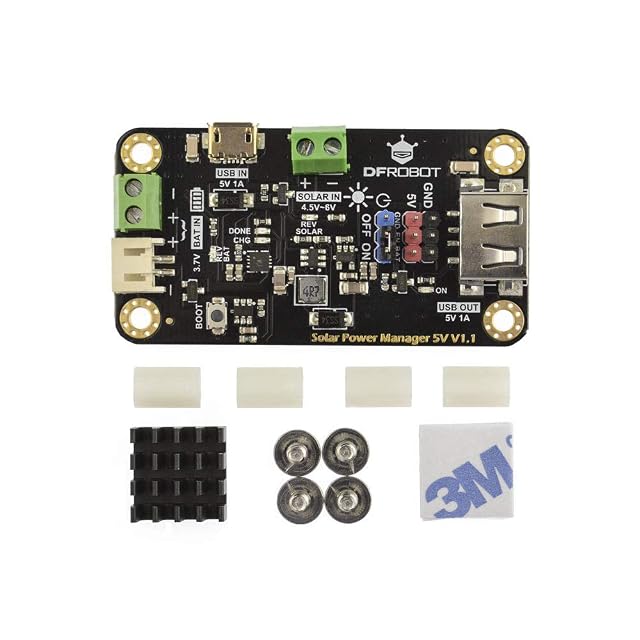
If price decides: DFRobot Solar Power Manager 5 V (DFR0559), at $14.
Who this one is for, among portable power units
Portable panels feeding a 12 or 24 V battery in a camper or a tent
Sources
Specifications: the manufacturer sheet for portable power gear and the matching Amazon product page. Prices and availability: Keepa. Every figure on this page names its source.
DFRobot DFR0559 solar power manager module: CN3165 MPPT for 5 V panels up to 10 W, 900 mA charging for 3.7 V Li-ion/LiPo, regulated 5 V 1 A output with switch, Micro-USB charging, under 1 mA standby, 33 × 63 mm
A 33 × 63 mm MPPT module for 5 V panels up to 10 W that charges a 3.7 V cell at 900 mA and outputs 5 V for Arduino and ESP32 projects, $13.90.
Best for: Solar-powered IoT nodes, weather stations and maker projects
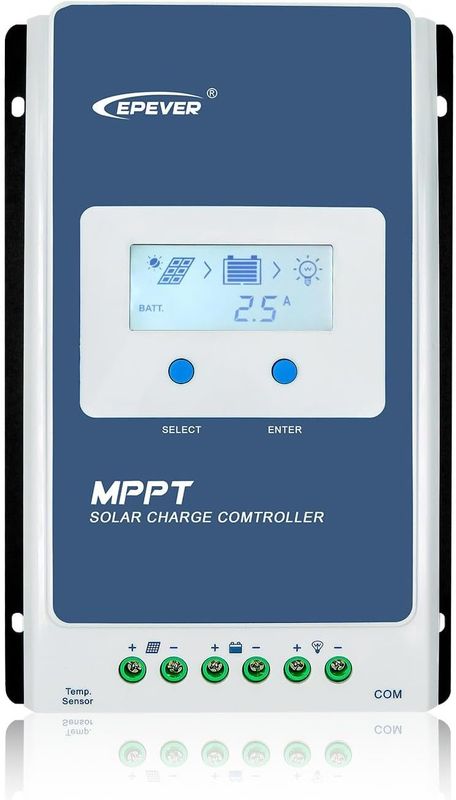
EPEVER Tracer4210AN G3 40 A MPPT controller: 12/24 V auto, 100 V PV, 520 W at 12 V or 1,040 W at 24 V, common negative ground, LiFePO4 and NCM profiles, temperature compensation, RS485 Modbus, over 99.5% tracking
EPEVER’s 40 A Tracer G3 states its panel limits outright, 520 W at 12 V and 1,040 W at 24 V, with common negative ground and RS485, for $118.99.
Best for: Solar builders who want a configurable controller with an open Modbus interface
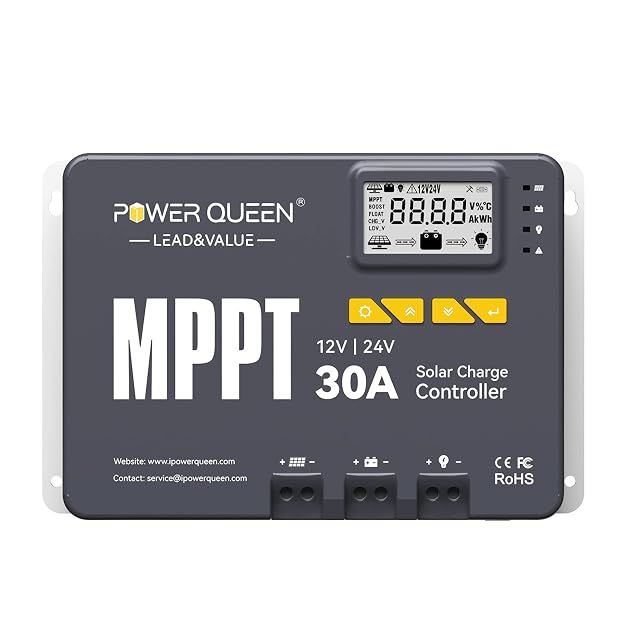
Power Queen 30 A MPPT controller, 12/24 V, built-in Bluetooth, 99% tracking and 98% peak conversion, LCD with four buttons, die-cast aluminum body, default LiFePO4 mode, 2 kg
A 30 A MPPT controller with Bluetooth built in and a die-cast aluminum body, set for LiFePO4 by default, for $122.99. PV voltage not in the bullets.
Best for: LiFePO4 owners who want app monitoring without extra modules