Most controllers state amps and leave you to work out the panels. EPEVER does it: up to 520 W of panels on a 12 V battery and 1,040 W on 24 V, with a 100 V PV ceiling. The Tracer4210AN G3 auto-detects the system voltage.
Built for vehicles
It uses common negative grounding, the arrangement found in RVs and vans where the negative is bonded to the chassis. Battery temperature compensation and real-time energy statistics are standard.
Battery profiles
Gel, AGM, flooded and sealed lead-acid; LiFePO4 at 4s for 12 V and 8s for 24 V; NCM lithium at 3s, 6s or 7s; and a user mode.
An open interface
An RS485 port speaks Modbus. EPEVER offers MT52 and MT55 remote meters, Wi-Fi and BLE adapters, the eLOG01 logger and a USB-RS485 cable.
Price on Amazon.com
Goland Century listed it at $118.99 on November 2, 2026, $50 less than the Renogy Rover 40 A.
Prices quoted in this text were read on November 2, 2026. The live price is at the top of the page.
What it gets right, and what it leaves out
Strengths
Maximum panel power stated per battery voltage, 520 W and 1,040 W
Common negative ground, which suits RV and vehicle wiring
Profiles for NCM as well as LiFePO4, plus temperature compensation
Battery temperature compensation, energy statistics
Tracking
Over 99.5%
Communication
RS485 Modbus; optional MT52/MT55 meters, Wi-Fi and BLE adapters, eLOG01
Weight
1.65 kg
Amazon reference
B07C2XLPZY
Questions owners ask about this one
Why does common negative ground matter?
In vehicles and RVs, the battery negative is bonded to the chassis. A controller with a common negative between panel, battery and load fits that wiring without isolating the negative.
How do I monitor it?
Over RS485 with Modbus, using EPEVER’s optional MT52 or MT55 meters, a Wi-Fi or BLE adapter, the eLOG01 logger or a USB-RS485 cable.
Can it charge an NCM lithium pack?
Yes. EPEVER lists Li(NiCoMn)O2 profiles for 3s on 12 V and 6s or 7s on 24 V, alongside LiFePO4.
Our score
8.0/ 10
The most explicit 40 A controller here on what it can take, with common negative ground and Modbus. Add the adapter you need for monitoring.
Set beside the neighboring portable power units
Same category, nearby prices, between portable power units. What remains is the specifications every one publishes — half empty, a column is no use.
Where the models are not equal, in portable power units
If price decides: iSunergy 20 A portable MPPT controller, at $48.
Highest Charge current in the table: Renogy Rover 40 A (40 A).
Who this one is for, among portable power units
Solar builders who want a configurable controller with an open Modbus interface
Sources
Specifications: the manufacturer sheet for portable power gear and the matching Amazon product page. Prices and availability: Keepa. Every figure on this page names its source.
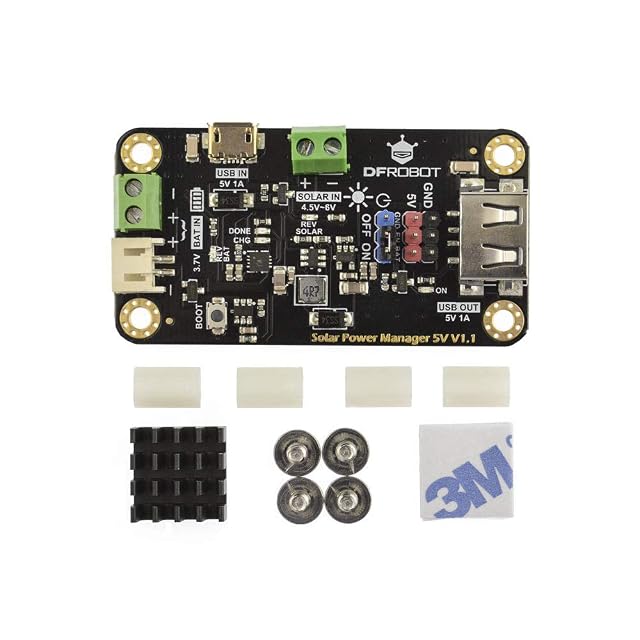
DFRobot DFR0559 solar power manager module: CN3165 MPPT for 5 V panels up to 10 W, 900 mA charging for 3.7 V Li-ion/LiPo, regulated 5 V 1 A output with switch, Micro-USB charging, under 1 mA standby, 33 × 63 mm
A 33 × 63 mm MPPT module for 5 V panels up to 10 W that charges a 3.7 V cell at 900 mA and outputs 5 V for Arduino and ESP32 projects, $13.90.
Best for: Solar-powered IoT nodes, weather stations and maker projects
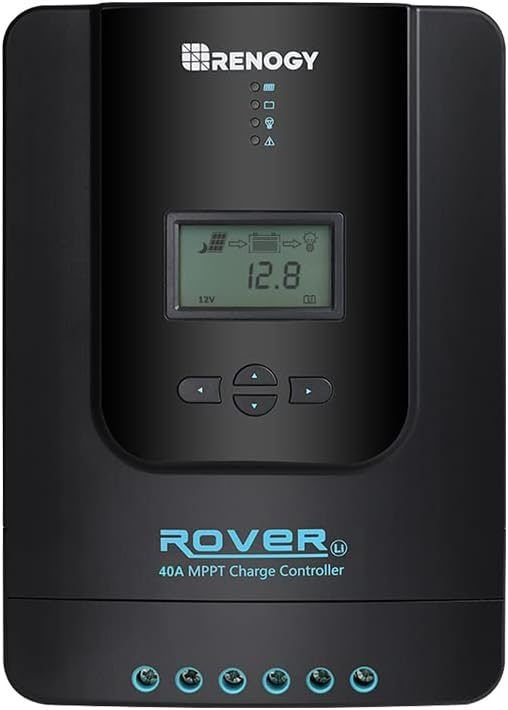
Renogy Rover 40 A MPPT controller, 12/24 V auto, 100 V PV, 98% conversion and 99% tracking efficiency, -40 to 149 °F with low-temperature protection, 4-stage lead-acid and 2-stage lithium charging, RS485, 3-year warranty
Renogy’s Rover 40 A MPPT for 12 and 24 V banks, rated from -40 to 149 °F with low-temperature charge protection, sold by Amazon at $168.99.
Best for: RV and cabin systems in cold climates, on 12 or 24 V lithium banks
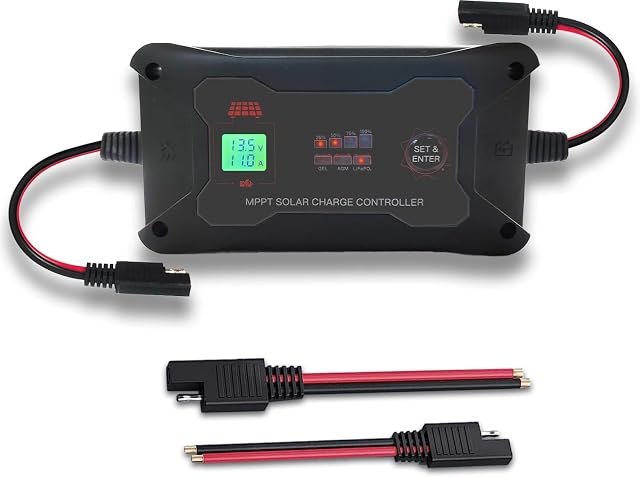
iSunergy M2420P 20 A portable MPPT controller, 12/24 V, up to 600 W PV, panel Voc no more than 30 V on 12 V or 60 V on 24 V, SAE connectors with two extensions, LCD and LEDs, 3-stage charging, 350 g, 24-month warranty
A 20 A portable MPPT with SAE plugs and an LCD, for $47.69. Its panel limit is strict on 12 V: no more than 30 V open-circuit, one panel.
Best for: Portable panels feeding a 12 or 24 V battery in a camper or a tent