Renogy’s Rover 40 A operates from -40 to 149 °F and has built-in low-temperature protection with a cut-off you can adjust in the app. For a lithium battery in a trailer that sits through winter, that cut-off is what prevents charging cells below freezing.
Charging
It auto-detects 12 or 24 V, charges lead-acid in four stages (bulk, absorption, float, equalization) and lithium in two, and can reactivate a lithium battery whose BMS has shut down. Renogy quotes 98% conversion and 99% tracking efficiency, with a 100 V PV limit.
Monitoring
An RS485 port connects a Renogy BT-2 module for the DC Home app, with real-time data and 30 days of history. The module is not in this box; the Rover BT version includes it.
Price on Amazon.com
Amazon.com listed it at $168.99 on November 2, 2026, with a three-year warranty.
Prices quoted in this text were read on November 2, 2026. The live price is at the top of the page.
What it gets right, and what it leaves out
Strengths
A -40 to 149 °F operating range and a low-temperature charge cut-off you can adjust
A three-year warranty, sold and shipped by Amazon
3,928 ratings, the most among the MPPT controllers here
Compromises
App monitoring needs a Bluetooth module; the Rover BT version includes it for $11 more
12 and 24 V only, no 48 V
40 A is about 580 W of panels on 12 V
Specifications
Charge current
40 A
Battery voltage
12/24 V auto-detect
PV input
100 V maximum
Efficiency
98% conversion, 99% tracking
Operating range
-40 to 149 °F, built-in low-temperature protection with app-adjustable cut-off
Charging
4-stage for lead-acid, 2-stage for lithium, lithium reactivation
Batteries
Gel, AGM, flooded, lithium
Connectivity
RS485; DC Home app through a BT-2 module
Dimensions
6.81 × 2.85 × 9.37 in
Warranty
3 years
Amazon reference
B01MSYGZGI
Questions owners ask about this one
How much solar can it take?
At 40 A, about 580 W on a 12 V bank and 1,160 W on 24 V, with the PV voltage under 100 V.
Will it charge lithium in freezing weather?
Renogy lists built-in low-temperature protection with an app-adjustable cut-off, so it can stop charging a lithium battery when it is too cold.
Do I need the Bluetooth version?
This model communicates over RS485 and needs a Renogy BT-2 module for the app. The Rover BT 40 A on this site includes the module for $179.99.
Our score
8.0/ 10
A proven 40 A MPPT with the widest temperature range here and an adjustable cold cut-off. Buy the BT version if you want the app.
Set beside the neighboring portable power units
Same category, nearby prices, between portable power units. What remains is the specifications every one publishes — half empty, a column is no use.
Specifications: the manufacturer sheet for portable power gear and the matching Amazon product page. Prices and availability: Keepa. Every figure on this page names its source.
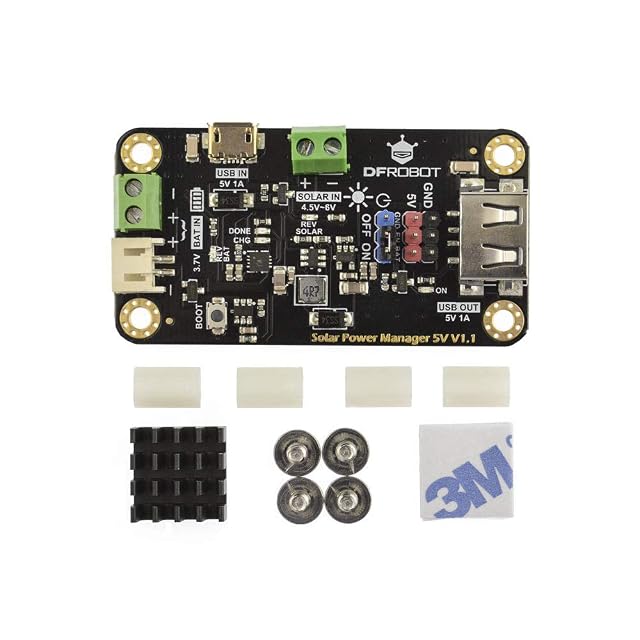
DFRobot DFR0559 solar power manager module: CN3165 MPPT for 5 V panels up to 10 W, 900 mA charging for 3.7 V Li-ion/LiPo, regulated 5 V 1 A output with switch, Micro-USB charging, under 1 mA standby, 33 × 63 mm
A 33 × 63 mm MPPT module for 5 V panels up to 10 W that charges a 3.7 V cell at 900 mA and outputs 5 V for Arduino and ESP32 projects, $13.90.
Best for: Solar-powered IoT nodes, weather stations and maker projects
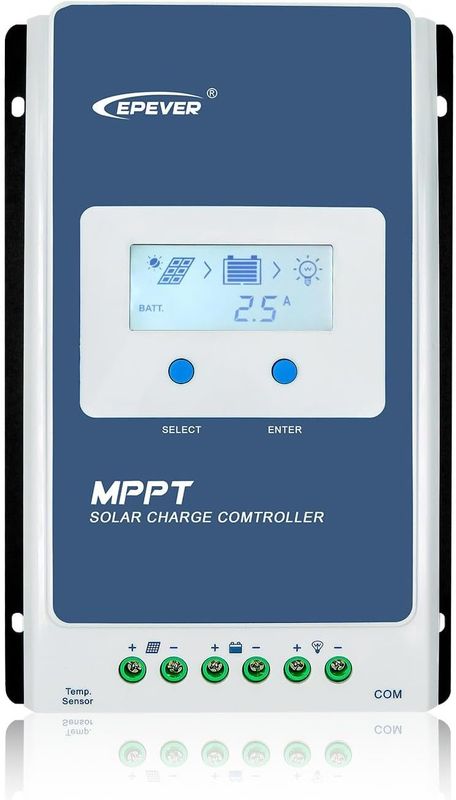
EPEVER Tracer4210AN G3 40 A MPPT controller: 12/24 V auto, 100 V PV, 520 W at 12 V or 1,040 W at 24 V, common negative ground, LiFePO4 and NCM profiles, temperature compensation, RS485 Modbus, over 99.5% tracking
EPEVER’s 40 A Tracer G3 states its panel limits outright, 520 W at 12 V and 1,040 W at 24 V, with common negative ground and RS485, for $118.99.
Best for: Solar builders who want a configurable controller with an open Modbus interface
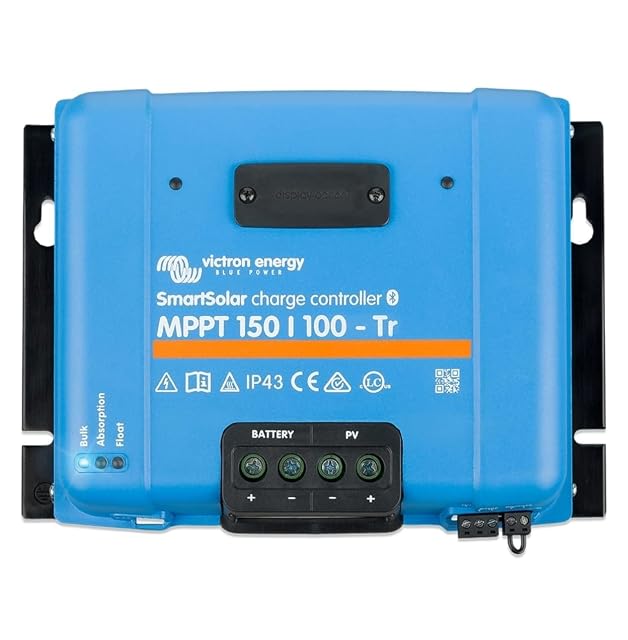
Victron SmartSolar MPPT 150/100-Tr solar charge controller: 150 V PV input, 100 A charge current, 12/24/36/48 V batteries, Tr screw terminals, built-in Bluetooth, 5.05 kg
Victron’s SmartSolar 150/100-Tr: 150 V of PV and 100 A of charge for 12 to 48 V banks, with Bluetooth built in. The large-system controller here.
Best for: Large van, boat and off-grid cabin arrays on 24 or 48 V banks