Deep-cycle means a different plate, not a bigger number · review
EXTRALINK 12 V 100 Ah AGM, deep cycle review
A 12 V 100 Ah sealed AGM leisure battery rated for over 600 cycles at 50 % depth of discharge, with a published temperature range and a self-discharge figure.
The bottom line The best-documented AGM here for a battery that will spend time idle: a self-discharge rate, a temperature range at both ends, and full physical details. It publishes no charging voltage, which is the number a charger needs.
A 100 Ah sealed AGM leisure battery, specified for standby as much as for cycling.
The number for a battery that waits
Self-discharge under 3 % a month. On a battery that spends the winter in a shed or a boat, that figure decides how often it must be checked and whether it survives until spring. Lead-acid left discharged sulphates, and the damage is not undone by charging it later.
The working depth
600 cycles at 50 % discharge. That pairing is the conventional lead-acid arrangement: roughly half the rated capacity is the everyday working range, and the cycle count assumes it. Reading 100 Ah as 100 Ah of usable energy is the commonest error on this shelf.
Fitting and handling
330 × 172 × 217 mm, 22.5 kg, M8 terminals, described as shock and vibration resistant. Everything the tray and the hold-down need.
What a charger will not find here
No charging voltage, and no absorption or float figures. Those are the settings a multi-stage charger has to be given, and this listing leaves them to the charger’s defaults.
Availability
German, French, Italian and Spanish Amazon stores quoted 120 € to 143 € when this page was compiled.
American Amazon catalogue carries an entry for it, with nobody selling.
British Amazon store returned nothing at all, so the buy button there runs a search instead of landing on an empty page.
These figures are what Keepa reported on the day this page was last updated. Availability and pricing move without notice.
Prices quoted in this text were read on 16 September 2026. The live price is at the top of the page.
What it gets right, and what it leaves out
Strengths
A self-discharge rate under 3 % a month is published, which decides how long it survives storage
A temperature range is published at both ends, −20 °C to +50 °C
Dimensions, weight and terminal type are all given
Compromises
No charging voltage, which is what a charger has to be set to
No discharge current at all
The ten-year life claim in the first bullet has no basis on the page
Specifications
Capacity
100 Ah at 12 V, first bullet
Discharge rate
Nowhere in the listing — no discharge current or C-rate is published
Construction
AGM, sealed, gas-tight and maintenance-free, first and fourth bullets
Depth of discharge
The cycle figure is quoted at 50 % discharge, second bullet; no usable capacity is stated separately
Cycle life
Up to 600 cycles at 50 % depth of discharge, second bullet — the depth is stated, the remaining capacity is not
Charging voltage
Nowhere in the listing
Terminals
M8, described as shock and vibration resistant, fifth bullet
Dimensions
330 × 172 × 217 mm, 22.5 kg, third bullet
Amazon reference
B0C53HNZZB (same reference on 5 Amazon marketplaces)
EAN
5905090334330
Questions owners ask about this one
Why does the self-discharge figure matter?
Because a lead-acid battery left to discharge sulphates, and sulphation is not reversible by ordinary charging. Under 3 % a month tells you roughly how often a battery in storage needs attention — which is the question that decides whether it survives a winter unused.
What does “600 cycles at 50 %” mean in practice?
That the count assumes half the capacity is used each time. Going deeper reduces it. It also means only about half of the 100 Ah is intended for everyday use, which is the conventional working depth for this construction.
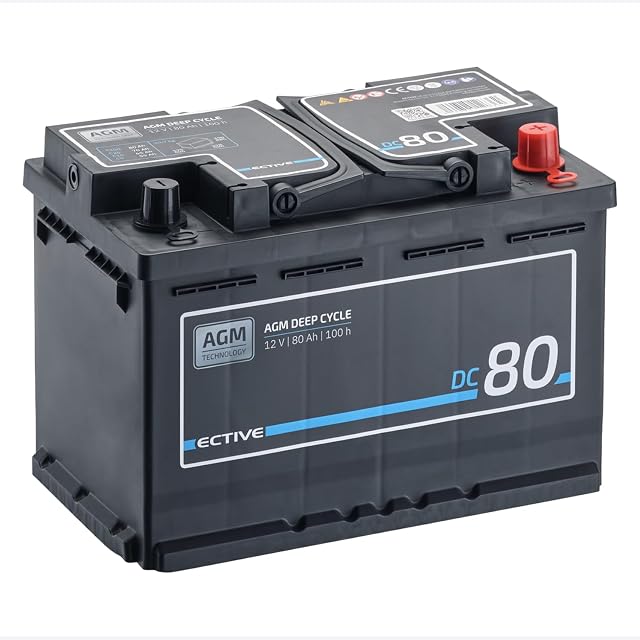
80 Ah at 12 V · AGM, maintenance-free · up to 55 % usable capacity · up to 700 cycles · low internal resistance · sealed and vibration-resistant
A 12 V 80 Ah AGM deep-cycle battery rated for up to 700 cycles, and the only battery in this catalogue whose listing publishes a usable capacity figure.
Best for: A van fit-out where the working capacity, rather than the rated one, is what the budget is built on.
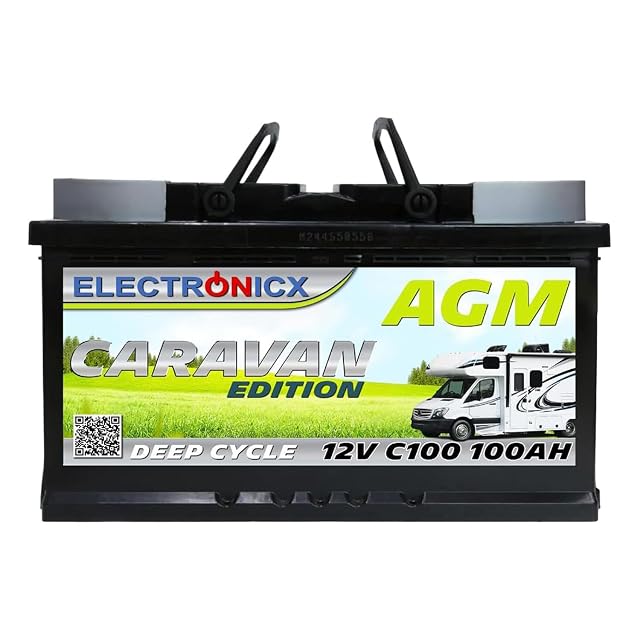
100 Ah at 12 V · AGM, sealed · terminal clamps, positive on the right, plus 19.5 mm / minus 17.9 mm · supplied filled and charged · 2-year warranty · 278 × 175 × 190 mm · 21.5 kg
A 12 V 100 Ah sealed AGM leisure battery supplied filled and charged, published with terminal post diameters and polarity, and explicitly stated not to be a starter battery.
Best for: A direct replacement in a caravan tray where the existing clamps must fit the new posts.
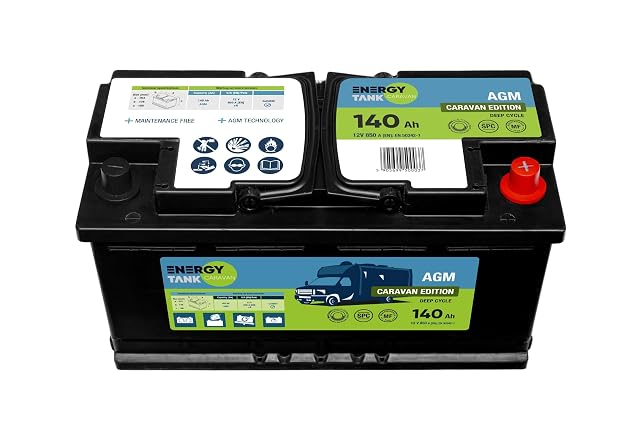
140 Ah at 12 V · AGM with glass fibre mats · 850 A (EN) · deep-discharge protection named · positive on the right · dimensions published with a unit error in the listing
A 12 V 140 Ah AGM leisure battery quoted at 850 A to EN, described as gas-tight and suitable for indoor use, with a deep-discharge protection named.
Best for: A motorhome with a mover, where the high current figure is the relevant one.