A lead-acid charger never finishes a lithium battery · review
CTEK Lithium XS, 12 V 5 A, LiFePO4 5–60 Ah review
A 5 A charger dedicated to 12 V LiFePO4 batteries, charging packs from 5 to 60 Ah and maintaining up to 120 Ah, with a test sequence that assesses the battery before charging.
The bottom line A specialist maintenance charger that publishes the two capacities it serves and tests a battery before charging it. Five amps makes it the wrong tool for a large bank, and it publishes no voltages at all.
A 5 A charger for lithium packs that spend more time waiting than working.
Two capacities, published separately
Charges 5 to 60 Ah. Maintains up to 120 Ah. That distinction is the whole design: keeping a battery full takes a fraction of the current that filling it does, and stating both figures tells you exactly which job this charger is for.
The test first
A sequence analysing whether the battery can accept and hold charge, before charging starts. On a pack that has been flat for months that is a genuine check rather than a feature name.
The maintenance stage
Described as patented, restoring full capacity and maintaining performance after months of inactivity. What it does electrically is not stated, and LiFePO4 is not floated the way lead is — so the mechanism matters and is not given.
The current
5 A. A 100 Ah pack at 5 A is twenty hours of bulk charging before any taper. This is not a bench charger for a leisure bank; it is a maintainer for something small that sits.
The voltages
None. A dedicated lithium charger that never states what voltage it applies.
Availability
German, French, Italian and Spanish Amazon stores quoted 100 € to 148 € when this page was compiled.
American and British Amazon catalogues carry an entry for it, with nobody selling.
These figures are what Keepa reported on the day this page was last updated. Availability and pricing move without notice.
Prices quoted in this text were read on 16 September 2026. The live price is at the top of the page.
What it gets right, and what it leaves out
Strengths
The pack capacities it charges and maintains are published separately — 5 to 60 Ah and up to 120 Ah
A test sequence assesses the battery before charging rather than simply applying current
A maintenance stage described as restoring capacity after months of inactivity
Compromises
5 A is the lowest current here, so a 100 Ah pack is a long job
No charging voltages published at all
No low-temperature behaviour, on a dedicated lithium charger
Specifications
Charge current
Up to 5 A, second bullet
Absorption
Nowhere in the listing
Float voltages
Absent as a figure; a patented maximisation stage with maintenance charging is named in the fourth bullet
Profiles
LiFePO4 only, 12 V, charging packs of 5 to 60 Ah and maintaining up to 120 Ah, second bullet
Low-temperature behaviour
Nowhere in the listing
Connectors
Nowhere in the listing
Protections
Absent as a list; a test sequence analysing the battery’s ability to accept and hold charge is named in the third bullet
Amazon reference
B00D5T086Y (same reference on 6 Amazon marketplaces)
EAN
7350009568999
Questions owners ask about this one
Why separate charging and maintenance capacities?
Because holding a battery topped up takes far less current than filling it. This charger fills packs up to 60 Ah and maintains packs up to 120 Ah — so a larger battery can be kept alive over a winter even though this charger would take a long time to fill it.
What does a test sequence do?
The third bullet describes analysing whether the battery can safely accept and hold charge before charging begins. On a pack that has been sitting flat, that is a check rather than a blind application of current.
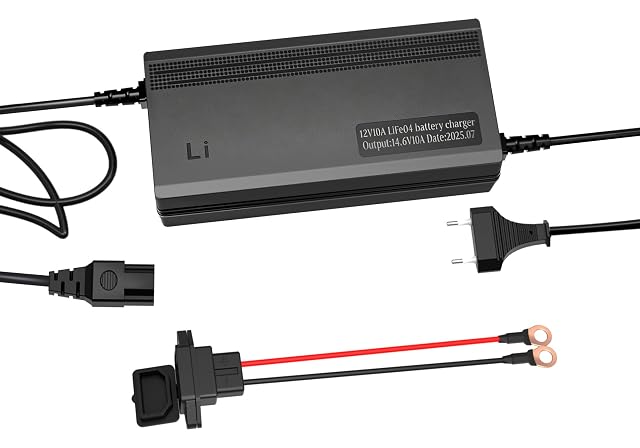
10 A charge · 14.6 V constant voltage published · float not published · LiFePO4 only, 12 V/12.8 V · low-temperature behaviour not published · connectors not described · over-temperature, output over-voltage, over-current, reverse polarity, output short circuit, overload
A 14.6 V 10 A charger built only for 12 V LiFePO4 batteries, using a three-stage constant current, constant voltage and full charge sequence with a side cooling fan.
Best for: A 12 V LiFePO4 bank that wants a charger doing one thing correctly.
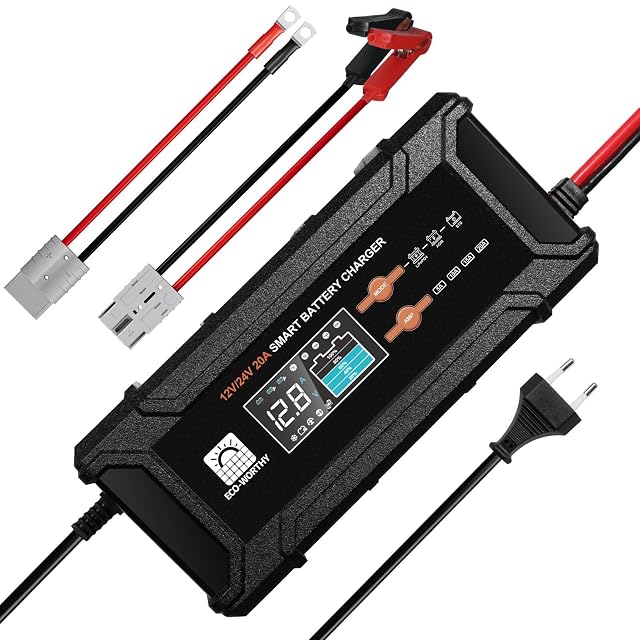
5, 10, 15 or 20 A selectable · absorption not published · float not published · LiFePO4, AGM, gel and lead-acid with automatic voltage detection · 0 V activation for LiFePO4, low-temperature lead charging named · connectors not described · reconditioning mode for lead
A 20 A charger for 12 V and 24 V systems with four selectable currents, automatic voltage detection, a 0 V activation function for lithium packs and a lead reconditioning mode.
Best for: A workshop dealing with both chemistries, and with lithium packs that have been left too long.
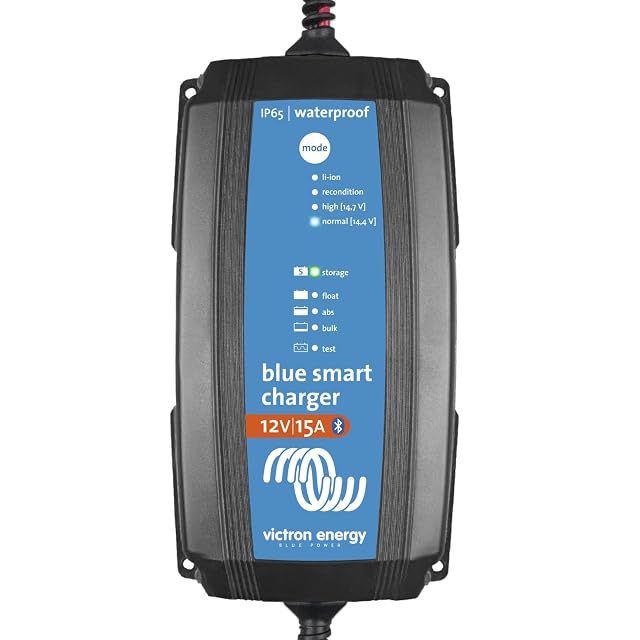
15 A charge · seven-stage algorithm from bulk to float, voltages not published · float named as a stage · lead-acid and lithium-ion, 12 V and 24 V · low-temperature behaviour not published · CEE 7/17 mains lead · IP65 · forced charge and desulfation for deeply discharged batteries
A 15 A IP65 charger with a seven-stage algorithm, integrated Bluetooth, and a forced charge function with a built-in desulfator for reviving deeply discharged batteries.
Best for: A boat or a van locker where the charger lives permanently and is checked from a phone.