Voltage guesses the state of charge; a shunt counts it · review
Renogy 500 A shunt monitor, 12/24/36/48 V, programmable alarm review
A 500 A shunt battery monitor for 12 to 48 V systems with a programmable high and low capacity alarm, custom battery parameters and a memory that survives a power interruption.
The bottom line A capable shunt monitor with five chemistries, custom parameters and a memory that survives an interruption. It publishes no self-consumption figure and no installation guidance — and on a shunt, installation is where monitors go wrong.
A 500 A shunt monitor that counts rather than guesses.
Why shunt-based matters
Voltage does not indicate state of charge on a LiFePO4 bank — the curve is nearly flat across most of the usable range. A shunt counts the current in and out, which is a quantity rather than a symptom. Every monitor in this family works this way, and it is why they exist.
The parameters
Five chemistries named, plus user-defined values. A monitor is only as accurate as the capacity and full-charge criteria it is given, and presets rarely match a specific bank exactly.
The memory
Data recorded and restored through a power interruption. A monitor that resets loses its accumulated count and has to re-synchronise on the next full charge.
The two absences
Self-consumption — the current the monitor itself draws, permanently, across the battery it is watching. And installation guidance: every load and every charging source must pass through the shunt, and one connection left on the battery terminal makes the reading drift forever.
Availability
German, French, Italian and Spanish Amazon stores quoted about 59 € when this page was compiled.
British Amazon store carries it too, priced in its own currency, which the euro range above deliberately omits.
American Amazon catalogue carries an entry for it, with nobody selling.
These figures are what Keepa reported on the day this page was last updated. Availability and pricing move without notice.
Prices quoted in this text were read on 16 September 2026. The live price is at the top of the page.
What it gets right, and what it leaves out
Strengths
Five chemistries named, and user-defined battery parameters rather than presets only
A memory function that records and restores data through a power interruption
Programmable alarms on both high and low capacity
Compromises
No self-consumption figure, on a device wired permanently across a battery
No installation guidance, which on a shunt is where the errors happen
No application, so it is read at the display or not at all
Specifications
Measurement method
Shunt-based, from the title — current counted rather than voltage inferred
Shunt rating
500 A, from the title
Accuracy
Described as high precision in the title; no figure is published
Chemistries
LiFePO4, AGM, sealed, gel and flooded, first bullet
Display
Included; the second bullet describes the alarm and parameter interface
App
Nowhere in the listing
Alarms
Programmable high and low capacity alarm with user-defined battery parameters, second bullet
Self-consumption
Nowhere in the listing
Installation requirements
Nowhere in the listing
Amazon reference
B07RGPCZSZ (same reference on 6 Amazon marketplaces)
EAN
0810009712602
Questions owners ask about this one
Why do custom parameters matter?
Because a monitor counts energy against a capacity you tell it, and the criteria for a full charge — voltage, tail current, duration — have to match the bank. Presets cover common cases; custom values cover the bank you actually have.
What does the memory function protect?
The accumulated count. A monitor that loses its state on a power interruption starts guessing again from zero, and the second bullet says this one records and restores. On a system that is isolated over winter, that matters.
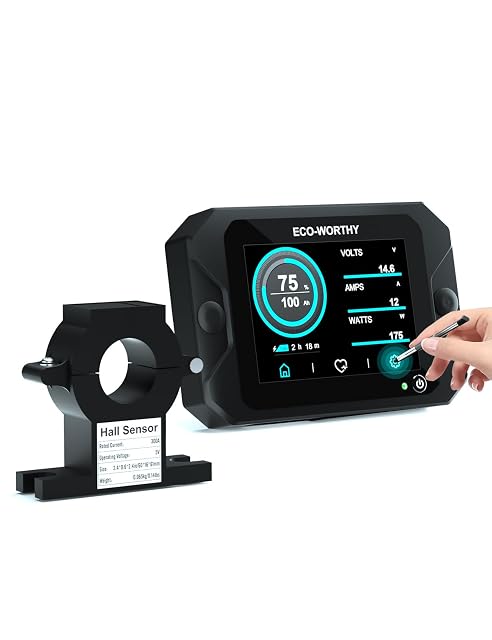
shunt-based counting · 300 A shunt · accuracy not published · chemistries not named, custom parameters supported · 3.5-inch colour touchscreen with adjustable brightness · no app named · voltage, current and temperature alarms · 0.5 mA self-consumption, PUBLISHED · installation requirements not described
A 300 A shunt monitor with a 3.5-inch colour touchscreen and a published self-consumption of 0.5 mA — the only self-consumption figure in this catalogue.
Best for: A system where the monitor itself must not be part of the standing drain.
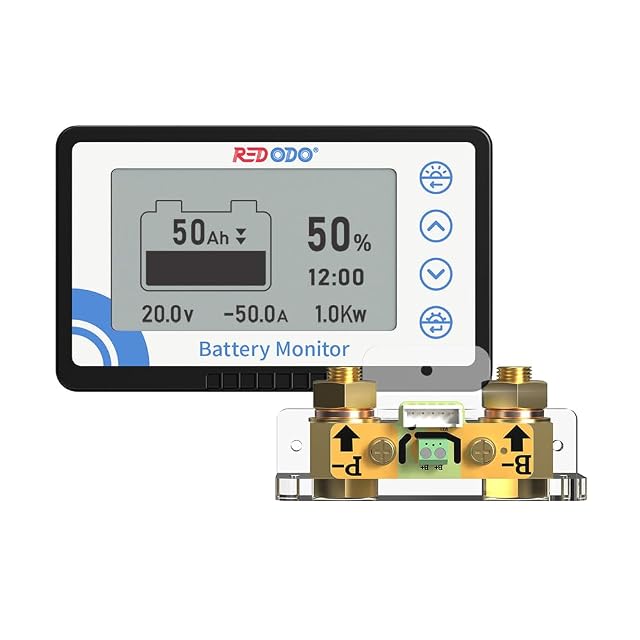
shunt-based counting · 500 A shunt, M8 connection · accuracy not published · LiFePO4, lithium-ion, AGM, gel and lead-acid · backlit LCD · no app named · flashing display and buzzer every 10 seconds at a set threshold · self-consumption not published · 0–9999 Ah capacity range
A 500 A shunt monitor for 8 to 120 V systems with M8 terminals, five named chemistries, a capacity range to 9999 Ah and a backlit LCD with a buzzer alarm.
Best for: A large mixed-chemistry installation where the terminal size has to be known in advance.
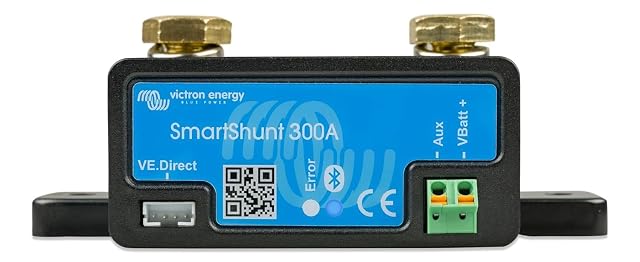
shunt-based counting · 300 A, 50 mV shunt · accuracy not published · chemistries not named · NO display — the phone is the display · VictronConnect over Bluetooth · alarms not described · self-consumption not published · VE.Direct plus a second connection for a second battery, midpoint or temperature sensor
A 300 A shunt monitor with no display of its own, reading out over Bluetooth to VictronConnect, with a VE.Direct port and an input for a second battery or a temperature sensor.
Best for: An installation already using Victron equipment, where one application covers everything.