One inverter per panel, and one shaded panel stops costing the others · review
APsystems EZ1-M 800 W, two MPPT, 16–60 V input review
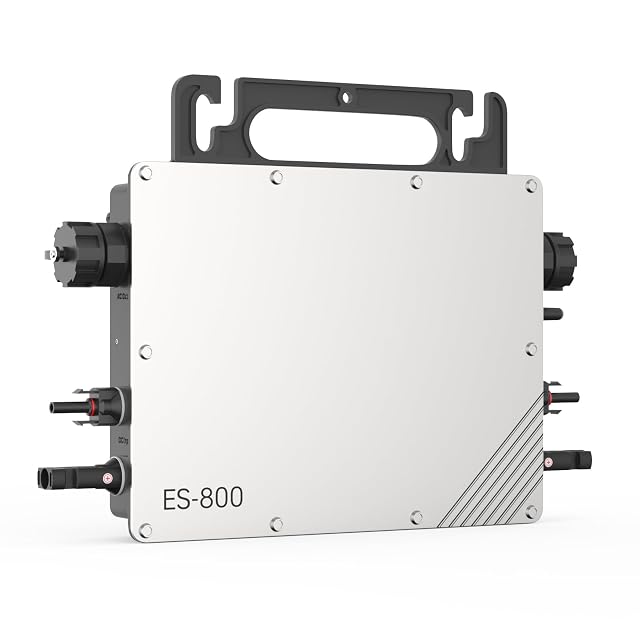
An 800 W APsystems micro-inverter and the only one in this family to publish its input window: 28 to 45 V at the maximum power point, 16 to 60 V operating, 60 V maximum.
The bottom line The only micro-inverter on this shelf whose panels can be chosen on paper: four input figures published, a named certification and an integrated relay. It omits the enclosure rating that six of its seven neighbours publish.
An 800 W micro-inverter with the specification sheet the rest of this family does not have.
The four numbers that decide a panel
MPPT voltage range 28 to 45 V. Operating range 16 to 60 V. Maximum input voltage 60 V. Maximum input current 2 × 20 A. With those, a panel’s open-circuit voltage and maximum power voltage can be checked against the inverter before either is bought — including for the cold morning when open-circuit voltage is at its highest.
Six other micro-inverters in this family publish a wattage and nothing else.
The certification, as a part
VDE certified, with an integrated VDE relay named in the third bullet. Naming the relay is different from claiming compliance: it identifies the component that performs the disconnection.
The monitoring
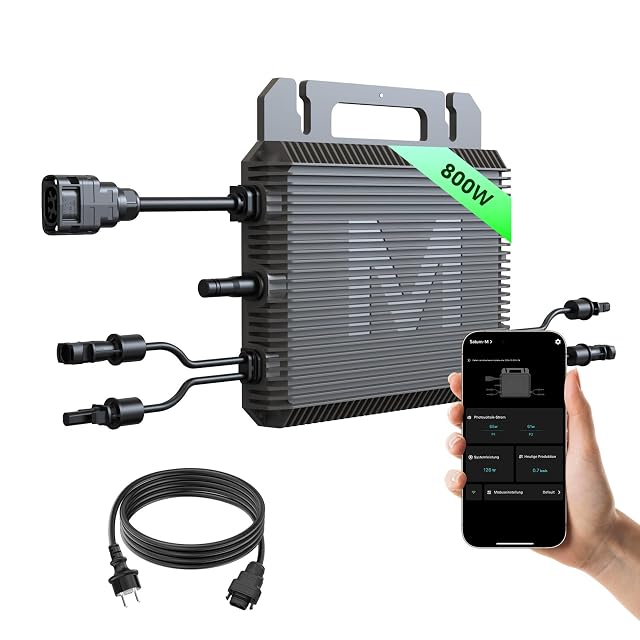
WiFi and Bluetooth both integrated. Bluetooth matters where a balcony is out of range of a household network, which is common enough to be worth the line.
What is missing
The ingress rating. Every other micro-inverter here except the EcoFlow publishes IP67, and this one publishes nothing about its housing. And no warranty.
Availability
German, French, Italian and Spanish Amazon stores quoted 126 € to 171 € when this page was compiled.
British Amazon catalogue carries an entry for it, with nobody selling.
American Amazon store returned nothing at all, so the buy button there runs a search instead of landing on an empty page.
These figures are what Keepa reported on the day this page was last updated. Availability and pricing move without notice.
Prices quoted in this text were read on 16 September 2026. The live price is at the top of the page.
What it gets right, and what it leaves out
Strengths
The complete input window is published — MPPT range, operating range, maximum voltage and maximum current
VDE certification with an integrated relay, named as a component rather than as a claim
Both WiFi and Bluetooth, with Bluetooth usable when no network is present
Compromises
No ingress rating, on a device mounted outdoors
No warranty stated
The listing is a reseller’s, and APsystems’ own documentation carries more
Specifications
Rated output
800 W maximum output, first bullet
Inputs
Two input channels with independent MPPT, second bullet; maximum input current 2 × 20 A, fourth bullet
Limits
MPPT voltage range 28–45 V, operating range 16–60 V, maximum input voltage 60 V, maximum input current 2 × 20 A, fourth bullet — the only complete input window in this family
MPPT channels
Two independent MPPTs, second bullet
Certified grid standards
VDE certified with an integrated VDE relay, third bullet
Monitoring
Integrated WiFi and Bluetooth, tracked from a phone anywhere, third bullet
Ingress rating
Nowhere in the listing
Warranty
Nowhere in the listing
Amazon reference
B0CN9DKX9M (same reference on 5 Amazon marketplaces)
EAN
4260558575528
Questions owners ask about this one
Why is a 60 V maximum input the important figure?
Because open-circuit voltage rises as cells get colder, and a string that sits comfortably under 60 V in August can exceed it on a clear January morning. The maximum input is what that cold-case calculation is checked against, and this is the only micro-inverter here that publishes one.
What does the 28–45 V MPPT range mean in practice?
It is where the tracker can actually find a maximum power point. A panel whose operating voltage falls outside it will still connect — the operating range runs 16 to 60 V — but the tracking will be less effective. Publishing both ranges separately is what makes a panel match checkable.
800 W · 2 independent MPPT at 400 W each · limits not published · 2 MPPT · VDE and EMC certified · app monitoring · IP67 · warranty not stated
An 800 W grid-tied micro-inverter with two 400 W MPPT channels, VDE and EMC certification, lightning protection and an 800 V supercapacitor, at a stated 96 % conversion efficiency.
Best for: A two-panel installation where each panel is around 400 W and the per-channel limit is the deciding figure.
800 W · 2 MPPT inputs · limits not published · MPPT efficiency 99.8 %, peak 96.5 % · grid standard not named · monitoring not described · IP67 · MC4 plug and play
An 800 W micro-inverter with two independent MPPT channels quoted at 99.8 % tracking efficiency and 96.5 % peak conversion, with MC4 connectors and IP67 protection.
Best for: A straightforward two-panel balcony where monitoring is not wanted and MC4 is what the panels have.