A van charges from three sources, and they rarely agree · review
SOLIS SB100SMF, 12 V 100 Ah C100 sealed review
A 12 V 100 Ah sealed lead battery rated at the C100 hour rate, published with a maximum charge current and both float and charge voltages — the only battery in this catalogue to give them.
The bottom line The only battery in this catalogue that publishes what a charger needs: a rate beside the capacity, a maximum charge current, and both float and charge voltages. Everything else about it is ordinary; that one column is not.
A 100 Ah sealed lead battery whose second bullet is a specification sheet in miniature.
The rate, published with the rating
100 Ah at C100 — measured over a hundred hours. Lead-acid capacity depends on how fast it is taken out, and an amp-hour figure without its rate is not comparable with one that has it. Two other batteries in this catalogue publish C100 as well; most publish nothing.
What a charger needs
Maximum charge current 24 A. Float 13.6 to 13.8 V. Maximum charge voltage 14.7 to 14.8 V. These are the settings a multi-stage charger is given, and this is the only listing in twenty to publish them. A charger on a generic profile is guessing at exactly these numbers.
Fitting
278 × 175 × 190 mm, standard posts, positive on the right. The same case as two other 100 Ah batteries here, which makes a swap straightforward.
The claims without figures
Over 600 cycles to DIN, without a depth of discharge. And 20 % more cycles than a conventional standby battery, which names neither the comparison nor the measurement.
Availability
German Amazon store quoted about 95 € when this page was compiled.
American, British, French, Italian and Spanish Amazon stores returned nothing at all, so the buy button there runs a search instead of landing on an empty page.
These figures are what Keepa reported on the day this page was last updated. Availability and pricing move without notice.
Prices quoted in this text were read on 16 September 2026. The live price is at the top of the page.
What it gets right, and what it leaves out
Strengths
The capacity is published with its discharge rate — C100 — which is what makes an amp-hour figure comparable
Float and maximum charge voltages are both published, the only battery in this catalogue to give them
A maximum charge current is stated in amps
Compromises
The over-600-cycle figure cites DIN without naming the depth of discharge
No low-temperature figure
The 20 % improvement claim names no comparison battery
Specifications
Capacity
100 Ah at the C100 rate, 12 V, second bullet — the rate is published with the figure
Chemistry
Sealed maintenance-free lead, first bullet, described as delivering over 20 % more cycles than a conventional standby solar battery
Alternator and shore charging
Maximum charge current 24 A, float 13.6 to 13.8 V, maximum charge voltage 14.7 to 14.8 V, second bullet
Low-temperature protection
Nowhere in the listing
Mounting constraints
Standard posts with positive on the right, second bullet; sealed and stated as leak-proof
Dimensions
278 × 175 × 190 mm, second bullet
Amazon reference
B08J1CQ7ZQ (same reference on 1 Amazon marketplace)
EAN
4260628449353
Questions owners ask about this one
Why does C100 matter beside the 100 Ah?
Because a lead battery gives more capacity when discharged slowly. C100 means the 100 Ah was measured over a hundred hours. The same battery discharged in ten hours gives noticeably less, which is why a rating without its rate cannot be compared with one that has it.
What are the float and charge voltages for?
They are what a multi-stage charger has to be set to. A charger left on a generic profile may overcharge or undercharge a particular battery, and these two figures — 13.6 to 13.8 V float, 14.7 to 14.8 V maximum — are the ones to enter.
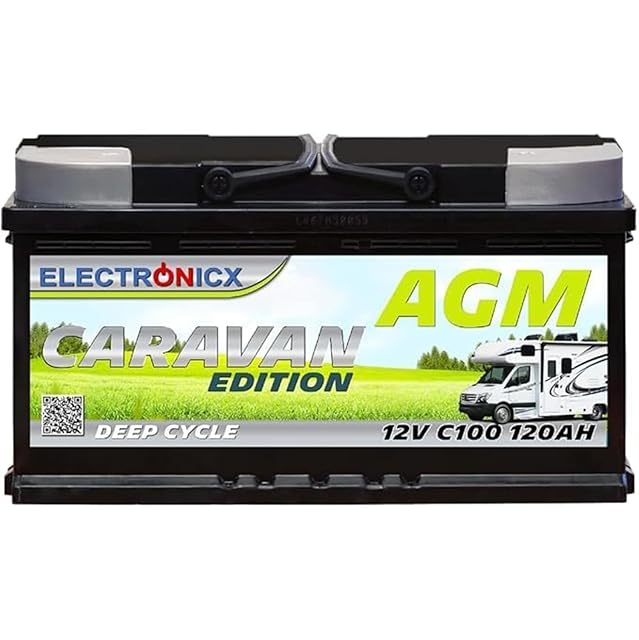
120 Ah C100 at 12 V · AGM, sealed and gas-tight · over 600 cycles · suitable indoors · vibration-resistant · named for inverters and movers
A 12 V 120 Ah sealed AGM battery rated at the C100 hour rate and for over 600 cycles, described as gas-tight and therefore suitable for installation inside a vehicle.
Best for: A caravan needing more capacity than 100 Ah, where the tray has already been measured.
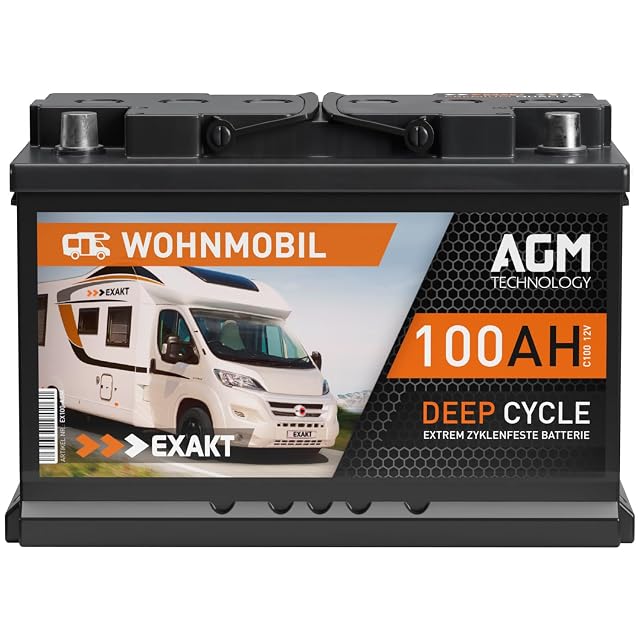
100 Ah C100 at 12 V · AGM VRLA, valve-regulated and maintenance-free · deep-cycle construction · round standard posts, positive on the right · 278 × 175 × 190 mm · supplied ready to use
A 12 V 100 Ah valve-regulated AGM battery rated at the C100 hour rate, published with dimensions, post type and polarity, and supplied ready to use.
Best for: A straight AGM replacement in a motorhome where the existing charger profile already suits lead-acid.
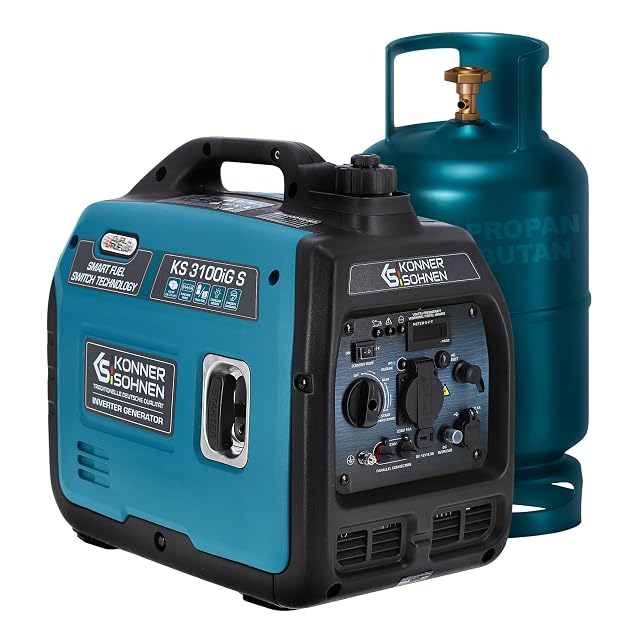
tank not published · 3100 W, 230 V 50 Hz sine from a microprocessor-controlled inverter module · transfer time not applicable · 16 A socket, 2 USB at 5 V/1 A and 5 V/2.1 A · petrol or LPG, everything for gas supplied · 63 dB Lpa at 7 m, distance STATED · outdoor machine, manual governs
A 3100 W dual-fuel inverter generator supplied with everything needed to run on LPG, quoted at 63 dB Lpa at 7 metres, with parallel cables included and an eco mode saving up to 50 % of fuel.
Best for: A household backup kept for years between uses, where bottled gas avoids stale petrol.