MPPT converts surplus voltage into amps; PWM throws it away · review
Y&H 40 A, 12 V/24 V, dual USB, LCD review
A 40 A controller for 12 V and 24 V systems with an LCD and two USB ports, whose own listing describes its MPPT technology as detecting maximum charge current rather than tracking a power point.
The bottom line A controller whose first bullet contradicts itself on chemistry and whose second describes something other than maximum power point tracking. It publishes no maximum PV voltage. The three most important lines on the page are unusable.
A 40 A controller sold as MPPT, described by its own maker in terms that do not match.
The contradiction on line one
“The solar controller is only suitable for lead batteries: OPEN, AGM, GEL. It is also suitable for Ni-MH, Li-Ion or other batteries.” Two sentences, mutually exclusive, in the first bullet. Chemistry decides the charging profile, and a controller that cannot say which chemistry it serves cannot be matched to a battery.
The description that is not tracking
The second bullet explains that this controller’s MPPT technology detects the maximum charge current rather than the panel’s operating voltage. Maximum power point tracking means continuously finding the combination of voltage and current at which the panel delivers most. This is the maker describing its own product, and it is reproduced here rather than translated into a claim the maker did not make.
No ceiling on the panel voltage
Maximum PV input voltage. A string above a controller’s ceiling damages it, and open-circuit voltage rises in cold weather. Without the ceiling, no array can be checked.
What is genuinely useful
A low-voltage cut-off with automatic resumption, and a state-of-charge function controlling charge current and load supply. Both described clearly.
Availability
German, French, Italian and Spanish Amazon stores quoted 18 € to 21 € when this page was compiled.
British Amazon store carries it too, priced in its own currency, which the euro range above deliberately omits.
American Amazon store returned nothing at all, so the buy button there runs a search instead of landing on an empty page.
These figures are what Keepa reported on the day this page was last updated. Availability and pricing move without notice.
Prices quoted in this text were read on 16 September 2026. The live price is at the top of the page.
What it gets right, and what it leaves out
Strengths
A state of charge function is described as managing charge current and supplying loads
Automatic charge cut-off at low battery voltage with automatic resumption
The cheapest controller sold as MPPT in this family
Compromises
The first bullet contradicts itself on battery chemistry within two sentences
The second bullet describes the MPPT technology as detecting maximum charge current rather than tracking a maximum power point
No maximum PV voltage — the figure that decides whether a string destroys the input
Specifications
Charge current
40 A, from the title
Maximum PV voltage
Nowhere in the listing — no input voltage ceiling is published
Efficiency
Nowhere in the listing
Battery profiles
The first bullet says the controller is only for lead batteries — open, AGM, gel — and then that it is also suitable for NiMH, Li-ion and other cells. The two statements contradict each other and are reported as published.
Monitoring
LCD display with two USB charging ports, from the title
Wiring sizes
Nowhere in the listing
Enclosure
Nowhere in the listing
Amazon reference
B08RJ92B4Q (same reference on 5 Amazon marketplaces)
EAN
0738866166300
Questions owners ask about this one
Is it for lead batteries or for lithium?
The first bullet says both, in consecutive sentences: “only suitable for lead batteries: OPEN, AGM, GEL” and then “also suitable for Ni-MH, Li-Ion or other batteries”. Those cannot both be true, and this page does not choose. The question has to go to the seller.
Is this a real MPPT controller?
The second bullet says its technology “detects the maximum charge current, not the boost type or automatic charging of the solar panel voltage”. Maximum power point tracking means continuously finding the panel’s best voltage and current together. The maker’s own description is not that, and it is reported here as written.
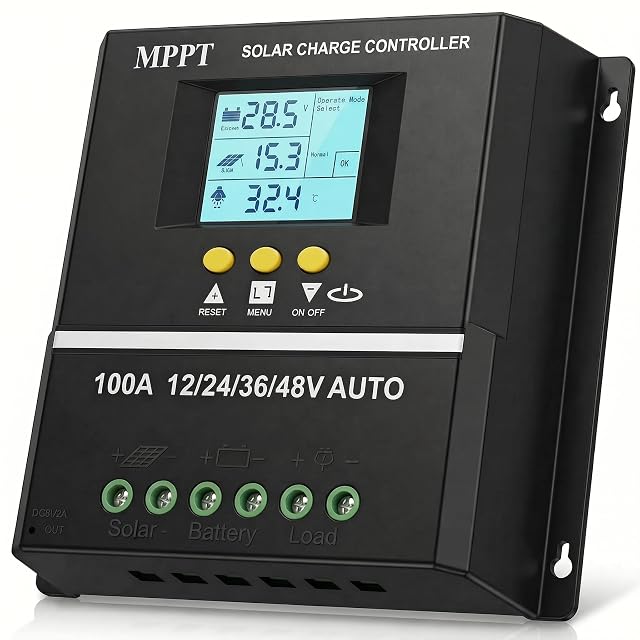
100 A charge · maximum PV voltage not published · tracking efficiency not less than 99 % · sealed, gel, flooded and LiFePO4 · LCD with single-touch settings and seven modes · wiring sizes not published · described as waterproof without a rating
A 100 A controller for 12 to 48 V systems with dual 5 V USB ports, single-touch settings and protection against over-voltage, over-current, over-charge and deep discharge.
Best for: An outdoor or semi-exposed installation where the protections list is the deciding factor.
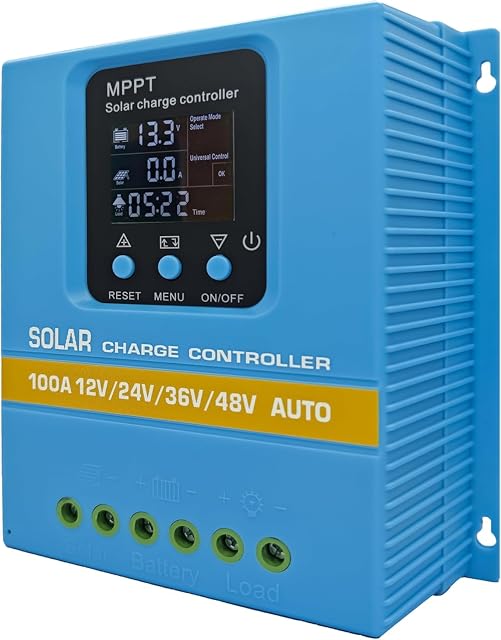
60/80/100 A selectable · maximum PV voltage not published · MPPT algorithm named, efficiency not published · lead-acid and lithium · backlit LCD with live data and fault codes · wiring sizes not published · three-layer protection
A controller selectable at 60, 80 or 100 A for 12 to 48 V systems, with seven intelligent modes including dusk-to-dawn operation for street lighting.
Best for: A street lighting or garden installation where the timing modes do most of the work.
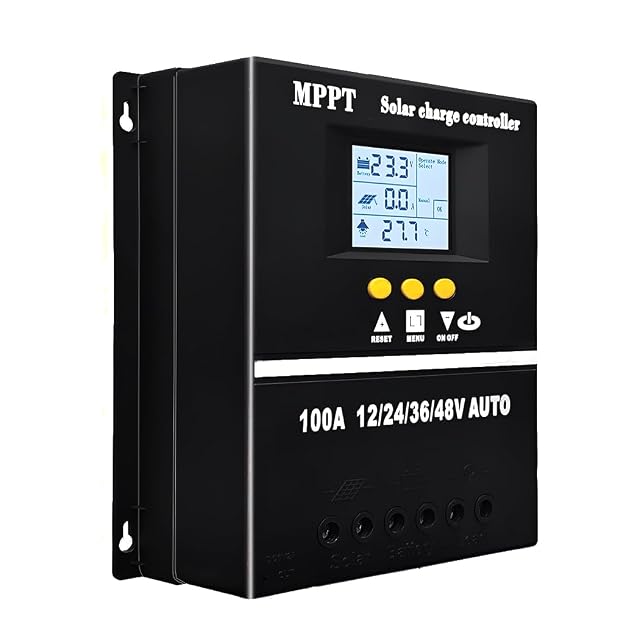
100 A charge · 100 V maximum PV input · tracking efficiency not less than 99.5 % · sealed, gel, flooded and LiFePO4 · LCD with clock and seven modes · wiring sizes not published · enclosure not rated
A 100 A controller for 12 to 48 V systems with a published 100 V PV input ceiling, whose listing describes it as combining MPPT and PWM charging technology.
Best for: A 48 V off-grid array whose string voltage is already known to sit under 100 V.