A fixed panel is chosen by its voltage as much as by its watts · review
NAHUI 2 × 450 W bifacial N-type 16BB, glass-glass review
A pair of 450 W bifacial N-type modules with 16 busbars and half cells, published with front and rear mechanical loads, a German fire class and a thirty-year warranty.
The bottom line The module with the most convincing durability evidence here: loads in pascals for both faces, a named fire class, and every unit EL-tested. It shares the family failing — no voltages, no temperature coefficient, no dimensions.
A pair of 450 W bifacial modules sold on construction rather than on appearance.
The numbers that describe strength
5400 Pa on the front, 2400 Pa on the rear. Snow presses down on the front; wind lifts from behind. Publishing the two separately is more informative than one figure, and it is the specification that decides a module on an exposed roof.
The fire class
German fire class A, named. Two other modules here say “fire-resistant” with nothing behind it. A class is a defined test.
The testing claim
100 % electroluminescence inspection before dispatch, aimed specifically at micro-cracks and hidden defects. That is a manufacturing commitment rather than a product property, and it is checkable by asking for the report.
The bifacial figure, honestly stated
5 to 20 % depending on what is behind the module — bright roofs and sand at the top of that range. Compare with the 30 % claimed elsewhere in this family: this one names the dependency and gives a range.
What is absent
Voltages. Temperature coefficient. Dimensions. Weight. The same three or four blanks as every other module here.
Availability
German Amazon store quoted about 200 € when this page was compiled.
American, British, French, Italian and Spanish Amazon catalogues carry an entry for it, with nobody selling.
These figures are what Keepa reported on the day this page was last updated. Availability and pricing move without notice.
Prices quoted in this text were read on 16 September 2026. The live price is at the top of the page.
What it gets right, and what it leaves out
Strengths
Mechanical loads published in pascals for both faces — 5400 Pa front, 2400 Pa rear
A fire class is named rather than “fire-resistant” being asserted
Every module electroluminescence-tested before dispatch, which addresses micro-cracks specifically
Compromises
No voltages and no temperature coefficient
No dimensions and no weight, on a module sold in pairs
The bifacial gain is quoted as 5 to 20 % depending on the surface, which is honest but unusable for planning
Specifications
Peak wattage
2 × 450 W, from the title
Cell technology
N-type half cells with 16 busbars and SMBB interconnection, second and sixth bullets, described as reducing losses and hot spots
Voltages
Nowhere in the listing
Temperature coefficient
Nowhere in the listing
Frame
Reinforced aluminium alloy frame, fourth bullet
Glass
1.6 + 1.6 mm tempered double glass with a fluoride-free rear film, first and fourth bullets
Dimensions
Nowhere in the listing
Warranty terms
30-year performance warranty with 100 % electroluminescence testing before dispatch, fifth bullet; German fire class A named in the first
Amazon reference
B0FCFRF3BV (same reference on 6 Amazon marketplaces)
EAN
0762612835073
Questions owners ask about this one
What does 5400 Pa mean in practice?
It is a pressure the front face is rated to withstand — the figure that matters under snow load. The rear rating of 2400 Pa covers uplift from wind. Publishing both separately is more useful than a single number, because the two forces act on different faces.
Why does electroluminescence testing matter?
It reveals micro-cracks invisible to the eye, which develop into hot spots and output loss over years. Testing every module rather than a sample is a specific, checkable commitment.
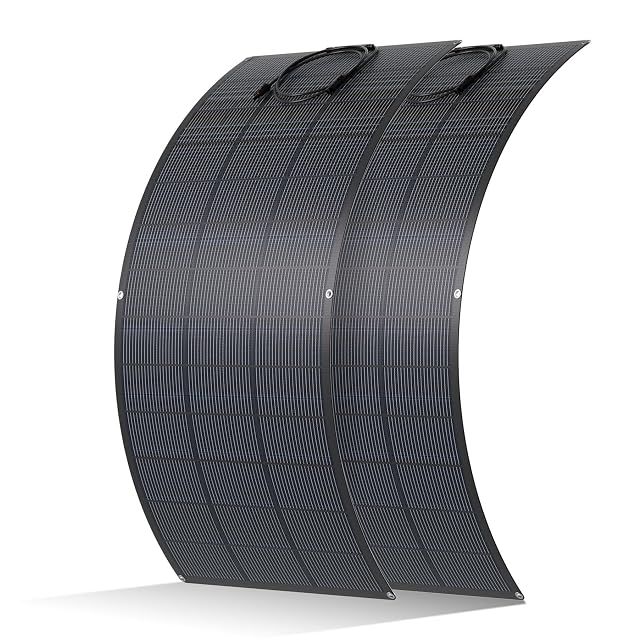
2 × 200 W peak · N-type 18-busbar cells, 25 % stated · voltages not published · temperature coefficient not published · frameless flexible · ETFE with 95 % transmission · dimensions not published · bypass diodes fitted
A pair of 200 W flexible ETFE panels with 18-busbar N-type cells and integrated bypass diodes, fitted with six stainless eyelets and six straps each.
Best for: A van roof or a curved cabin top where a framed module cannot sit flat.
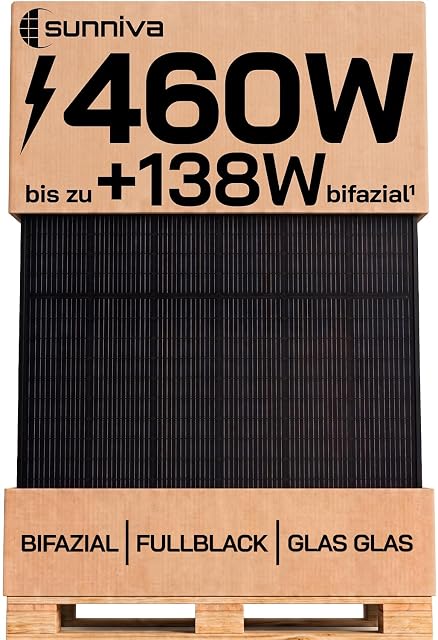
460 W peak with a 0–5 W positive tolerance · N-TOPCon · voltages not published · optimised coefficient, figure not given · 1762 × 1134 × 30 mm · glass-glass · 0.40 % annual degradation, 87.4 % after 30 years · 25-year product and 30-year linear performance warranty
A 460 W bifacial N-TOPCon module published with dimensions, an annual degradation rate, a thirty-year performance warranty and certification to IEC 61215, IEC 61730 and IEC 61701.
Best for: A balcony or roof installation where the module will still be there in twenty years and the warranty terms are part of the purchase.
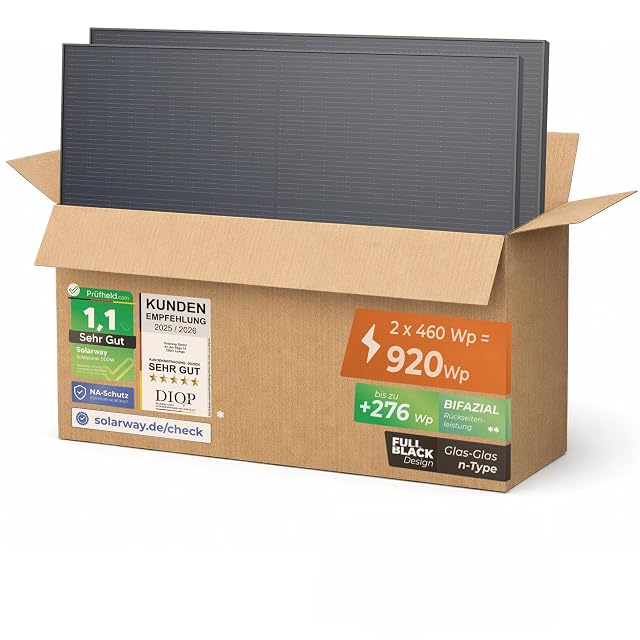
460 W peak · N-type TOPCon · voltages not published · temperature coefficient named but not given · black frame · double tempered glass · dimensions not published · IP68
A 460 W bifacial glass-glass module using N-type TOPCon cells in a full black finish, rated IP68, whose listing claims up to 30 % extra yield from the rear face.
Best for: A balcony rail or a flat roof where the rear face sees reflected light and the module will be bought on appearance.