A fixed panel is chosen by its voltage as much as by its watts · review
Solarway 460 W bifacial glass-glass N-TOPCon, 1762 × 1134 × 30 mm review
A 460 W bifacial N-TOPCon module published with dimensions, an annual degradation rate, a thirty-year performance warranty and certification to IEC 61215, IEC 61730 and IEC 61701.
The bottom line The best-documented module in this family on everything except the one thing every module here omits: voltages. A published degradation rate, a thirty-year linear warranty and three named IEC standards put it ahead of its neighbours by a distance.
A 460 W bifacial module whose listing reads like a datasheet rather than an advertisement.
The warranty, published properly
0.40 % degradation a year. Up to 87.4 % of rated output after thirty years. A 25-year product warranty and a 30-year linear performance warranty. Those four figures together describe a promise that can be checked; most modules here publish none of them.
The standards, with a test house
IEC 61215 for design qualification, IEC 61730 for construction safety, IEC 61701 for salt mist — TÜV Nord named as the testing body. The third of those is unusual and specific, and it is what matters near the coast.
The tolerance
A positive power tolerance of 0 to 5 W. That means 460 W is a minimum rather than a nominal figure, which is a small and real distinction.
The lines still left blank
Open-circuit voltage, maximum power voltage and current. Fifteen panels in this catalogue and only one publishes them — not this one. And a temperature coefficient described as optimised, without the number that would say by how much.
Availability
German Amazon store quoted about 200 € when this page was compiled.
American, French, Italian and Spanish Amazon catalogues carry an entry for it, with nobody selling.
British Amazon store returned nothing at all, so the buy button there runs a search instead of landing on an empty page.
These figures are what Keepa reported on the day this page was last updated. Availability and pricing move without notice.
Prices quoted in this text were read on 16 September 2026. The live price is at the top of the page.
What it gets right, and what it leaves out
Strengths
The only module here to publish an annual degradation rate and the resulting output after thirty years
Three IEC standards named with the test house, including IEC 61701 for salt mist
A positive power tolerance is stated, so 460 W is a floor rather than a target
Compromises
No voltages, so a string still cannot be checked against an inverter
The temperature coefficient is described as optimised without a figure
No frame description and no weight
Specifications
Peak wattage
460 W with a stated positive tolerance of 0 to 5 W, from the title
Cell technology
N-TOPCon with low light-induced degradation, second bullet, at up to 23.52 % efficiency
Voltages
Nowhere in the listing
Temperature coefficient
Described as optimised for hot climates, fourth bullet; NO figure is published
Frame
Nowhere in the listing
Glass
Glass-glass bifacial with a light-transmitting rear, first bullet
Dimensions
1762 × 1134 × 30 mm, fourth bullet
Warranty terms
0.40 % degradation a year, up to 87.4 % of rated output after 30 years, with a 25-year product warranty and a 30-year linear performance warranty, third bullet; TÜV Nord tested to IEC 61215, IEC 61730 and IEC 61701
Amazon reference
B0BN9D3YGW (same reference on 5 Amazon marketplaces)
EAN
4262403070127
Questions owners ask about this one
What does “0.40 % a year, 87.4 % after 30 years” describe?
A degradation curve. Output falls a little every year, and the warranty promises a floor at the end. Publishing the annual rate and the endpoint together is the honest form of a performance warranty, and this is the only module in this catalogue to do it.
What is IEC 61701 for?
Salt mist corrosion testing. It matters near a coast, and it is not part of the usual IEC 61215 and 61730 pair. Naming it — with TÜV Nord as the test house — is a specific claim rather than a general one.
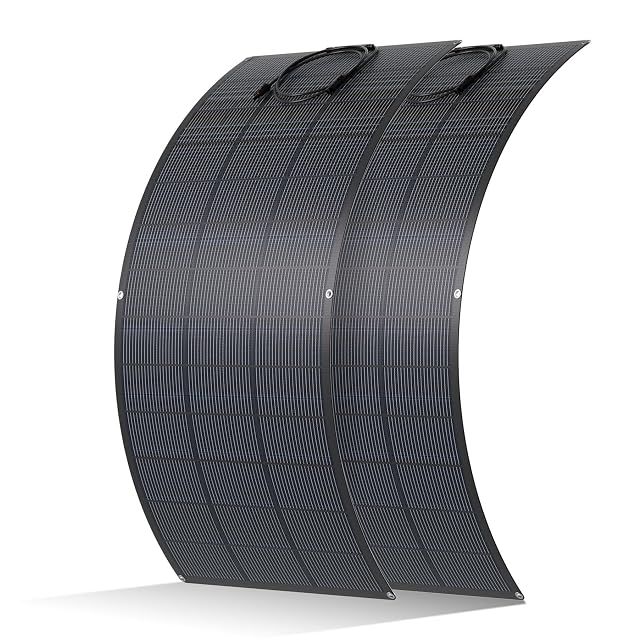
2 × 200 W peak · N-type 18-busbar cells, 25 % stated · voltages not published · temperature coefficient not published · frameless flexible · ETFE with 95 % transmission · dimensions not published · bypass diodes fitted
A pair of 200 W flexible ETFE panels with 18-busbar N-type cells and integrated bypass diodes, fitted with six stainless eyelets and six straps each.
Best for: A van roof or a curved cabin top where a framed module cannot sit flat.
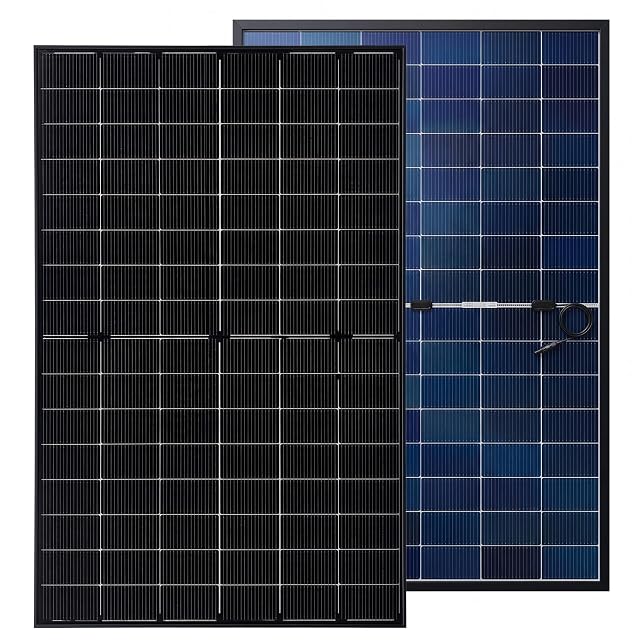
2 × 450 W peak · N-type half-cell 16BB SMBB · voltages not published · temperature coefficient not published · reinforced aluminium frame · 1.6 + 1.6 mm tempered double glass · 5400 Pa front, 2400 Pa rear · German fire class A · 30-year warranty · EL tested
A pair of 450 W bifacial N-type modules with 16 busbars and half cells, published with front and rear mechanical loads, a German fire class and a thirty-year warranty.
Best for: A snowy or windy site where the mechanical load figures are the deciding specification.
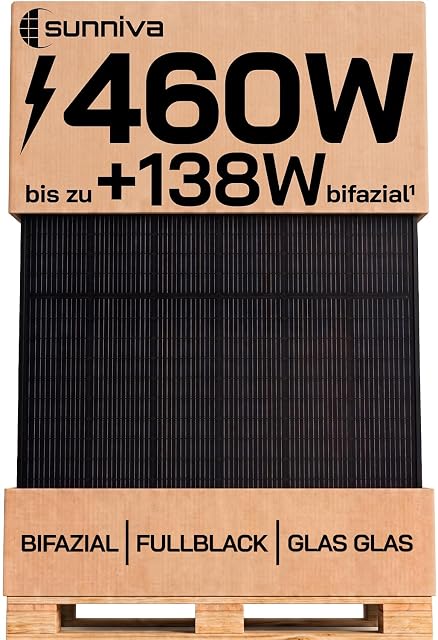
460 W peak · N-type TOPCon · voltages not published · temperature coefficient named but not given · black frame · double tempered glass · dimensions not published · IP68
A 460 W bifacial glass-glass module using N-type TOPCon cells in a full black finish, rated IP68, whose listing claims up to 30 % extra yield from the rear face.
Best for: A balcony rail or a flat roof where the rear face sees reflected light and the module will be bought on appearance.