A bag is a panel that has to survive being packed · review
enjoy solar Helios 200 W 12 V, 182 mm cells, 10 busbars review
A 200 W folding panel that publishes all five of its electrical figures — Pmax, Vmp, Imp, Voc and Isc — together with an operating range and two IEC certifications.
The bottom line The only folding panel in this catalogue that can be designed into a system on paper: five electrical figures, a maximum system voltage, an operating range and two named IEC standards. Everything else here publishes a wattage and asks to be trusted.
A 200 W folding panel with the specification sheet every other panel in this catalogue omits.
The five numbers
Pmax 200 W. Vmp 17.40 V. Imp 11.50 A. Voc 20.40 V. Isc 12.07 A. Plus a maximum system voltage of 200 V DC. Those are what a charge controller’s input window is checked against, and what a string calculation needs. Fourteen other panels in this catalogue publish a wattage and stop.
The certifications
TÜV certification to IEC 61215 and IEC 61730 — design qualification and construction safety, the pair that serious modules cite. And a positive tolerance of +3 %, making the rating a floor.
The construction
Patented polymer composite, hail tested, an IP67 junction box, and 4 mm² double-insulated solar cable terminating in MC4. That cable cross-section is published, which matters: it is what decides the loss on a run to the controller.
The operating range
−10 °C to +60 °C, published at both ends.
The two weaknesses
A three-year manufacturer warranty, against twenty-five and thirty years on the rigid modules here. And the folded dimensions, which the listing text cuts off mid-sentence.
Availability
German, French, Italian and Spanish Amazon stores quoted 160 € to 192 € when this page was compiled.
British Amazon store carries it too, priced in its own currency, which the euro range above deliberately omits.
American Amazon store returned nothing at all, so the buy button there runs a search instead of landing on an empty page.
These figures are what Keepa reported on the day this page was last updated. Availability and pricing move without notice.
Prices quoted in this text were read on 16 September 2026. The live price is at the top of the page.
What it gets right, and what it leaves out
Strengths
The only panel in this catalogue to publish Vmp, Imp, Voc and Isc — the four figures a controller input is checked against
IEC 61215 and IEC 61730 both named with TÜV certification and a +3 % positive tolerance
A maximum system voltage of 200 V DC is published, which is the figure a string calculation needs
Compromises
The folded dimensions are cut off in the listing text
No integrated controller, unlike two of its neighbours here
A three-year manufacturer warranty, which is short beside the rigid modules in this catalogue
Specifications
Peak wattage
200 W Pmax, third bullet
Panel count
Absent as a count; 182 mm cells with 10 busbars are named in the title
Construction
Patented polymer composite, hail tested, with an IP67 junction box and 4 mm² double-insulated solar cable, second bullet
Output connectors
MC4 solar connectors on 4 mm² double-insulated cable, second bullet
Any integrated controller
None — the panel is supplied with leads and connectors only
Folded size
Absent as a folded figure; the unfolded dimension is cut off in the listing
Weight
6.54 kg, first bullet
Stated weather resistance
IP67 junction box, hail test passed, and an operating range of −10 °C to +60 °C, second and third bullets; TÜV certified to IEC 61215 and IEC 61730, fifth bullet
Amazon reference
B0BFFQ75W9 (same reference on 5 Amazon marketplaces)
EAN
4260558573883
Questions owners ask about this one
Why do Voc and Isc matter more than the wattage?
Because a controller has a minimum starting voltage and a maximum input it must never see, and open-circuit voltage rises as cells get colder. Voc is what that ceiling is checked against, on the coldest clear morning the installation will meet. A panel that publishes only watts cannot be checked at all.
What does the +3 % tolerance mean?
That the module is warranted not to fall below its rating, and may exceed it by up to three per cent. It makes 200 W a floor rather than a nominal figure, which is the useful direction for a tolerance to run.
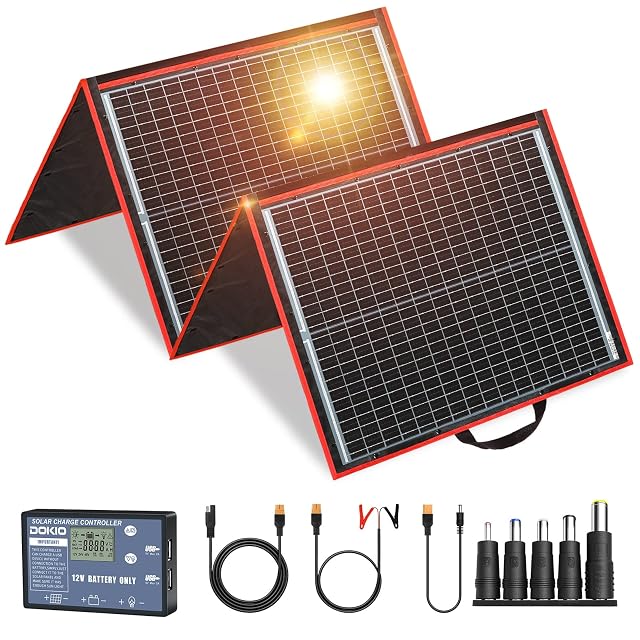
160 W peak · folding monocrystalline · integrated 12 V charge controller with 2 USB ports · USB outputs · controller protects against overload, short circuit, over-voltage and reverse polarity · folded size not published · weight not published · weather resistance not rated
A 160 W folding monocrystalline panel supplied with a 12 V charge controller carrying two USB ports and four named protections.
Best for: A 12 V battery on a boat or in a garden shed, where the supplied controller is the whole point.
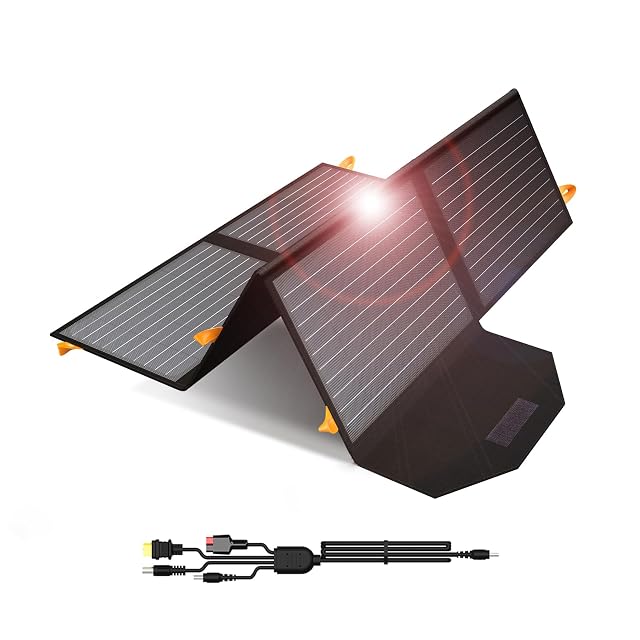
60 W peak · six-fold · PET surface over monocrystalline A+ cells · 3 USB and 1 DC output · no integrated controller · 35 × 23 × 5.6 cm folded · about 2.9 kg · waterproof, no rating code
A 60 W six-fold solar charger with three USB outputs and a DC output, whose listing states plainly that it delivers 30 to 40 W under light cloud.
Best for: Charging phones, a tablet and a small station directly, where honesty about cloudy-day output matters more than peak wattage.
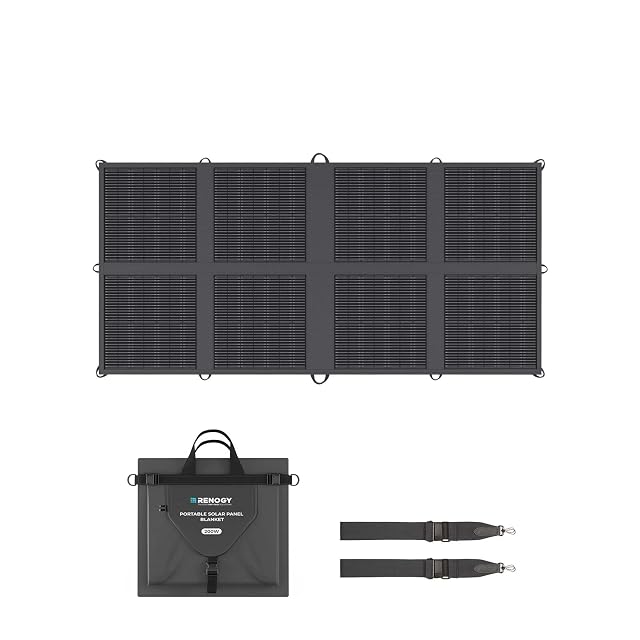
200 W peak · eight-fold · ETFE laminate · 2 m cable, 1 USB-C and 2 USB-A · no integrated controller · folds to rucksack size · 4 kg · IP65, −10 °C to 65 °C
A 200 W eight-fold solar blanket weighing 4 kg, with a 2 m lead for stations and 12 V or 24 V batteries plus three USB ports, rated IP65.
Best for: Anyone carrying a 200 W panel any distance, where every kilogram counts.