A kit is a station and a panel that agree on volts and amps · review
FF FLASHFISH 144.3 Wh station with a 60 W folding panel review
A 144.3 Wh station bundled with a 60 W monocrystalline panel quoted at 21.5 to 23.5 % efficiency, rated 200 W continuous with a 400 W peak and a published operating range.
The bottom line The better-documented of the two small bundles here: a solar charging time for the panel supplied, an operating range, and a plain statement that pass-through use is not possible. The efficiency percentage without its conditions is decoration; the rest of the sheet is not.
A 144 Wh station bundled with a 60 W folding panel, and the most complete small bundle on this page.
What the bundle publishes
A 4 to 5 hour solar charge from the panel actually supplied — which is the only form of that claim worth anything, since a time quoted for an unnamed panel cannot be checked. An operating range of −10 °C to 45 °C. A total weight of 3.9 kg split between the two parts.
The limitation stated outright
The station cannot charge and discharge simultaneously. That removes pass-through use, and it is the kind of constraint most listings leave to a review to discover. Here it is in the second bullet, in capitals.
Output
200 W continuous with a 400 W peak, over a mains socket, 12 V DC and 18 W USB QC ports. The peak carries no duration, as everywhere on this shelf.
Where the panel figure stops short
21.5 to 23.5 % IPCE describes the cells. A panel’s useful rating is its peak wattage under defined test conditions, and those conditions are not published here. The 60 W stands as a laboratory figure without its laboratory.
Availability
German, French, Italian and Spanish Amazon stores quoted 180 € to 200 € when this page was compiled.
British Amazon catalogue carries an entry for it, with nobody selling.
American Amazon store returned nothing at all, so the buy button there runs a search instead of landing on an empty page.
These figures are what Keepa reported on the day this page was last updated. Availability and pricing move without notice.
Prices quoted in this text were read on 16 September 2026. The live price is at the top of the page.
What it gets right, and what it leaves out
Strengths
A solar charging time is published for the panel actually supplied, rather than for a hypothetical one
An operating range of −10 °C to 45 °C is stated, which most bundles omit
The panel is described as ETFE-coated and weather-resistant, with its folded weight given
Compromises
The second bullet states the station cannot charge and discharge at the same time, which rules out pass-through use
The 60 W figure has an efficiency percentage but no test conditions
Over 1000 cycles is claimed with no capacity percentage
Specifications
Station capacity
144.3 Wh, first bullet; no usable figure is published
Panel rating and test conditions
60 W monocrystalline with a stated 21.5–23.5 % IPCE, third bullet; no irradiance or cell temperature is given
Input window
Absent as a voltage range; the panel charges the station over QC3.0 and USB-C, third bullet
Connectors
QC3.0 and USB-C from the panel, third bullet; a cigarette-lighter adapter and car lead are included, second bullet
Recharge time
4 to 5 hours from the bundled panel, third bullet
Bundle contents
Station, TSP60 panel, mains adapter, car lead and manual; 3.9 kg total, of which 2 kg station and 1.9 kg panel, fifth bullet
Amazon reference
B0FSR5GDJY (same reference on 5 Amazon marketplaces)
EAN
0607615042571
Questions owners ask about this one
Why does “cannot charge and discharge at the same time” matter?
Because it rules out leaving the station on solar while something is plugged in — a common way to use one. The listing states it plainly in the second bullet, which is better than leaving it to be discovered.
Is a 21.5–23.5 % efficiency figure useful?
It describes the cells rather than the output, and it is quoted without the conditions it was measured under. It tells you the cell type is a current one; it does not predict what the panel will deliver on a given morning.
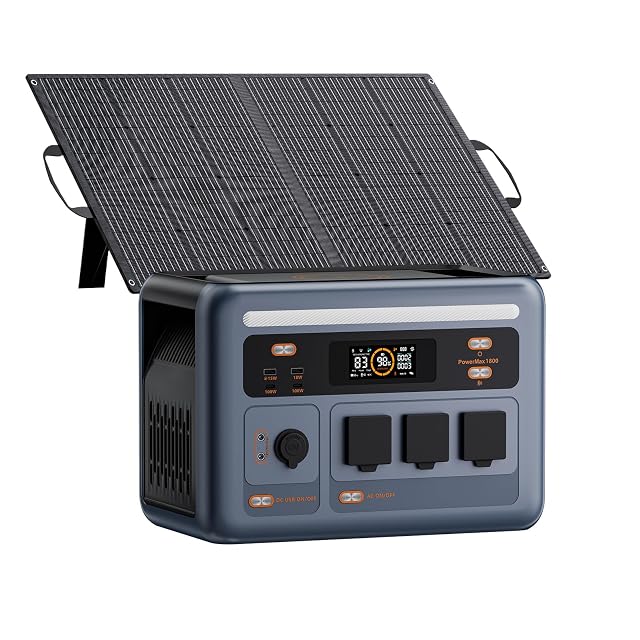
1024 Wh station · 100 W panel, no test conditions stated · 1800 W rated · 800 W solar input, full in 1.5 h · 11 outputs · 14 kg · 7-year warranty
A 1024 Wh LiFePO4 station bundled with a 100 W panel, rated 1800 W across eleven outputs, with an 800 W solar input ceiling and a stated seven-year warranty.
Best for: A household backup where the 100 W panel is a starting point and more panels will follow.
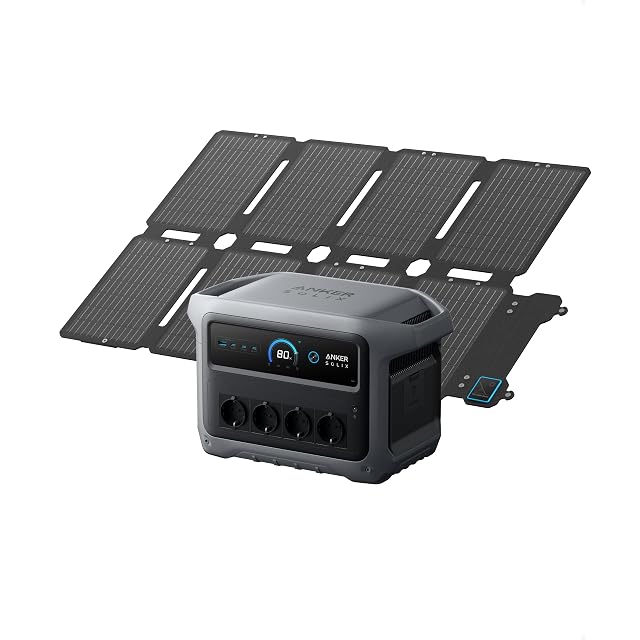
1024 Wh station · 100 W folding panel, no test conditions stated · 2000 W continuous, 3000 W peak · 600 W solar at 60 V max · 4000 cycles to 80 % · 10 ms UPS
The SOLIX C1000 Gen 2 sold with a 100 W folding panel: 1024 Wh, 2000 W continuous, a 600 W solar ceiling capped at 60 V, and 4000 cycles to 80 % capacity.
Best for: Someone buying the station for household backup who wants one panel now and the option of five more later.
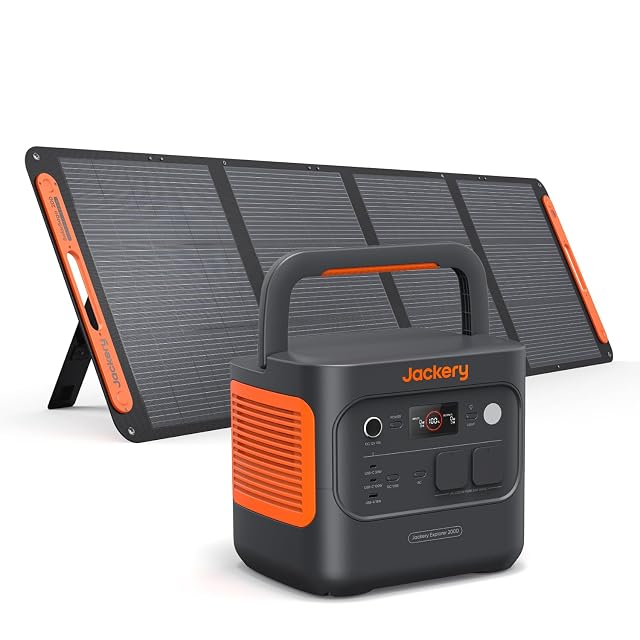
2042 Wh station · 200 W panel, no test conditions stated · 2200 W across 2 AC outlets · 80 % in 52 min · 5.5 h solar at 400 W · 20 ms UPS · 17.5 kg · under 30 dB
A 2042 Wh LiFePO4 station bundled with a 200 W panel, rated 2200 W across two mains outlets, reaching 80 % in a stated 52 minutes and offering a 20 ms uninterruptible switchover.
Best for: A household that wants 2 kWh of backup and expects to add a second panel before the first winter.