A kit is a station and a panel that agree on volts and amps · review
powkey 97.68 Wh station with a 40 W folding panel review
A 97.68 Wh station sold with a 40 W folding panel, six outputs and a 100 W mains ceiling, whose own listing warns that the panel may charge considerably more slowly than expected.
The bottom line A small bundle whose listing does something almost nothing else here does: it warns that its own panel may disappoint. What it does not do is publish the test conditions or the connector, which are the two things that would let the panel be compared or reused.
A sub-100 Wh station sold with a folding 40 W panel, and a listing that is unusually frank about the panel.
The warning the maker wrote itself
The last note states that the real charging rate of the 40 W panel may be considerably slower than expected, and asks the buyer to plan for it. That is the maker describing standard test conditions without naming them: a panel rating is measured under an irradiance and a cell temperature that a campsite does not reproduce.
What the bundle contains
The station, the panel, a mains adapter at 15 V/2.4 A and a car charger at 12 V/2 A. Both weights are published — 1.3 kg and 1.45 kg — and the panel’s folded dimensions are given.
The lines this listing leaves blank
No test conditions for the 40 W figure, so it cannot be set beside another panel. No connector type, so the panel cannot be placed against another station. No input voltage window, which is the specification that decides whether any other panel would charge this station at all.
The ceiling
100 W on the mains output, and the second bullet names kettles, curling tongs and compressors as excluded. As with the smallest stations here, the honest description is a charger for electronics rather than a supply for appliances.
Availability
German, French, Italian and Spanish Amazon stores quoted 174 € to 215 € when this page was compiled.
British Amazon catalogue carries an entry for it, with nobody selling.
American Amazon store returned nothing at all, so the buy button there runs a search instead of landing on an empty page.
These figures are what Keepa reported on the day this page was last updated. Availability and pricing move without notice.
Prices quoted in this text were read on 16 September 2026. The live price is at the top of the page.
What it gets right, and what it leaves out
Strengths
The listing warns in its own words that the 40 W panel may charge much more slowly than expected — a rare piece of honesty on this shelf
Both weights are published separately, 1.3 kg for the station and 1.45 kg for the panel
MPPT is named rather than a simpler regulator
Compromises
No test conditions for the 40 W rating, so the number cannot be compared with another panel
No connector type is named, which is what decides whether the panel works with anything else
The 100 W mains ceiling excludes anything that heats, which the second bullet states
Specifications
Station capacity
97.68 Wh, first bullet; no usable figure is published
Panel rating and test conditions
40 W, named in the fifth bullet; no test conditions are stated anywhere
Input window
Absent as a voltage range — the listing gives a 15 V/2.4 A mains adapter and a 12 V/2 A car charger, fifth bullet
Connectors
Not named; the panel is described as connecting to the station without the connector type being stated
Recharge time
Absent for the panel; the listing gives no solar charging time and warns the real rate may be slower than expected
Bundle contents
Station, 40 W folding panel, mains adapter and car charger, fifth bullet; the panel folds to 36.5 × 20.5 × 4 cm at 1.45 kg
Amazon reference
B0CPLY3Y2S (same reference on 5 Amazon marketplaces)
EAN
0764046731723
Questions owners ask about this one
How much does a 40 W panel actually deliver?
Less than 40 W, and how much less depends on the sky, the angle and the cell temperature — none of which the listing states, because it publishes no test conditions. The maker itself says the real rate may be considerably slower than expected, which is the most useful sentence on the page.
Can the panel be used with another station?
That depends on the connector and the input window, and this listing names neither. Without both, compatibility with anything outside the bundle cannot be read from the page.
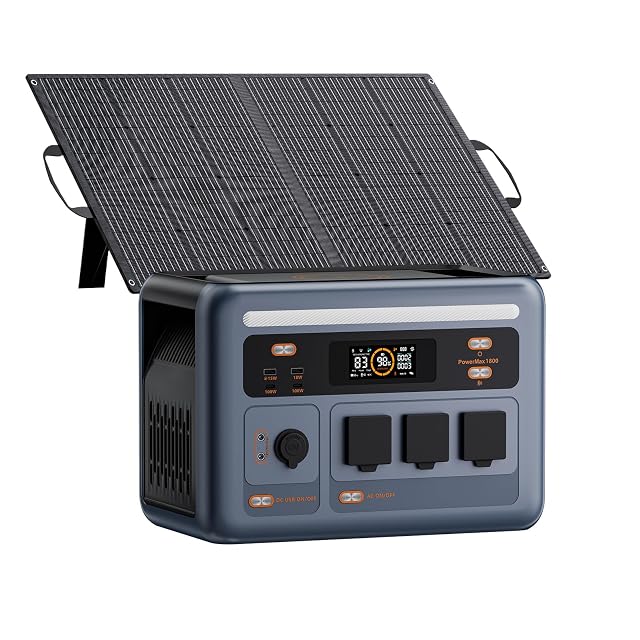
1024 Wh station · 100 W panel, no test conditions stated · 1800 W rated · 800 W solar input, full in 1.5 h · 11 outputs · 14 kg · 7-year warranty
A 1024 Wh LiFePO4 station bundled with a 100 W panel, rated 1800 W across eleven outputs, with an 800 W solar input ceiling and a stated seven-year warranty.
Best for: A household backup where the 100 W panel is a starting point and more panels will follow.
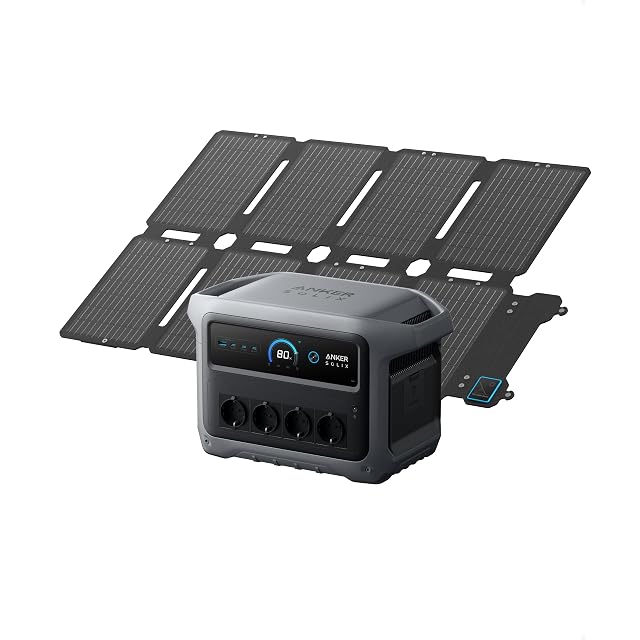
1024 Wh station · 100 W folding panel, no test conditions stated · 2000 W continuous, 3000 W peak · 600 W solar at 60 V max · 4000 cycles to 80 % · 10 ms UPS
The SOLIX C1000 Gen 2 sold with a 100 W folding panel: 1024 Wh, 2000 W continuous, a 600 W solar ceiling capped at 60 V, and 4000 cycles to 80 % capacity.
Best for: Someone buying the station for household backup who wants one panel now and the option of five more later.
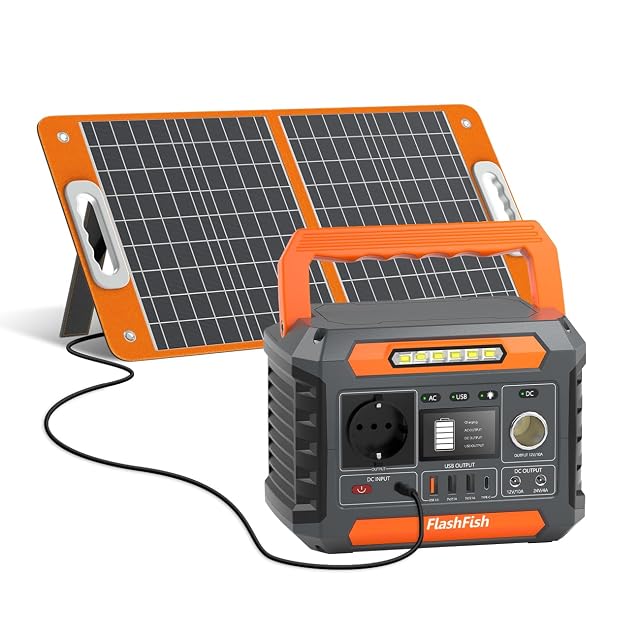
144.3 Wh station · 60 W monocrystalline panel, 21.5–23.5 % IPCE · 200 W continuous, 400 W peak · 4–5 h solar charge · −10 °C to 45 °C · 3.9 kg total
A 144.3 Wh station bundled with a 60 W monocrystalline panel quoted at 21.5 to 23.5 % efficiency, rated 200 W continuous with a 400 W peak and a published operating range.
Best for: A camping setup where the station is charged during the day and used in the evening, never both at once.