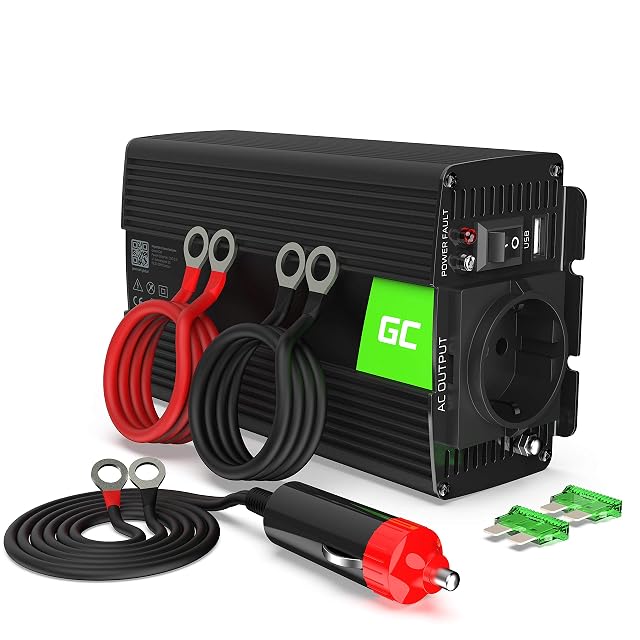
The bottom line The plainest-speaking converter in this family: a named waveform and a capitalised list of what not to plug in. It names two fuses and rates neither, and publishes no input current for the cable that feeds it.
A 300 W converter that tells you what it will not do.
The bullet that prevents a return
Capitalised in the first line: not for kettles, coffee machines, curling tongs, heaters or hair dryers. Those are exactly the appliances someone buys a converter for and exactly the ones a 300 W unit cannot run. Five of the seven converters here leave the buyer to find out.
The waveform, named
Modified sine, in the second bullet. Three of the seven converters in this family name their waveform; the others let the reader assume. On a converter this size the distinction matters for motors and for some chargers.
The charging that bypasses the conversion
USB-C and USB-A at 3 A, up to three devices at once. Anything charged there never passes through the inverter stage, which is the efficient way to use a small converter.
What is named without a number
Two fuses, internal and external, with no rating for either. The fuse rating is what sizes the cable from the battery, and the BESTEK pure sine wave inverter elsewhere in this catalogue publishes its 40 A. This one does not.
Availability
German, French, Italian and Spanish Amazon stores quoted about 35 € when this page was compiled.
American and British Amazon catalogues carry an entry for it, with nobody selling.
These figures are what Keepa reported on the day this page was last updated. Availability and pricing move without notice.
Prices quoted in this text were read on 16 September 2026. The live price is at the top of the page.
What it gets right, and what it leaves out
Strengths
The first bullet states in capitals that it is NOT for kettles, coffee machines, curling tongs, heaters or hair dryers
The waveform is named as modified sine rather than left to be discovered
USB-C and USB-A at 3 A charge three devices at once without the inverter stage
Compromises
Both fuses are named and neither is rated
No input current, so the cable feeding it cannot be sized
No idle consumption, as on every converter in this family
Specifications
Output power
300 W, first bullet
Waveform
Modified sine, second bullet — stated plainly rather than left implied
Input current
Nowhere in the listing
Recommended cable
Nowhere in the listing
Fusing
Built-in and external fuses named, fourth bullet; no rating is given
Mounting
Nowhere in the listing — described as compact and portable
Remote control
None
Protections
Short circuit, overload, over-voltage, under-voltage and over-temperature with automatic shutdown, fourth bullet
Amazon reference
B072V4XPKL (same reference on 6 Amazon marketplaces)
EAN
0842167110273
Questions owners ask about this one
Why does naming the excluded appliances matter?
Because a 300 W converter and a hair dryer are separated by a factor of five or more, and a buyer choosing on the socket rather than the wattage will find out by tripping it. Two converters in this family say so; five do not.
What does modified sine mean here?
A stepped approximation of the mains waveform rather than a smooth one. It suits heating elements and simple electronics; motors run hotter on it, and some chargers and medical devices specify a true sine supply.
500 W continuous, 1000 W peak · PURE sine, unusually for this family · input current not published · cable not specified · fusing not published · no mounting described · no remote · protections claimed without a list
A 500 W pure sine converter with a 1000 W short-term peak and a USB port — a true sine unit sold under the general converter term rather than in the sine wave family.
Best for: Someone who wants a true sine output at converter money and will accept an unspecified sheet.
900 W continuous, 2000 W peak · modified sine · input current not published · cable not specified · fusing not published · battery clamps or cigarette lighter · no remote · over-heating, overload, over and under-voltage, over-current, short circuit, over-charge
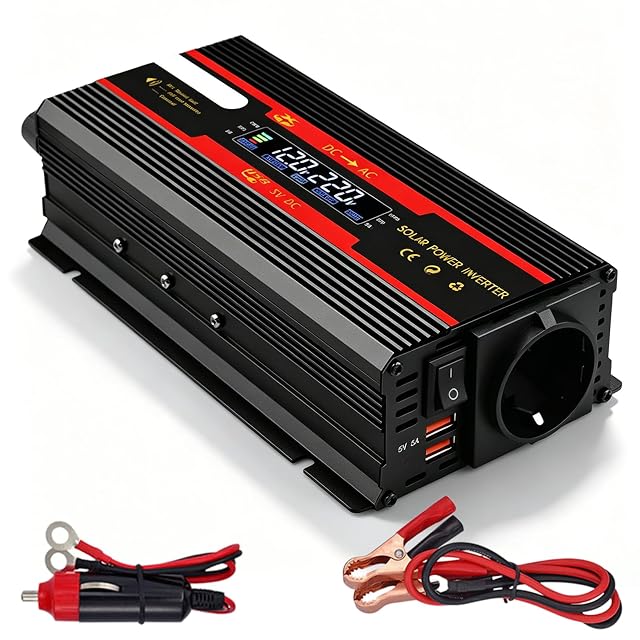
A converter titled 2000 W that delivers 900 W continuously, accepting both 12 V and 24 V input, connectable by battery clamps or a cigarette lighter plug.
Best for: A 24 V vehicle where the clamps go straight to the battery and the socket lead stays in the box.
1500 W continuous, 3000 W peak held for at least 20 ms · modified sine · input current not published · connection cables included · fusing not published · no mounting described · remote NOT fitted · overload, short circuit, reverse polarity, over and under-voltage
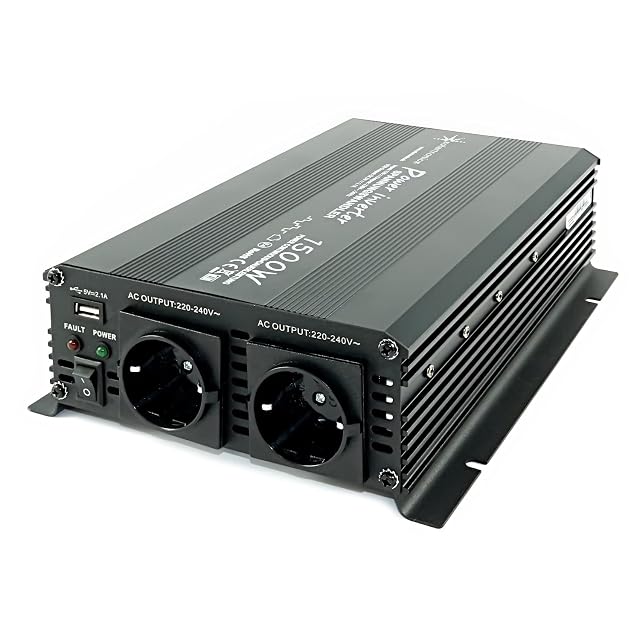
A 1500 W modified sine converter for lead, AGM and gel batteries, and the only product in this catalogue to publish the duration of its peak — at least 20 ms.
Best for: Starting a motor load from a lead-acid or AGM bank, where the peak duration is the deciding figure.