What matters is what stays on, and for how long · review
NECESPOW 483.84 Wh LiFePO4, 700 W continuous, 1400 W peak review
A 483.84 Wh LiFePO4 station rated 700 W continuous with three mains sockets, a 100 W USB-C output and a solar input specified as 12 to 28 V up to 180 W.
The bottom line The only genuinely indoor product in this family, with a solar input window published rather than a bare wattage. It says twice that its battery goes dormant if left, and never says how to wake it.
A 484 Wh LiFePO4 station in a family otherwise made of engines.
What it is, against what it sits beside
A battery, an inverter and sockets in a box. No fuel, no exhaust, no noise. The two other products in this family are petrol generators, and the only thing all three share is the question they answer.
The input window
12 to 28 V, 7.5 A, up to 180 W of solar, with a full charge in as little as 3.5 hours. Publishing the voltage range as well as the wattage is what makes a panel checkable before purchase, and most stations in this catalogue publish only watts.
The warning, given twice
A LiFePO4 pack left unused enters a dormant state and its capacity reads far below normal. Two of the five bullets say so. Neither says what to do — whether it recovers on charge, or whether a procedure is needed. That question belongs to the manual.
What a backup supply should publish and does not
A transfer time. This is sold to keep things running when the mains fails, and how long the output is interrupted while it takes over is the figure that decides whether a computer restarts. It is absent.
Availability
German, Italian and Spanish Amazon stores quoted 246 € to 350 € when this page was compiled.
French Amazon store wanted more than 1.6× what the cheapest country wanted. A margin that wide usually means stock shipped in from elsewhere rather than a seller on the ground, so that quote stays out of the range above.
British Amazon catalogue carries an entry for it, with nobody selling.
American Amazon store returned nothing at all, so the buy button there runs a search instead of landing on an empty page.
These figures are what Keepa reported on the day this page was last updated. Availability and pricing move without notice.
Prices quoted in this text were read on 16 September 2026. The live price is at the top of the page.
What it gets right, and what it leaves out
Strengths
The solar input is published as a voltage window — 12 to 28 V at 7.5 A — not only as a wattage
Three mains sockets, more than most stations of this size
The listing warns twice that a LiFePO4 pack enters a dormant state if left unused for a long time
Compromises
No transfer time, on a product sold as a backup supply
No usable capacity figure
The dormancy warning is given twice and the recovery procedure is not described
Specifications
Capacity
483.84 Wh, from the title; no usable figure is published
Continuous output
700 W continuous with a 1400 W peak, first bullet; the peak carries no duration
Transfer time
Nowhere in the listing
Supported circuits
Three 230 V 50 Hz mains sockets, one USB-C PD at 100 W, one USB PD at 18 W and two USB-A QC3.0, first bullet — appliances plug in directly, nothing is wired
Recharge sources
Mains, and solar at 12 to 28 V and 7.5 A up to 180 W, full in as little as 3.5 hours, third bullet — a published input WINDOW, not only a wattage
Noise
Absent as a figure; a battery station has no engine
Stated indoor use
Not stated explicitly; a LiFePO4 station with no exhaust is an indoor product by construction
Amazon reference
B0B717KPKY (same reference on 5 Amazon marketplaces)
EAN
0797444464597
Questions owners ask about this one
What is the dormant state the listing warns about?
A LiFePO4 pack left unused drifts down and its management system eventually disconnects, at which point the battery appears empty and may not accept charge normally. The listing says this happens; it does not say what to do about it, which is a question for the manual.
Why is the solar voltage window important?
Because a panel string below the minimum will not start the charger and one above the maximum risks the input. Publishing 12 to 28 V lets a panel be checked before it is bought — and open-circuit voltage rises in cold weather, so the check is against the cold case.
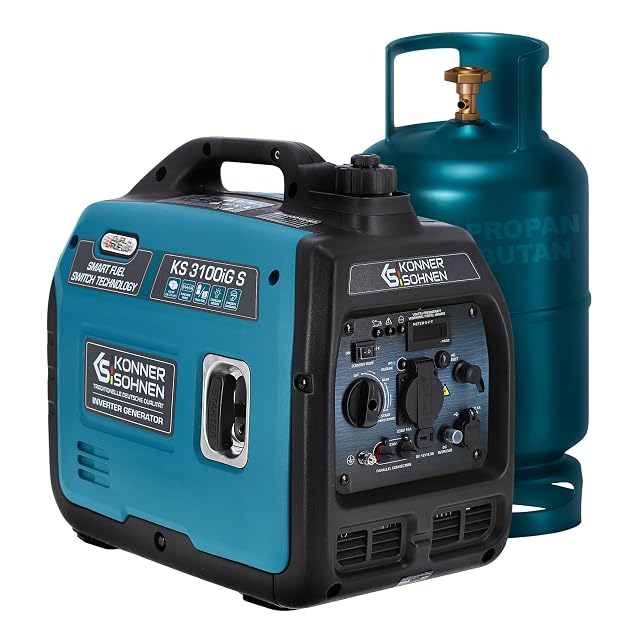
tank not published · 3100 W, 230 V 50 Hz sine from a microprocessor-controlled inverter module · transfer time not applicable · 16 A socket, 2 USB at 5 V/1 A and 5 V/2.1 A · petrol or LPG, everything for gas supplied · 63 dB Lpa at 7 m, distance STATED · outdoor machine, manual governs
A 3100 W dual-fuel inverter generator supplied with everything needed to run on LPG, quoted at 63 dB Lpa at 7 metres, with parallel cables included and an eco mode saving up to 50 % of fuel.
Best for: A household backup kept for years between uses, where bottled gas avoids stale petrol.
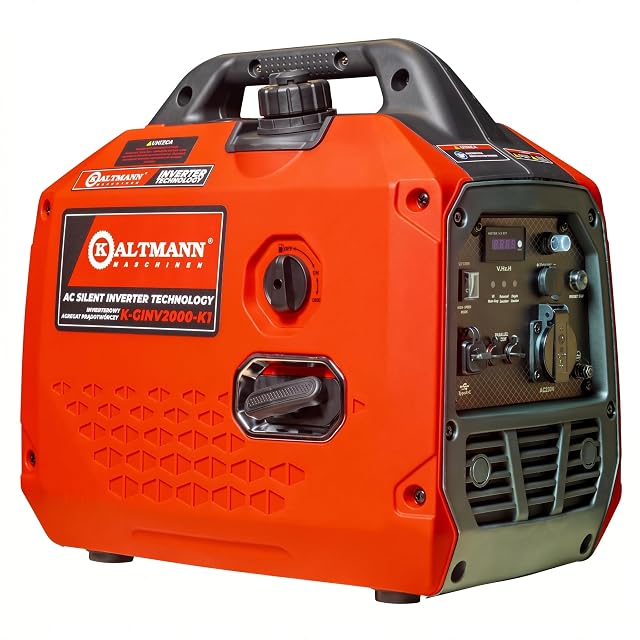
tank 5.6 l · 1800 W continuous, 2000 W peak, pure sine · transfer time not applicable — a generator, not a UPS · 230 V socket, USB-A, USB-C, 12 V DC · petrol, parallel operation with a second unit · 45–50 dB at about 7 m, distance STATED · outdoor machine, manual governs
A 2000 W peak inverter generator with a 5.6 litre tank, up to six hours in eco mode, parallel operation with a second unit, and a noise figure published with its distance.
Best for: A camping pitch or a garden where noise at the boundary is the constraint.
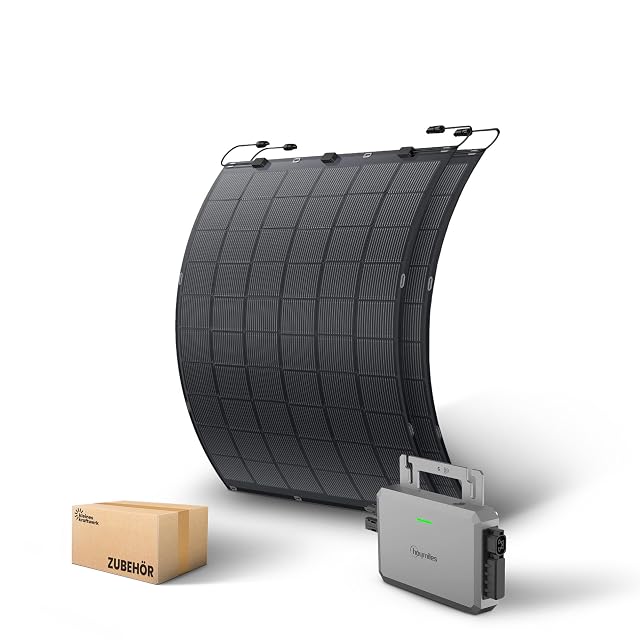
2 × 225 W flexible, 115.9 × 100.9 × 0.3 cm each · 800 W micro-inverter · cap not stated · 5 m connection cable, socket type not named · metal cable ties supplied, no drilling · app-readable inverter · registration duties not stated
A 450 Wp flexible balcony kit with two ultra-thin modules fixed by metal cable ties rather than brackets, and an 800 W micro-inverter readable from an application.
Best for: A rented balcony with an unusual shape, where nothing may be drilled and the fixings have to come in the box.