A smart alternator will not fill a second battery on its own · review
ECTIVE BB 20C PRO, 20 A adjustable, 12 V to 12 V review
A 20 A DC-DC charger with the output current selectable at 5, 10, 15 or 20 A, Bluetooth monitoring and both CI-Bus and CAN-Bus interfaces for integration into a caravan system.
The bottom line The only DC-DC charger here whose current can be set to suit the bank, with a published capacity range and two bus interfaces. It has no solar input and describes no engine detection, both of which cheaper units in this family provide.
A 20 A charger built to fit into a caravan rather than beside one.
The current, chosen rather than fixed
5, 10, 15 or 20 A. Every other DC-DC charger in this family has one output current. A 100 Ah LiFePO4 bank and a 30 Ah one want different charge rates, and this is the only unit here that lets the installer set it.
The capacity range, published
10 to 200 Ah recommended. Six chargers here and one states which banks it suits. Combined with the four current steps, that turns a compatibility question into an arithmetic one.
The bus interfaces
CI-Bus and CAN-Bus, for integration into an existing system. A caravan with a habitation control panel can show the charger’s state there rather than requiring a separate application.
What it costs
No solar input, which two cheaper chargers in this family include, and no published engine detection. For a caravan towed by a modern vehicle, that second question needs the manual.
Availability
German Amazon store quoted about 199 € when this page was compiled.
American, British, French, Italian and Spanish Amazon catalogues carry an entry for it, with nobody selling.
These figures are what Keepa reported on the day this page was last updated. Availability and pricing move without notice.
Prices quoted in this text were read on 16 September 2026. The live price is at the top of the page.
What it gets right, and what it leaves out
Strengths
The output current is selectable in four steps, so a small bank is not charged harder than it should be
A recommended bank capacity range is published — 10 to 200 Ah — which nothing else here gives
CI-Bus and CAN-Bus interfaces for integration into an existing caravan system
Compromises
No solar input, on a unit priced above two chargers that have one
No engine detection mechanism described
No enclosure rating, cable size or fuse specification
Specifications
Output current
Selectable at 5, 10, 15 or 20 A, second bullet — the only charger here with a user-set current
Input range
12 V to 12 V, from the title; no voltage range is published
Engine detection
Absent as a described mechanism; the first bullet refers to controlled charging while driving
Profiles
AGM, gel, flooded and LiFePO4, third bullet, for recommended bank capacities of 10 to 200 Ah
Solar input
None
Cable
Nowhere in the listing
Fuse requirements
Nowhere in the listing
Heat management
Nowhere in the listing
Amazon reference
B0GJTMWMMX (same reference on 6 Amazon marketplaces)
EAN
4260725127536
Questions owners ask about this one
Why select a lower charge current?
Because a battery has a maximum charge current of its own, and a small bank behind a 20 A charger may be charged harder than its maker permits. The recommended range of 10 to 200 Ah, published with four current steps, lets the two be matched.
What do CI-Bus and CAN-Bus add?
They let the charger report into a caravan’s existing control system rather than only to a phone. On a vehicle where the habitation panel already shows battery state, that is the difference between one display and two.
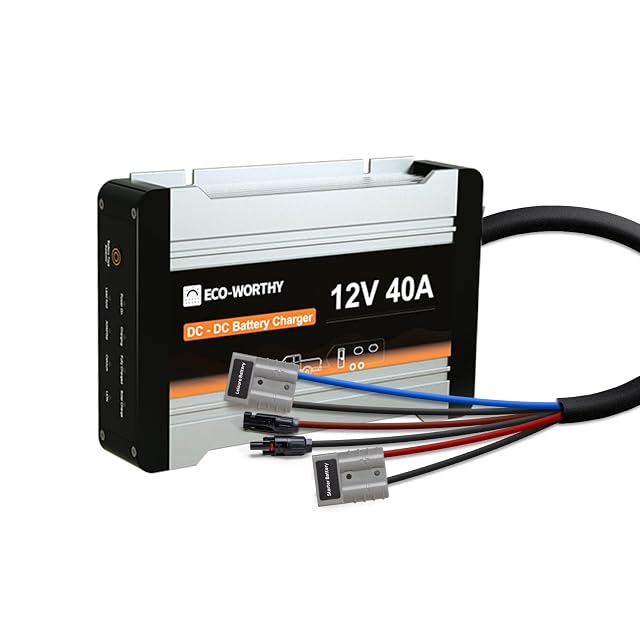
40 A output · 12 V dual input · engine detection not described · multi-stage with charge memory · MPPT solar input at 99 % tracking · cable not specified · fuse requirements not published · IP65
A 40 A DC-DC charger with two inputs — alternator and solar — an integrated MPPT controller at 99 % tracking efficiency, and an IP65 housing.
Best for: A motorhome locker where the charger will be exposed to damp and has to handle both the alternator and a roof panel.
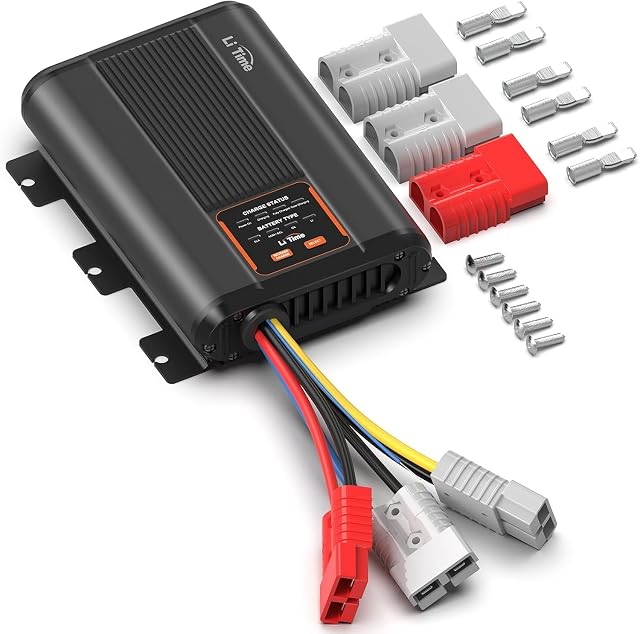
40 A output · 14.6 V output voltage published · ACC cable for smart and conventional alternators · LiFePO4, AGM, gel, SLA and calcium · MPPT solar at 99 % tracking · cable not specified · fuse requirements not published · NOT waterproof, stated
A 40 A DC-DC charger with a published 14.6 V output, an ACC cable for both smart and conventional alternators, an integrated MPPT input, and a warning that it is not waterproof.
Best for: A van with a recent engine, where the alternator is variable and the unit will live inside the habitation space.
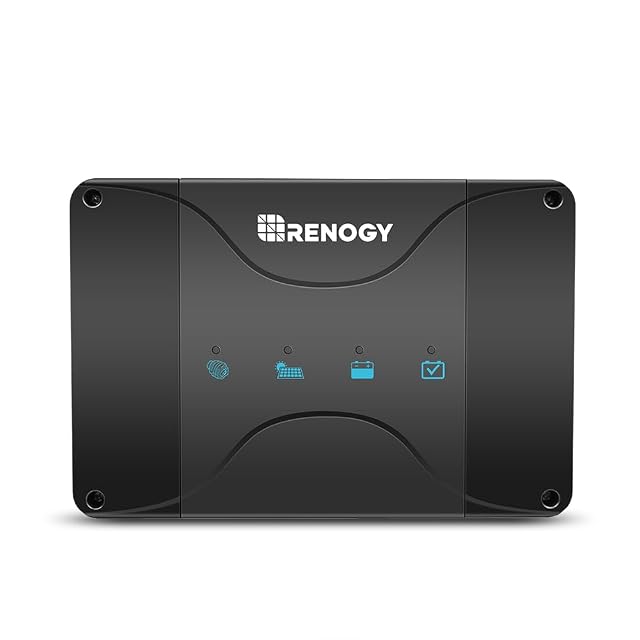
50 A output · dual charging from alternator or solar · engine detection not described · LiFePO4 named · three-stage MPPT solar input · cable not specified · fuse requirements not published · removable side cover over the terminals
A 50 A DC-DC charger with three-stage MPPT solar charging, CE, FCC and RoHS certification, and a removable side cover that shields the terminals in transit.
Best for: A large lithium bank that has to fill quickly on a short drive.