A smart alternator will not fill a second battery on its own · review
Renogy 50 A DC-DC with three-stage MPPT, 12 V review
A 50 A DC-DC charger with three-stage MPPT solar charging, CE, FCC and RoHS certification, and a removable side cover that shields the terminals in transit.
The bottom line The largest DC-DC charger here, with three-stage MPPT and a sensible terminal cover. It names one chemistry, describes no engine detection, and lists certifications that describe market access rather than performance.
A 50 A charger for banks that need filling on a short drive.
The current
50 A, the highest in this family and two and a half times the smallest. On a large LiFePO4 bank, that is the difference between arriving with a full battery and arriving with half of one.
It is also a substantial load on an alternator, and the listing says nothing about that — the vehicle maker’s rating is where the answer lives.
Two sources, three stages
Alternator or solar, with three-stage MPPT on the solar side. Three-stage means bulk, absorption and float rather than a single charging mode, which is what a lithium bank actually wants.
The cover
A removable side cover over the terminals, described as preventing contact during transport and daily use. Small, practical and rarely mentioned by anyone else here.
The certifications, read properly
CE, FCC and RoHS. The first is a manufacturer’s declaration of EU market access; the second is a United States electromagnetic compatibility rule; the third restricts hazardous substances. None describes how well the charger charges.
Availability
German, French, Italian and Spanish Amazon stores quoted 222 € to 238 € when this page was compiled.
British Amazon store carries it too, priced in its own currency, which the euro range above deliberately omits.
American Amazon store returned nothing at all, so the buy button there runs a search instead of landing on an empty page.
These figures are what Keepa reported on the day this page was last updated. Availability and pricing move without notice.
Prices quoted in this text were read on 16 September 2026. The live price is at the top of the page.
What it gets right, and what it leaves out
Strengths
The highest output current in this family at 50 A
Three-stage MPPT rather than a simple solar input
A removable terminal cover, described as preventing contact during transport and use
Compromises
No engine detection described, on a 50 A unit that will load an alternator heavily
Only LiFePO4 is named — other chemistries are implied rather than listed
CE, FCC and RoHS are market access and materials rules rather than performance certifications
Specifications
Output current
50 A, from the title — the highest in this family
Input range
Charges from the starter battery through the alternator or directly from a solar panel, first bullet; no voltage range is published
Engine detection
Nowhere in the listing
Profiles
LiFePO4 named in the second and third bullets; other chemistries are not listed individually
Solar input
Integrated three-stage MPPT charging, second bullet
Cable
Nowhere in the listing
Fuse requirements
Nowhere in the listing
Heat management
Absent as a figure; a removable side cover prevents contact with the terminals, fourth bullet
Amazon reference
B07SJGLGY8 (same reference on 5 Amazon marketplaces)
EAN
0810009713050
Questions owners ask about this one
Does 50 A put strain on an alternator?
It draws substantially more than a smaller charger, and an alternator has its own rating and its own cooling. Whether a particular vehicle tolerates it is a question for the vehicle maker, and this listing does not address it.
What is a terminal cover for?
It stops anything touching the connections, in transit and in use. On a unit carrying 50 A in a van locker where tools and equipment move around, that is a practical guard rather than a specification.
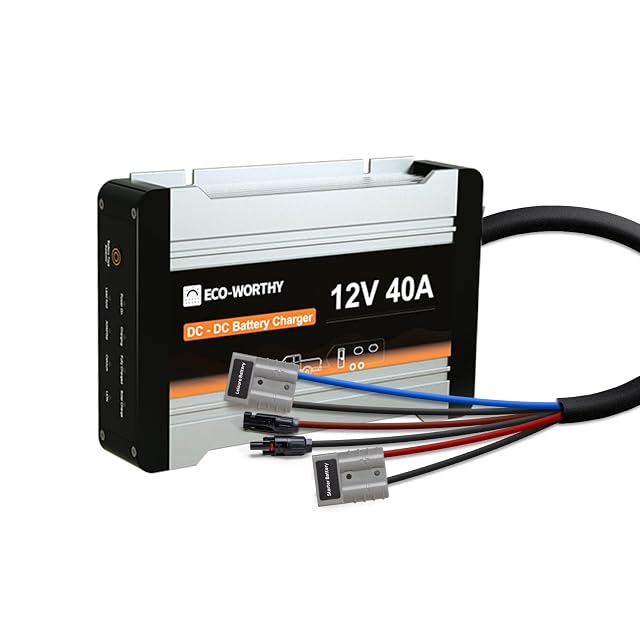
40 A output · 12 V dual input · engine detection not described · multi-stage with charge memory · MPPT solar input at 99 % tracking · cable not specified · fuse requirements not published · IP65
A 40 A DC-DC charger with two inputs — alternator and solar — an integrated MPPT controller at 99 % tracking efficiency, and an IP65 housing.
Best for: A motorhome locker where the charger will be exposed to damp and has to handle both the alternator and a roof panel.
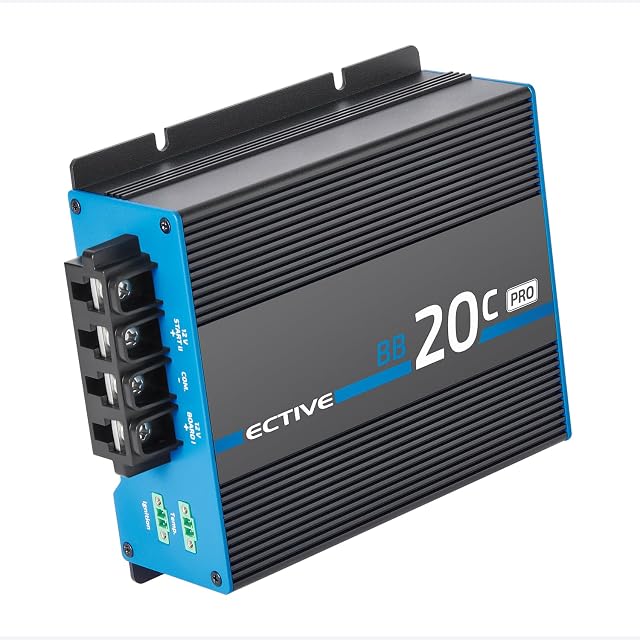
5, 10, 15 or 20 A selectable · 12 V to 12 V · engine detection not described · AGM, gel, flooded and LiFePO4, for 10–200 Ah banks · no solar input · cable not specified · fuse requirements not published · Bluetooth, CI-Bus and CAN-Bus
A 20 A DC-DC charger with the output current selectable at 5, 10, 15 or 20 A, Bluetooth monitoring and both CI-Bus and CAN-Bus interfaces for integration into a caravan system.
Best for: A caravan with an existing bus system, where the charger should report into it rather than stand alone.
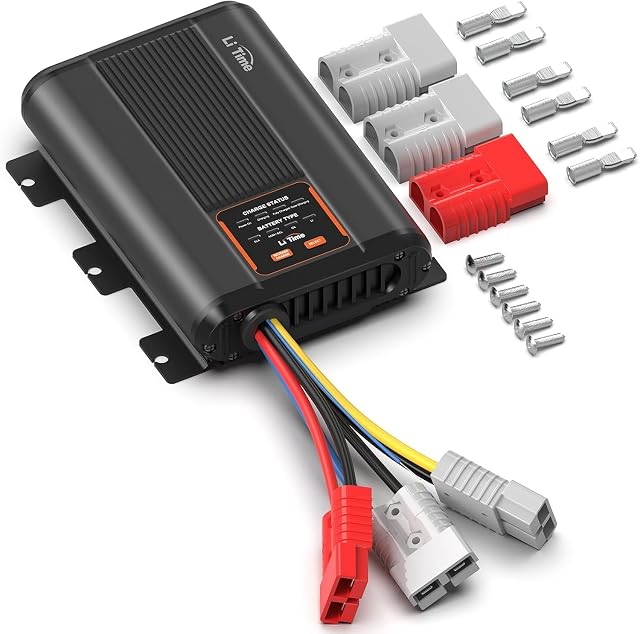
40 A output · 14.6 V output voltage published · ACC cable for smart and conventional alternators · LiFePO4, AGM, gel, SLA and calcium · MPPT solar at 99 % tracking · cable not specified · fuse requirements not published · NOT waterproof, stated
A 40 A DC-DC charger with a published 14.6 V output, an ACC cable for both smart and conventional alternators, an integrated MPPT input, and a warning that it is not waterproof.
Best for: A van with a recent engine, where the alternator is variable and the unit will live inside the habitation space.