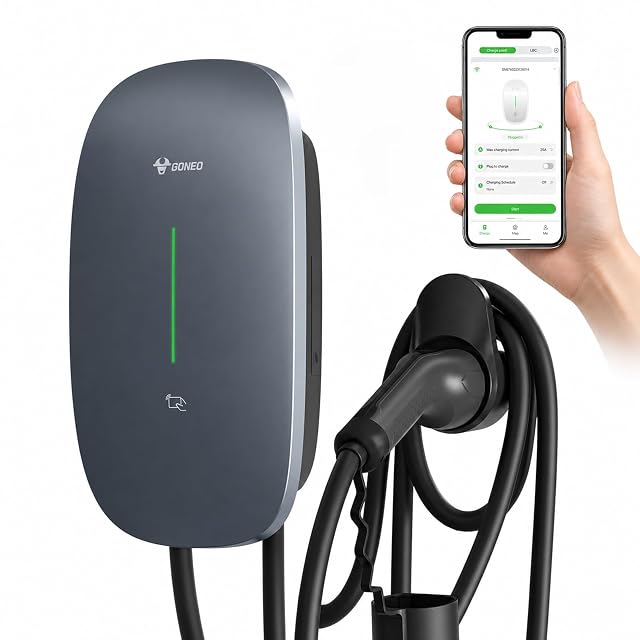
The bottom line The only charger here that sends surplus solar to the car and the only one with an impact rating. It never states its phase count or its cable, and its headline saving is a percentage with nothing behind it.
An 11 kW charger that decides when to charge rather than only how fast.
Solar surplus
Directing generation to the car instead of exporting it. That is the feature this shelf is moving towards and the only implementation here that says so outright. For a household that already generates, it changes the arithmetic of charging entirely.
Two ratings
IP65 for dust and water. IK10 for impact. The second is unusual — it describes resistance to a mechanical blow, which an IP rating says nothing about — and on a charger beside a driveway it is a real specification.
The range
−30 °C to +50 °C, published at both ends.
What is not stated
The phase count. The cable length. The connector arrangement. For a charger costing more than most of this shelf, those three absences are surprising.
The percentage, and the dependency
Up to 58 % a year, with no tariff and no consumption. And an AI scheduling function that reads electricity prices — which requires a service, with a lifetime the specification does not describe.
Availability
German and French Amazon stores quoted 559 € to 789 € when this page was compiled.
American, British, Italian and Spanish Amazon catalogues carry an entry for it, with nobody selling.
These figures are what Keepa reported on the day this page was last updated. Availability and pricing move without notice.
Prices quoted in this text were read on 16 September 2026. The live price is at the top of the page.
What it gets right, and what it leaves out
Strengths
Solar surplus charging, which directs generation to the car rather than to the grid
IK10 impact resistance published alongside IP65, which nothing else here gives
Operation is stated to continue during a WiFi outage, which is the failure an app-dependent charger invites
Compromises
Neither the phase count nor the cable is stated anywhere
The first bullet claims up to 58 % annual saving with no tariff or consumption behind it
The AI scheduling depends on a cloud service whose lifetime is not addressed
Specifications
Charging power
11 kW, from the title
Phases
Nowhere in the listing
Cable or socket
Nowhere in the listing — neither a cable length nor a socket type is given
Load management
AI scheduling combining electricity prices, driving plans and solar surplus, first bullet
Solar surplus charging
Stated explicitly — surplus solar is directed to the vehicle rather than exported, second bullet
Metering
Consumption data in the Anker application, with operation described as continuing during a WiFi outage, third bullet
Stated protection requirements
Absent as a requirement; IP65 and IK10 impact resistance are published with an operating range of −30 °C to +50 °C, fifth bullet
Amazon reference
B0FNCZD36Y (same reference on 6 Amazon marketplaces)
EAN
0194644273361
Questions owners ask about this one
What is IK10?
An impact resistance rating — the highest in its scale, describing resistance to a defined mechanical blow. On a charger mounted in a car park or beside a driveway it describes survival of a knock, which IP ratings do not cover.
What happens if the cloud service stops?
The third bullet says charging continues during a WiFi outage, which addresses a network failure. It does not address the service itself being withdrawn, and a charger whose scheduling depends on a maker’s cloud has a second lifetime that no specification states.
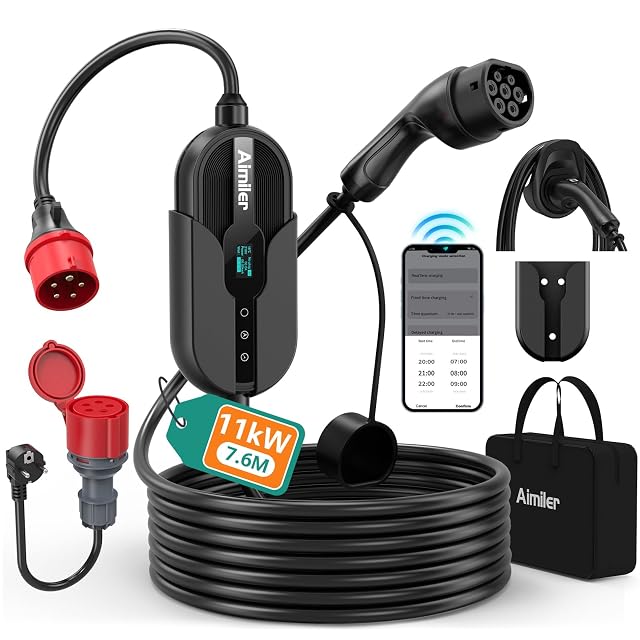
11 kW at 400 V, 16 A · three-phase · 7.6 m Type 2 cable with CEE, portable or wall-mounted · four current steps, app control · no solar surplus charging · OLED display · over-voltage above 120 %, under-voltage below 80 %, over 32 A overload and over-temperature
A portable or wall-mountable 11 kW charger with app control, four current steps, an OLED display and published protection thresholds for voltage, overload and temperature.
Best for: A driveway where the supply voltage is known to wander and the thresholds matter.
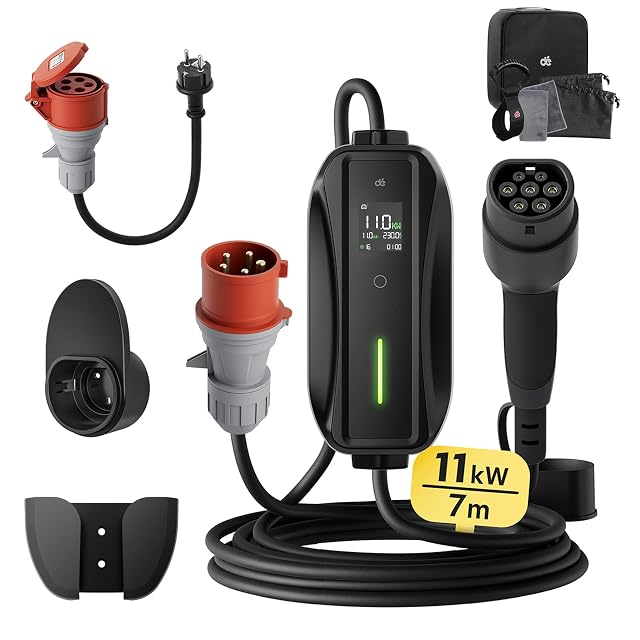
11 kW · three-phase · 7 m Type 2 cable with a CEE plug, not a fixed installation · load management not described · no solar surplus charging · metering not described · protection requirements not stated
A portable 11 kW charger plugging into an existing CEE socket with a 7 metre Type 2 cable and an adjustable current from 6 to 16 A, supplied with a Schuko adapter.
Best for: A driveway with an existing three-phase CEE socket and no appetite for an installation.
11 kW at 400 V, 16 A · single and three-phase supported · 7 m Type 2 cable · adjustable current with tariff scheduling · no solar surplus charging · app monitoring · CE and German TÜV, IP65
An 11 kW charger supporting single and three-phase charging, compatible with all Type 2 vehicles under IEC 62196-2, with app control, RFID, a 7 metre cable and IP65.
Best for: A property with only single-phase supply now and three phases later.