The car, the cable and the supply each cap the charge speed · review
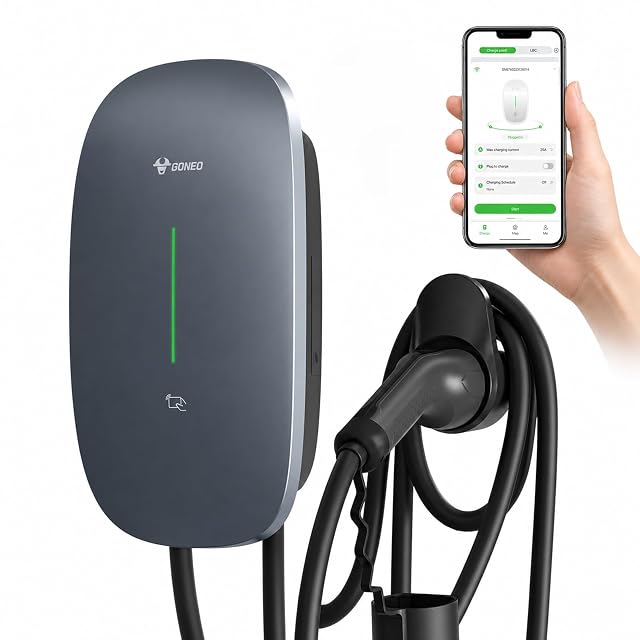
WityCharge 11 kW with app and RFID, 6–16 A, three-phase review
An 11 kW charger with a WiFi antenna specified for garages and cellars, RFID access control, and a charging current adjustable from 6 to 16 A with scheduling.
The bottom line The only charger here with access control, and the only one to address WiFi reception where chargers actually live. It publishes neither a cable length nor a connector type, which are the first two facts about any charger.
An 11 kW charger for a space that is not exclusively yours.
RFID
Card-based access control, so a session cannot be started by whoever parks there. On a shared driveway or a communal car park that is the difference between a charger and a public one. No other product on this shelf offers it.
The antenna
Specified for stable connection in a garage or a cellar. That is where chargers are installed and where household WiFi is weakest, and an app-controlled charger out of range is a charger with a button.
What is adjustable
6 to 16 A, with scheduling for cheaper tariff periods. The range covers the common circuit capacities.
What the bullets never say
The cable length. The connector type. Whether it is portable or fixed. Four bullets about the application, the scheduling, the RFID and the power, and nothing about the physical product.
And the saving
Up to 50 %, with no tariff. As on two other chargers here, a projection rather than a property.
Availability
German, Italian and Spanish Amazon stores quoted 254 € to 323 € when this page was compiled.
French Amazon catalogue carries an entry for it, with nobody selling.
American and British Amazon stores returned nothing at all, so the buy button there runs a search instead of landing on an empty page.
These figures are what Keepa reported on the day this page was last updated. Availability and pricing move without notice.
Prices quoted in this text were read on 16 September 2026. The live price is at the top of the page.
What it gets right, and what it leaves out
Strengths
RFID access control, so the charger cannot be used by a passer-by
A WiFi antenna specified for garages and cellars, which is where reception actually fails
Current adjustable across the full 6 to 16 A range for different circuit capacities
Compromises
No cable length or connector type in the bullets
The third bullet claims up to 50 % savings with no tariff named
No protection requirements stated
Specifications
Charging power
11 kW at 400 V and 16 A, first bullet
Phases
Three-phase CEE 16 A, first bullet
Cable or socket
Not specified in the bullets — neither a cable length nor a socket type is given
Load management
Charging current adjustable from 6 to 16 A with intelligent scheduling, third bullet
Solar surplus charging
None
Metering
Nowhere in the listing
Stated protection requirements
Nowhere in the listing; RFID access control is named in the fourth bullet
Amazon reference
B0GJ5H19Q1 (same reference on 4 Amazon marketplaces)
EAN
6979047250973
Questions owners ask about this one
What does RFID solve?
Unauthorised use. A charger on a shared driveway or in a communal car park can be used by anyone who parks there; a card reader means only the cardholders can start a session. It is the one feature on this shelf aimed at a shared installation.
Why mention the WiFi antenna?
Because chargers live in garages and cellars, where household WiFi is weakest, and an application-controlled charger that cannot reach the network is an ordinary charger. Naming the antenna addresses the failure that actually happens.
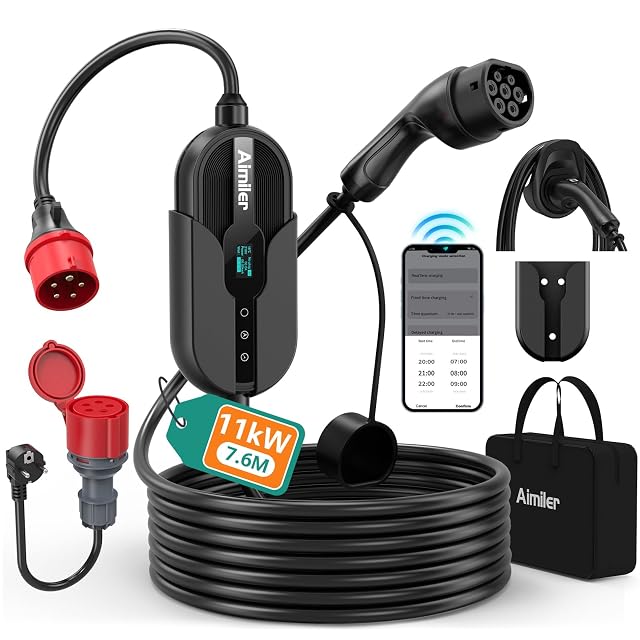
11 kW at 400 V, 16 A · three-phase · 7.6 m Type 2 cable with CEE, portable or wall-mounted · four current steps, app control · no solar surplus charging · OLED display · over-voltage above 120 %, under-voltage below 80 %, over 32 A overload and over-temperature
A portable or wall-mountable 11 kW charger with app control, four current steps, an OLED display and published protection thresholds for voltage, overload and temperature.
Best for: A driveway where the supply voltage is known to wander and the thresholds matter.
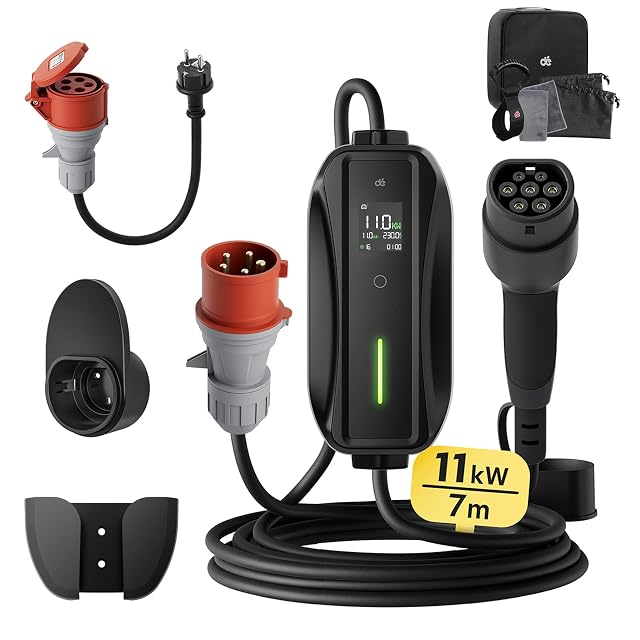
11 kW · three-phase · 7 m Type 2 cable with a CEE plug, not a fixed installation · load management not described · no solar surplus charging · metering not described · protection requirements not stated
A portable 11 kW charger plugging into an existing CEE socket with a 7 metre Type 2 cable and an adjustable current from 6 to 16 A, supplied with a Schuko adapter.
Best for: A driveway with an existing three-phase CEE socket and no appetite for an installation.
11 kW at 400 V, 16 A · single and three-phase supported · 7 m Type 2 cable · adjustable current with tariff scheduling · no solar surplus charging · app monitoring · CE and German TÜV, IP65
An 11 kW charger supporting single and three-phase charging, compatible with all Type 2 vehicles under IEC 62196-2, with app control, RFID, a 7 metre cable and IP65.
Best for: A property with only single-phase supply now and three phases later.