The bottom line A large hybrid with an unusually complete description of how it behaves without a battery, and eight protections named one by one. Half its input window and all of its efficiency and timing figures are missing.
A 6200 W hybrid for 48 V lithium systems, with grid feed-in.
The flexibility that is described well
The second bullet states that the unit runs with or without batteries, supplying loads directly from PV or the mains. That is genuinely useful: it means the inverter can be installed before the bank, and keeps working while the bank is out.
The protections, counted
Eight, named individually: short circuit, over-current, over-voltage, under-voltage, overload, backfill, and more. Backfill protection is worth noting — it is what prevents current flowing back into the array, and it is rarely named on this shelf.
The half-published window
Maximum PV input 500 V, array ceiling 6500 W. No minimum. No start voltage. The Y&H in this family publishes both ends and a start figure; this one publishes the ceiling alone, which prevents the low end of a string being checked.
The claim to verify before relying on it
BMS compatibility, with no protocol named. A lithium bank that expects to talk to its charger needs a matching protocol, and this listing gives nothing to match against.
What is absent
Transfer time. Efficiency. Both are standard figures on this product class and neither appears.
Availability
German Amazon store quoted about 269 € when this page was compiled.
American, British, French, Italian and Spanish Amazon stores returned nothing at all, so the buy button there runs a search instead of landing on an empty page.
These figures are what Keepa reported on the day this page was last updated. Availability and pricing move without notice.
Prices quoted in this text were read on 16 September 2026. The live price is at the top of the page.
What it gets right, and what it leaves out
Strengths
Operation with or without batteries is described explicitly, including direct supply from PV or the mains
Eight protections are named individually, including backfill protection
Grid feed-in is included alongside off-grid operation
Compromises
No minimum PV voltage or start voltage, so only half the input window is published
BMS compatibility is claimed with no protocol named, which makes it uncheckable
No transfer time and no efficiency
Specifications
Continuous and surge output
6200 W, first bullet; no surge figure is published
MPPT range
Maximum PV input voltage 500 V with a 6500 W array ceiling, first bullet; no minimum or start voltage is published
Current
120 A MPPT solar charger, first bullet
Supported battery voltages
48 V lithium, from the title; operation without batteries from PV or the mains is described in the second bullet
Transfer time
Nowhere in the listing
Protocols
BMS compatibility is named in the third bullet; no protocol is identified
Published efficiency
Nowhere in the listing
Amazon reference
B0H3L1V99C (same reference on 1 Amazon marketplace)
EAN
0768530573189
Questions owners ask about this one
What does running without batteries actually mean?
That the unit will supply loads directly from the PV array or the mains when no battery is connected or the battery is isolated. That matters during commissioning, during a battery replacement, and for anyone building the system in stages.
Is “BMS compatible” a useful claim?
Not without a protocol. Lithium packs communicate over defined buses, and an inverter that names none cannot be checked against a particular battery. It is a claim that requires a call to the maker before a purchase depends on it.
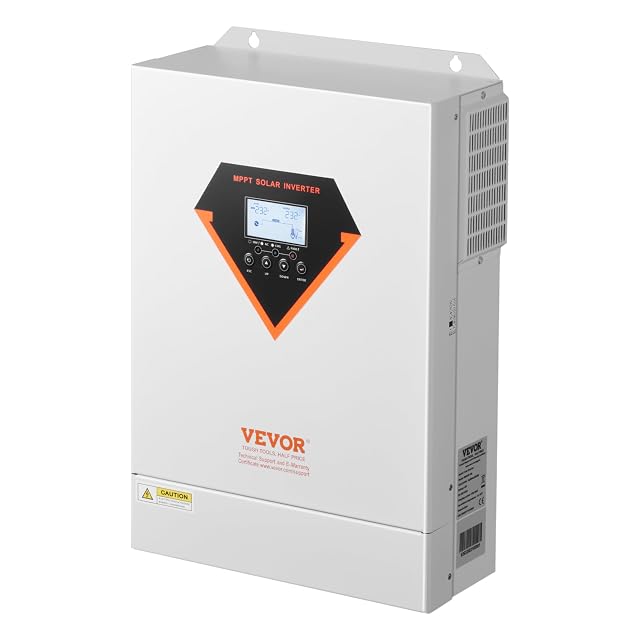
6000 W pure sine continuous, surge not stated · MPPT range not published · 120 A charging · 48 V lithium, lead-acid and others · transfer time not published · WiFi monitoring, protocol not named · efficiency described, not published
A 6000 W two-in-one hybrid inverter and controller for 48 V systems, charging at up to 120 A and supporting lithium, lead-acid and other battery types, with WiFi monitoring.
Best for: A 48 V installation whose array is already sized and whose owner will obtain the datasheet before wiring.
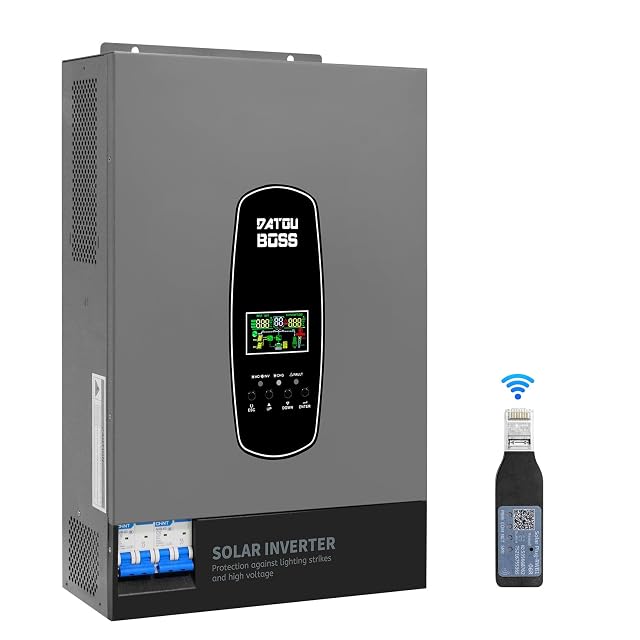
6200 W battery output, 6500 W PV inverter power, 8500 W array supported, surge not stated · PV open-circuit ceiling published · 120 A MPPT · 48 V · transfer time not published · protocols not published · efficiency not published
A 6200 W hybrid inverter for 48 V systems rated for a 6500 W PV inverter power and an 8500 W array, with integrated surge and lightning protection and an LCD diagnostic display.
Best for: A large off-grid array where oversizing the panels against the inverter is deliberate.
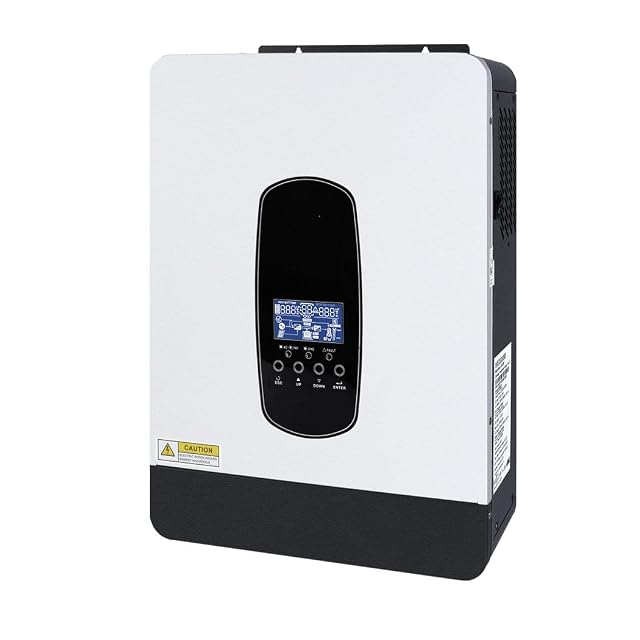
3200 W / 3200 VA continuous, surge not stated · PV 55–450 V, start above 60 V · 80 A MPPT charge, AC charger included · 24 V battery · transfer time not published · protocols not published · efficiency not published
A 3200 W pure sine hybrid inverter for 24 V systems with an 80 A MPPT controller, a 3000 W PV input rated to 450 V, and four charging modes.
Best for: A 24 V off-grid installation where the PV string voltage is already known and needs an inverter to match.