The bottom line The most complete cold specification in this family, published as three separate thresholds rather than one vague reassurance. Against that, no terminal type — the single fitting detail every other battery here publishes.
A 100 Ah LiFePO4 pack whose sheet is built around the thing most listings avoid: what happens in winter.
Three thresholds, not one
Charging stops at −7 °C. Discharging stops below −20 °C. Charging resumes at 0 °C or above. Three numbers, each describing a different behaviour, and together they describe how the pack will act on a January morning better than any general statement about the chemistry could.
That last figure matters most: a pack that stops charging at −7 °C does not start again at −6 °C. It waits for zero.
Current, in amps
100 A continuous in both directions, published plainly. That places the battery against an inverter without any conversion, and it is the figure two other batteries in this family omit entirely.
Expansion
Up to four in series or parallel, for 25.6 V 400 Ah or 51.2 V 200 Ah, and a stated 10.24 kWh maximum. The arrangements are named, which makes the ceiling checkable.
A cycle count with no depth behind it
No terminal type. Every other LiFePO4 here publishes M8 or similar; this listing gives dimensions and weight and stops. Anyone replacing an existing battery will need that answer before ordering.
Availability
German, French, Italian and Spanish Amazon stores quoted 200 € to 210 € when this page was compiled.
American and British Amazon catalogues carry an entry for it, with nobody selling.
These figures are what Keepa reported on the day this page was last updated. Availability and pricing move without notice.
Prices quoted in this text were read on 16 September 2026. The live price is at the top of the page.
What it gets right, and what it leaves out
Strengths
Three separate cold thresholds published — charge stop, charge resume and discharge stop
A continuous current is published in amps for both directions
Bluetooth monitoring with a stated range and nine app languages
Compromises
No terminal type at all, which is the one fitting detail this listing omits
The 15000-cycle figure carries neither of its two qualifiers
No peak discharge current, only the continuous figure
Specifications
Nominal capacity
100 Ah at 12 V, first bullet; 10.24 kWh maximum in a 4P2S or 2P4S arrangement, fifth bullet
Continuous and peak discharge current
100 A maximum continuous charge and discharge current, fifth bullet; no peak figure is published
BMS protections
100 A BMS with over-voltage, under-voltage, over-current, over-heating, short-circuit and low-temperature cut-off, second bullet
Low-temperature behaviour
Charging stops at −7 °C and resumes at ≥0 °C; discharge stops below −20 °C, second bullet — the most complete cold specification in this family
Cycle life
Up to 15000 cycles with a stated 10-year life, fourth bullet; neither a depth of discharge nor a remaining capacity accompanies the count
Terminals
Nowhere in the listing — no terminal type is named
Dimensions
260 × 168 × 214 mm, 10.5 kg, third bullet
Amazon reference
B0DF6ZTGGB (same reference on 6 Amazon marketplaces)
EAN
0810127135277
Questions owners ask about this one
Why are there three temperature numbers?
Because charging and discharging behave differently in the cold, and recovery has its own threshold. Charging stops at −7 °C because cold charging damages lithium cells permanently; discharge continues to −20 °C because taking current out does not. Charging resumes only at 0 °C or above, not at −7 °C.
How does this compare with the FEENCE threshold?
FEENCE stops charging at 0 °C and resumes at 5 °C; this pack stops at −7 °C and resumes at 0 °C. Same chemistry, different thresholds — which is why the figure belongs to the pack and its management system rather than to LiFePO4 in general.
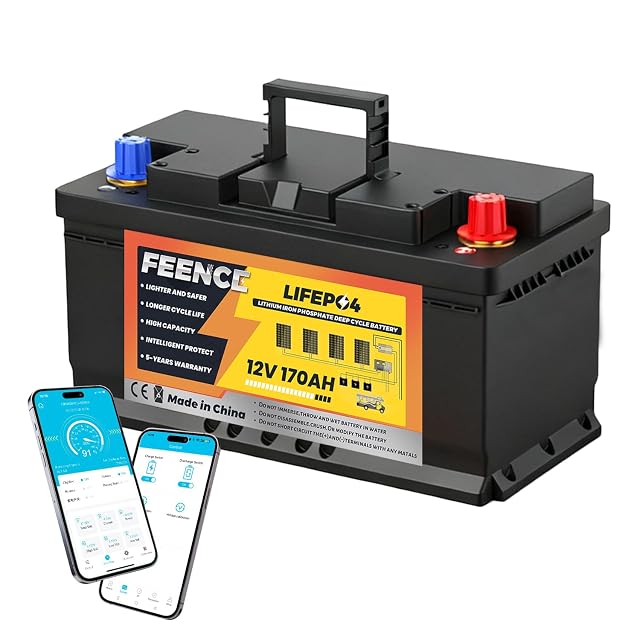
170 Ah at 12 V, 2176 Wh · 150 A BMS · charge stops below 0 °C, resumes at 5 °C; discharge stops below −20 °C · up to 15000 cycles · Bluetooth 5.0 · 352 × 174 × 190 mm · 14.5 kg
A 12 V 170 Ah LiFePO4 battery with a 150 A BMS and Bluetooth 5.0, published with charging and discharging temperature thresholds and stated not to be suitable as a starter battery.
Best for: A converted van or a fishing boat where the battery goes in sideways and the state of charge needs checking from a phone.
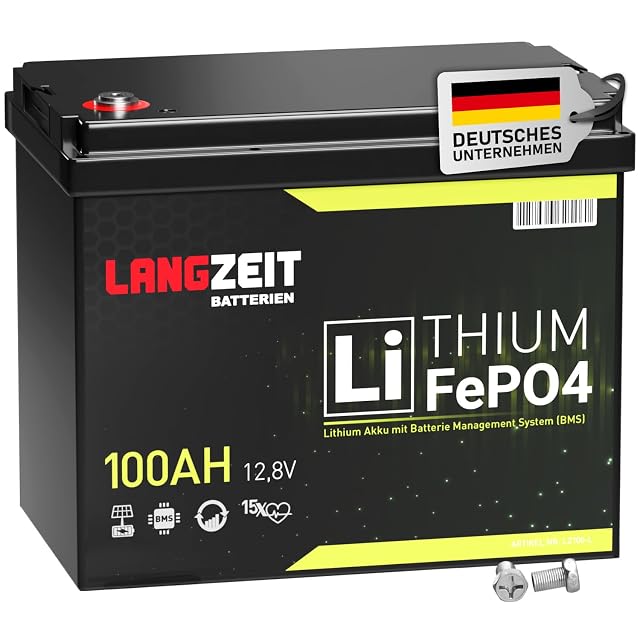
100 Ah at 12.8 V · 100 A maximum charge current · 15000 cycles at 10 % DoD, 8500 at 30 % · 12-year design life · M8 internal thread · 260 × 168 × 217 mm · 10 kg
A 12.8 V 100 Ah LiFePO4 battery published with two cycle figures at two depths, a maximum charge current in amps, and a stated 12-year design life.
Best for: A shallow-cycling installation — a balcony store or a standby bank — where the 15000-cycle figure is the relevant one.