The bottom line The best-documented battery in this family on the questions that decide installation: dimensions, terminals, polarity and a stated rate. It publishes no charging temperature threshold at all, which on a pack sold for vans is the one line a winter will find.
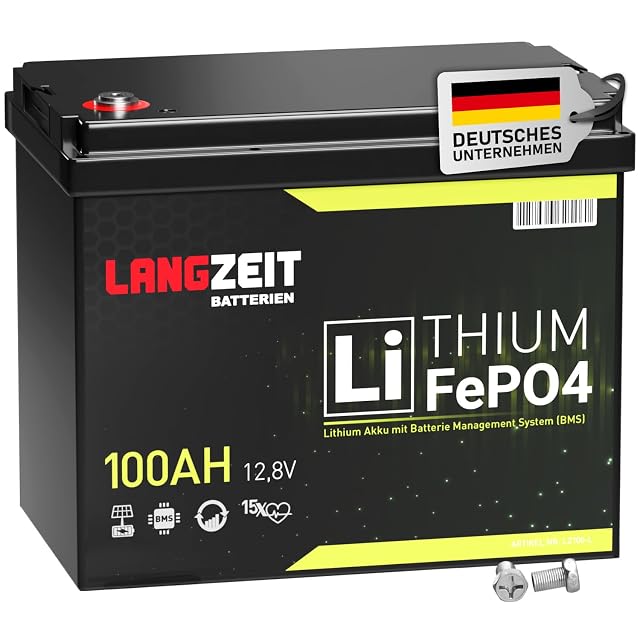
A 12.8 V 100 Ah LiFePO4 pack, sold on longevity, with a first bullet that does more work than most whole listings.
Everything needed to make it fit
Capacity, voltage, dimensions in millimetres, terminal arrangement, polarity and thread type — all in the first bullet. That is the set of facts that decides whether a battery drops into an existing tray and reaches the existing cables, and it is published in full.
The rate
Up to 1C charge and discharge. On a 100 Ah pack that is 100 A, which places it comfortably behind a mid-sized inverter. The listing gives the C-rate rather than the amps; the conversion is straightforward and it is done above rather than left to be guessed.
The cycle claim, half-qualified
8500 cycles at 30 % depth of discharge. The depth is stated, which is more than most. The capacity remaining at the end is not, and without it the number cannot be set beside a competitor’s.
The winter question
No charging temperature threshold appears anywhere. Two other batteries in this family publish theirs, and they differ from each other — which is exactly why it cannot be assumed here.
Availability
German Amazon store quoted about 167 € when this page was compiled.
American, British, French, Italian and Spanish Amazon stores returned nothing at all, so the buy button there runs a search instead of landing on an empty page.
These figures are what Keepa reported on the day this page was last updated. Availability and pricing move without notice.
Prices quoted in this text were read on 16 September 2026. The live price is at the top of the page.
What it gets right, and what it leaves out
Strengths
Dimensions, terminal type and polarity arrangement are all published, which is what decides whether it fits an existing tray
The cycle figure carries its depth of discharge rather than standing alone
A 1C rate is stated for both charge and discharge, which places the battery against an inverter
Compromises
No low-temperature threshold, on a battery sold for motorhomes and boats
The cycle count has no end-of-life capacity percentage
Discharge current is expressed as a C-rate rather than in amps, which the reader has to convert
Specifications
Nominal capacity
100 Ah at 12.8 V, first bullet
Continuous and peak discharge current
Not published as amps — the first and third bullets give a charge and discharge capability of up to 1C, which on a 100 Ah pack is 100 A
BMS protections
Over-heating and short-circuit protection with cell balancing and deep-discharge protection, fourth bullet; no current or voltage thresholds are given
Low-temperature behaviour
Nowhere in the listing — no charging temperature threshold is published
Cycle life
Up to 8500 cycles at 30 % depth of discharge, first bullet — the depth is stated, the remaining capacity is not
Terminals
M8 internal thread with terminal bolts, positive on the left, first bullet
Dimensions
260 × 168 × 209 mm, first bullet
Amazon reference
B0CMXWYFX6 (same reference on 1 Amazon marketplace)
EAN
4260713249554
Questions owners ask about this one
What does “up to 1C” mean on a 100 Ah battery?
A rate of 1C is the current that would empty the rated capacity in an hour — here, 100 A. Expressing it that way makes the figure portable between battery sizes; converting it is the reader’s job, and this page does the conversion rather than leaving it implied.
Does 8500 cycles mean 8500 uses?
It means 8500 cycles at 30 % depth of discharge, which is what the listing states. Discharge it further each time and the count falls. The figure that is missing is the capacity remaining at the end, without which two cycle claims cannot be compared.
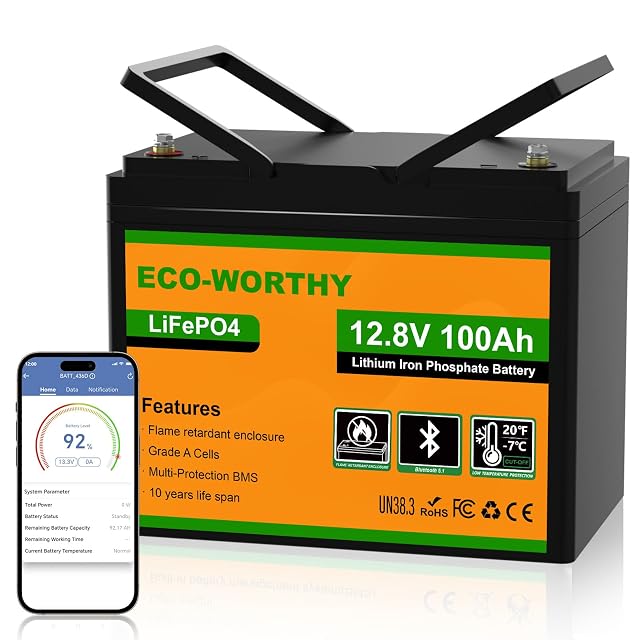
100 Ah at 12 V · 100 A BMS, 100 A continuous charge and discharge · charge stops at −7 °C, resumes at ≥0 °C, discharge stops below −20 °C · 15000 cycles · Bluetooth · 10.5 kg
A 12 V 100 Ah LiFePO4 battery with a 100 A BMS, Bluetooth monitoring, and published low-temperature thresholds for both charging and discharging.
Best for: A van or boat that will see freezing mornings, where the charging threshold is the specification that matters.
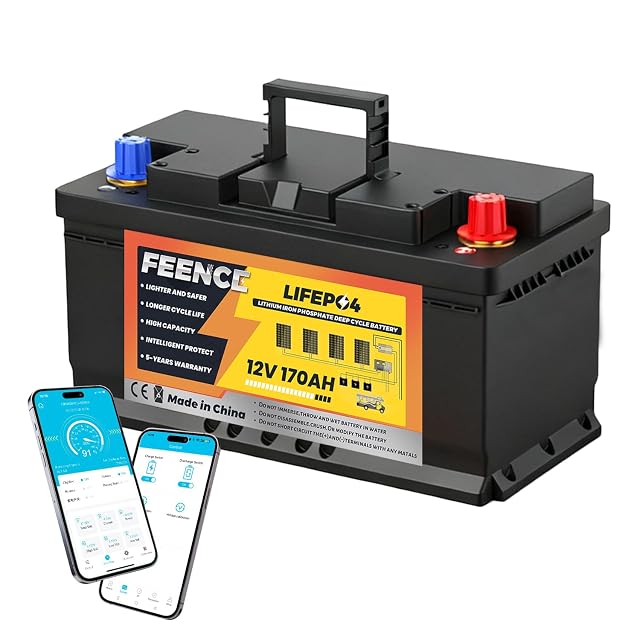
170 Ah at 12 V, 2176 Wh · 150 A BMS · charge stops below 0 °C, resumes at 5 °C; discharge stops below −20 °C · up to 15000 cycles · Bluetooth 5.0 · 352 × 174 × 190 mm · 14.5 kg
A 12 V 170 Ah LiFePO4 battery with a 150 A BMS and Bluetooth 5.0, published with charging and discharging temperature thresholds and stated not to be suitable as a starter battery.
Best for: A converted van or a fishing boat where the battery goes in sideways and the state of charge needs checking from a phone.
100 Ah at 12.8 V · 100 A maximum charge current · 15000 cycles at 10 % DoD, 8500 at 30 % · 12-year design life · M8 internal thread · 260 × 168 × 217 mm · 10 kg
A 12.8 V 100 Ah LiFePO4 battery published with two cycle figures at two depths, a maximum charge current in amps, and a stated 12-year design life.
Best for: A shallow-cycling installation — a balcony store or a standby bank — where the 15000-cycle figure is the relevant one.