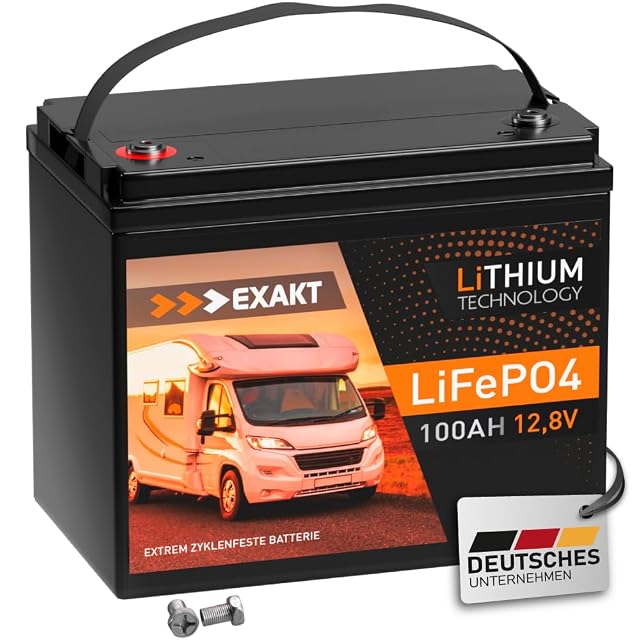
The bottom line The only battery in this family to publish its cycle life at two depths, which is the honest form of that claim. It publishes no discharge current, so the one thing it cannot tell you is what inverter it will support.
A 100 Ah LiFePO4 pack from the same catalogue family as the EXAKT, with a different emphasis in its numbers.
Two depths, published together
15000 cycles at 10 % depth of discharge, 8500 at 30 %. Publishing both is what turns a cycle claim into information: the figure is not a property of the cells alone but of how hard they are worked, and the gap between these two numbers shows it.
What fits
260 × 168 × 217 mm, 10 kg, M8 internal thread, positive on the left. Everything needed to decide whether it replaces an existing battery, in one bullet.
What is missing
A discharge current. The listing gives a maximum charge current of 100 A and nothing in the other direction. On a battery bought to run an inverter, that is the figure the purchase turns on, and it is absent.
Also absent: any charging temperature threshold, on a pack the fifth bullet offers for motorhomes, marine use and camping.
The claim without a basis
A twelve-year design life, stated as a conclusion. The cycle numbers above it are the evidence that would support such a claim; the two are not connected on the page.
Availability
German Amazon store quoted about 172 € when this page was compiled.
British and Italian Amazon catalogues carry an entry for it, with nobody selling.
American, French and Spanish Amazon stores returned nothing at all, so the buy button there runs a search instead of landing on an empty page.
These figures are what Keepa reported on the day this page was last updated. Availability and pricing move without notice.
Prices quoted in this text were read on 16 September 2026. The live price is at the top of the page.
What it gets right, and what it leaves out
Strengths
Two cycle figures at two depths, which shows the trade-off instead of selecting the flattering one
A maximum charge current is published in amps rather than as a C-rate
Weight and dimensions are both published, which the tray and the hold-down both need
Compromises
No discharge current at all — the figure that decides what inverter it can feed
No low-temperature threshold
The 12-year design life is stated without a cycle or capacity basis
Specifications
Nominal capacity
100 Ah at 12.8 V, first bullet
Continuous and peak discharge current
Not published — the first bullet gives a maximum CHARGE current of 100 A and no discharge figure
BMS protections
Over-heating and short-circuit protection with cell balancing, fourth bullet; no thresholds are given
Low-temperature behaviour
Nowhere in the listing
Cycle life
15000 cycles at 10 % depth of discharge and 8500 at 30 %, first bullet — two depths published, neither with a remaining-capacity figure
Terminals
M8 internal thread with terminal bolts, positive on the left, first bullet
Dimensions
260 × 168 × 217 mm and 10 kg, first bullet
Amazon reference
B0CPFXWZLP (same reference on 3 Amazon marketplaces)
EAN
4260713249714
Questions owners ask about this one
Why publish two cycle numbers?
Because a cycle count is set by the depth it was tested at, and publishing two shows how steeply the figure moves. Here, cycling to 10 % gives 15000 and cycling to 30 % gives 8500 — the same cells, described honestly at two working depths.
Does a missing discharge current matter?
It is the figure that decides what the battery can feed. A 100 Ah pack behind a 2000 W inverter is asked for well over 150 A at 12 V, and whether the management system permits that is not stated anywhere on this listing.
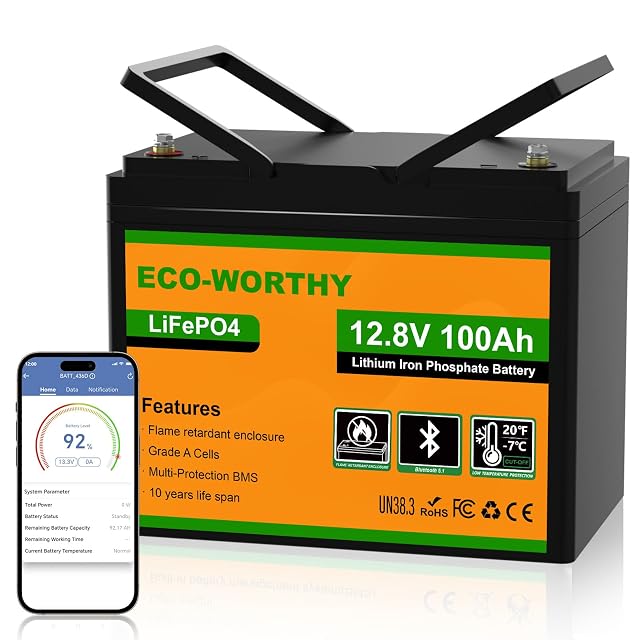
100 Ah at 12 V · 100 A BMS, 100 A continuous charge and discharge · charge stops at −7 °C, resumes at ≥0 °C, discharge stops below −20 °C · 15000 cycles · Bluetooth · 10.5 kg
A 12 V 100 Ah LiFePO4 battery with a 100 A BMS, Bluetooth monitoring, and published low-temperature thresholds for both charging and discharging.
Best for: A van or boat that will see freezing mornings, where the charging threshold is the specification that matters.
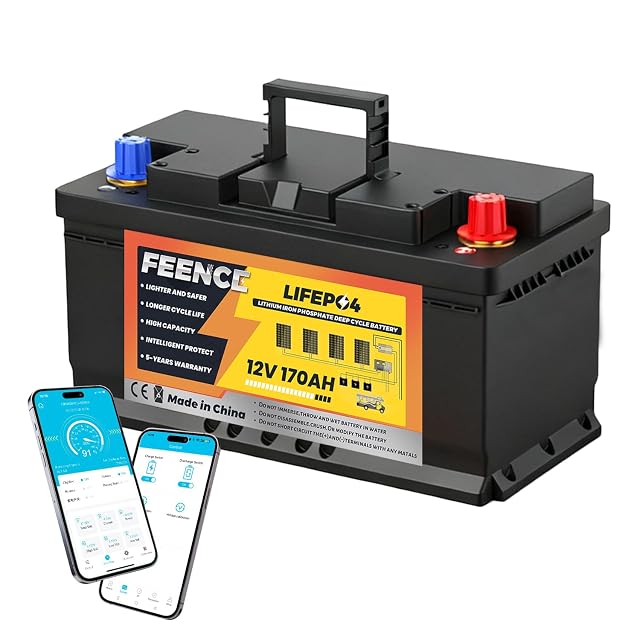
170 Ah at 12 V, 2176 Wh · 150 A BMS · charge stops below 0 °C, resumes at 5 °C; discharge stops below −20 °C · up to 15000 cycles · Bluetooth 5.0 · 352 × 174 × 190 mm · 14.5 kg
A 12 V 170 Ah LiFePO4 battery with a 150 A BMS and Bluetooth 5.0, published with charging and discharging temperature thresholds and stated not to be suitable as a starter battery.
Best for: A converted van or a fishing boat where the battery goes in sideways and the state of charge needs checking from a phone.