The BMS decides what the cells are allowed to do · review
FEENCE 12 V 170 Ah LiFePO4, 2176 Wh, Bluetooth review
A 12 V 170 Ah LiFePO4 battery with a 150 A BMS and Bluetooth 5.0, published with charging and discharging temperature thresholds and stated not to be suitable as a starter battery.
The bottom line The most usable battery here for a confined installation: two orientations described, dimensions to match, and remote isolation over Bluetooth. Its current rating is a BMS figure rather than a published discharge current, which leaves the inverter question half-answered.
A 170 Ah pack aimed at conversions, with a sheet written by someone who has fitted one.
The sentence that prevents a mistake
“Not suitable as a starter battery”, in the first bullet, in the middle of a capacity claim. A 150 A management system will not deliver cranking current, and a buyer choosing on amp-hours alone would have no way to know.
Fitting it
352 × 174 × 190 mm, 14.5 kg, with side mounting in an electric outboard or a fishing boat and horizontal installation in a converted motorhome both described. The dimensions and the orientations together answer the question a van conversion actually asks.
The cold, published
Charging stops below 0 °C and resumes at 5 °C. Discharging stops below −20 °C. Note the gap between stopping and resuming: it is not the same threshold, and a pack that stopped at 0 °C waits for 5 °C before it accepts charge again.
What the application does
Reports state of charge, voltage, cell current and temperature — and switches charge and discharge. Control rather than monitoring alone, which is rare here.
What is missing
A discharge current in amps, and any terminal type at all.
Availability
German, French, Italian and Spanish Amazon stores quoted 271 € to 285 € when this page was compiled.
American and British Amazon catalogues carry an entry for it, with nobody selling.
These figures are what Keepa reported on the day this page was last updated. Availability and pricing move without notice.
Prices quoted in this text were read on 16 September 2026. The live price is at the top of the page.
What it gets right, and what it leaves out
Strengths
The first bullet states outright that it is not suitable as a starter battery, which is the misuse this shelf invites
Charging and discharging can be switched remotely over Bluetooth, not merely monitored
Both installation orientations are described, with the dimensions that make them work
Compromises
No discharge current in amps, only a BMS rating
The 15000-cycle figure carries neither qualifier
No terminal type, so cable lugs cannot be chosen from the page
Specifications
Nominal capacity
170 Ah at 12 V, published as 2176 Wh with a 1.92 kW output load, first bullet
Continuous and peak discharge current
Not published as amps — a 150 A BMS is named, first bullet, and no separate continuous or peak figure is given
BMS protections
150 A intelligent BMS with low-temperature protection, first and fourth bullets; charge and discharge can be switched over Bluetooth
Low-temperature behaviour
Charging stops automatically below 0 °C and resumes at 5 °C; discharge stops below −20 °C, fourth bullet
Cycle life
Up to 15000 cycles, from the title; neither a depth of discharge nor a remaining capacity accompanies the count
Terminals
Nowhere in the listing
Dimensions
352 × 174 × 190 mm, 14.5 kg, second bullet, with horizontal and side installation both described
Amazon reference
B0DXP6BPZT (same reference on 6 Amazon marketplaces)
EAN
0717690263300
Questions owners ask about this one
Why say it is not a starter battery?
Because a starter battery is asked for several hundred amps for a second or two, and a deep-cycle lithium pack with a 150 A management system will refuse. Saying so in the first bullet prevents a purchase that would otherwise be made on capacity alone.
What does switching charge and discharge over Bluetooth add?
It lets the pack be isolated without reaching it — useful where the battery is behind panelling or under a floor. Monitoring is common on this shelf; control is not.
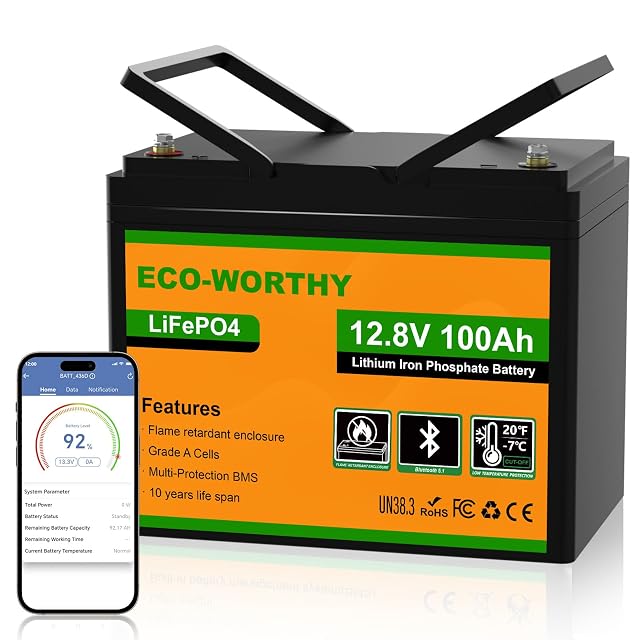
100 Ah at 12 V · 100 A BMS, 100 A continuous charge and discharge · charge stops at −7 °C, resumes at ≥0 °C, discharge stops below −20 °C · 15000 cycles · Bluetooth · 10.5 kg
A 12 V 100 Ah LiFePO4 battery with a 100 A BMS, Bluetooth monitoring, and published low-temperature thresholds for both charging and discharging.
Best for: A van or boat that will see freezing mornings, where the charging threshold is the specification that matters.
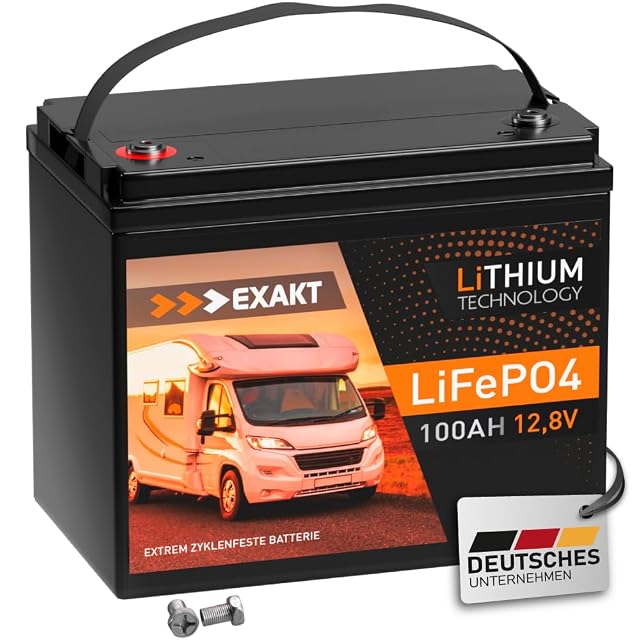
100 Ah at 12.8 V · 100 A maximum charge current · 15000 cycles at 10 % DoD, 8500 at 30 % · 12-year design life · M8 internal thread · 260 × 168 × 217 mm · 10 kg
A 12.8 V 100 Ah LiFePO4 battery published with two cycle figures at two depths, a maximum charge current in amps, and a stated 12-year design life.
Best for: A shallow-cycling installation — a balcony store or a standby bank — where the 15000-cycle figure is the relevant one.