The bottom line The largest single battery here and the one that publishes its capacity in the unit that travels. It publishes neither dimensions nor terminals, so whether it physically fits anything cannot be answered from the page — and its cycle claim spans a factor of three.
A 200 Ah pack sold on capacity and on expansion, with a sheet that is generous about energy and silent about physical fit.
Capacity, properly expressed
200 Ah at 12.8 V, published also as 2560 Wh. Amp-hours only compare within a voltage; watt-hours compare everywhere. A listing that gives both is making itself comparable, and most on this shelf give only the first.
The expansion arithmetic
4S4P to 51.2 V 800 Ah, quoted at 40.96 kWh with a 20.48 kW maximum load. The arrangement is named and the resulting figures are given, which is what makes a claimed ceiling checkable rather than decorative.
The cycle range
5000 to 15000 at full depth of discharge. Three times between the ends, with nothing on the page to say what moves it. The depth is published, which is more than several competitors manage; the remaining capacity is not.
What cannot be checked
No dimensions. No terminal type. For a 24 kg battery going into a locker or a van floor, those are the first two questions, and the listing answers neither.
Availability
German Amazon store quoted about 250 € when this page was compiled.
American, British, French, Italian and Spanish Amazon stores returned nothing at all, so the buy button there runs a search instead of landing on an empty page.
These figures are what Keepa reported on the day this page was last updated. Availability and pricing move without notice.
Prices quoted in this text were read on 16 September 2026. The live price is at the top of the page.
What it gets right, and what it leaves out
Strengths
Capacity is published in watt-hours as well as amp-hours, which is the unit that compares across voltages
A charge power in watts is given alongside the current
The 4S4P expansion is spelled out to 51.2 V 800 Ah with its energy and load figures
Compromises
The cycle range spans 5000 to 15000 — a factor of three, with no explanation of what moves it
No dimensions and no terminal type, so fit cannot be checked at all
No low-temperature threshold
Specifications
Nominal capacity
200 Ah at 12.8 V, stated as 2560 Wh maximum energy, first and second bullets
Continuous and peak discharge current
100 A maximum continuous charge and discharge, second bullet, with a 1280 W maximum charge power; no peak figure is published
BMS protections
100 A BMS named, second bullet; no individual protections or thresholds are listed
Low-temperature behaviour
Nowhere in the listing
Cycle life
5000 to 15000 cycles at 100 % depth of discharge, first bullet — the depth is stated, the remaining capacity is not, and the range spans a factor of three
Terminals
Nowhere in the listing
Dimensions
Not published; the weight is given as 24 kg, fourth bullet
Amazon reference
B0GXCXWHV3 (same reference on 1 Amazon marketplace)
EAN
0762779176354
Questions owners ask about this one
What should be made of “5000 to 15000 cycles”?
It is a range across a factor of three, published at 100 % depth of discharge with no remaining-capacity figure. Something moves the number between those ends — temperature, current, the definition of end of life — and the listing does not say what. Treat the lower figure as the one that can be planned against.
Why does publishing 2560 Wh help?
Because watt-hours compare between batteries of different voltages and amp-hours do not. A 200 Ah pack at 12.8 V and a 100 Ah pack at 25.6 V hold the same energy, and only the watt-hour figure shows it.
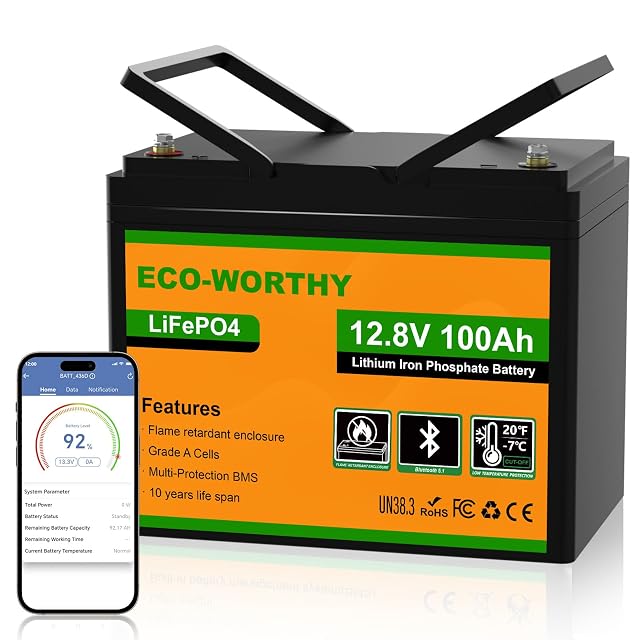
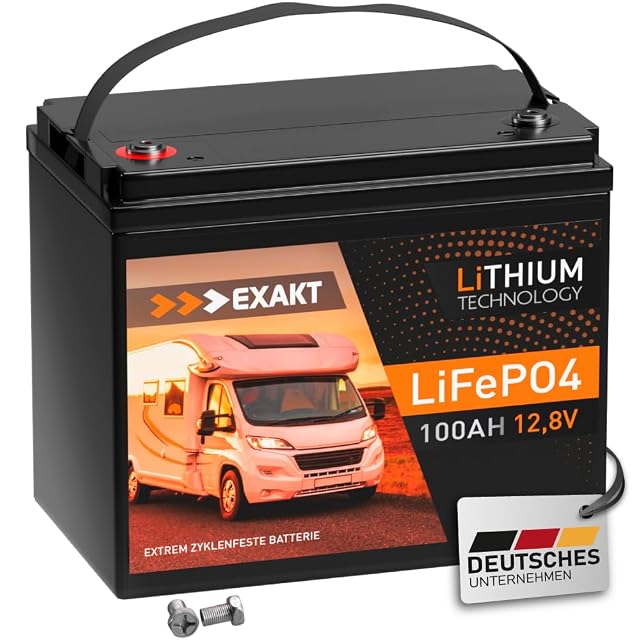
100 Ah at 12 V · 100 A BMS, 100 A continuous charge and discharge · charge stops at −7 °C, resumes at ≥0 °C, discharge stops below −20 °C · 15000 cycles · Bluetooth · 10.5 kg
A 12 V 100 Ah LiFePO4 battery with a 100 A BMS, Bluetooth monitoring, and published low-temperature thresholds for both charging and discharging.
Best for: A van or boat that will see freezing mornings, where the charging threshold is the specification that matters.
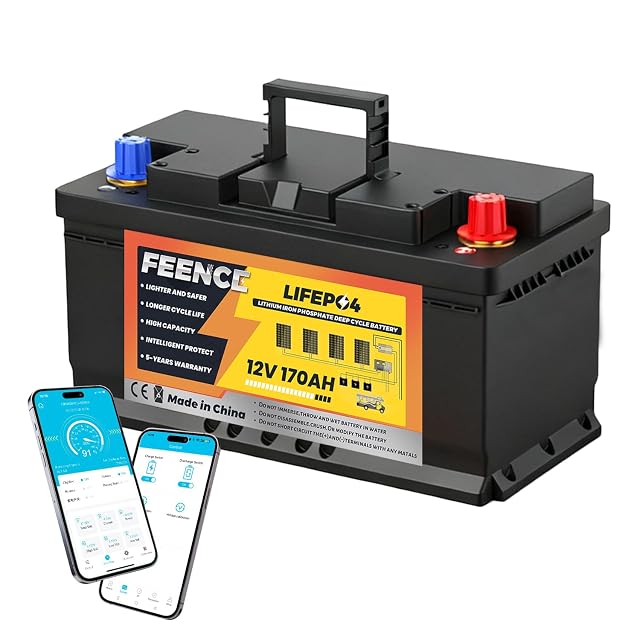
170 Ah at 12 V, 2176 Wh · 150 A BMS · charge stops below 0 °C, resumes at 5 °C; discharge stops below −20 °C · up to 15000 cycles · Bluetooth 5.0 · 352 × 174 × 190 mm · 14.5 kg
A 12 V 170 Ah LiFePO4 battery with a 150 A BMS and Bluetooth 5.0, published with charging and discharging temperature thresholds and stated not to be suitable as a starter battery.
Best for: A converted van or a fishing boat where the battery goes in sideways and the state of charge needs checking from a phone.