The BMS decides what the cells are allowed to do · review
Mehrpow 12 V 330 Ah LiFePO4, 4224 Wh, Bluetooth review
A 12 V 330 Ah LiFePO4 battery with a 200 A BMS and app monitoring, published as retaining over 80 % of capacity after 2000 cycles and expandable to a 51.2 V bank.
The bottom line The largest capacity in this family and the only listing to publish a remaining-capacity percentage against a cycle count. It also carries a headline cycle claim that its own bullet does not support, and it names a cold cut-off without ever giving the temperature.
A 330 Ah pack sold on capacity and expansion, with a sheet that contradicts itself in an instructive way.
Two cycle claims
The title says 15000 cycles. The second bullet says capacity remains above 80 % after 2000 cycles. Both may be true of the same cells under different assumptions, and the listing reconciles them nowhere. The second is the only one with a percentage attached, and it is the one that can be planned against.
The cut-off with no number
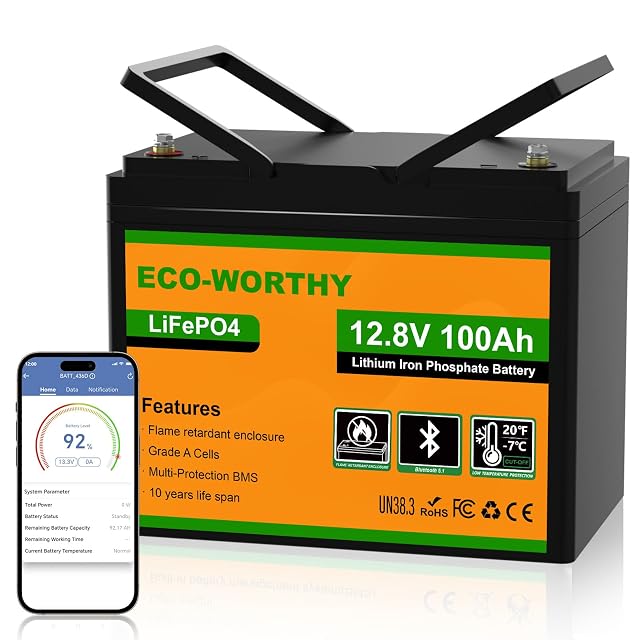
A low-temperature cut-off appears in the title. No threshold appears anywhere in the bullets. ECO-WORTHY publishes −7 °C and FEENCE publishes 0 °C for the same chemistry — the figure belongs to the pack, and an unnamed one tells you only that some threshold exists.
The lines this battery fills in
4224 Wh alongside 330 Ah, which makes the pack comparable across voltages. An expansion ceiling of 67.58 kWh with a 40.96 kW maximum load, from a named series-parallel arrangement. App monitoring covering current, voltage, temperature and cycle count.
What is absent
Dimensions. Terminals. On a battery of this size, those are the two facts that decide where it can go and what cable will reach it.
Availability
German Amazon store quoted about 355 € when this page was compiled.
French, Italian and Spanish Amazon catalogues carry an entry for it, with nobody selling.
American and British Amazon stores returned nothing at all, so the buy button there runs a search instead of landing on an empty page.
These figures are what Keepa reported on the day this page was last updated. Availability and pricing move without notice.
Prices quoted in this text were read on 16 September 2026. The live price is at the top of the page.
What it gets right, and what it leaves out
Strengths
The second bullet publishes a capacity percentage against a cycle count — over 80 % after 2000 cycles — which is the properly qualified form
Capacity is published in watt-hours as well as amp-hours
App monitoring covers current, voltage, temperature and cycle count
Compromises
The title claims 15000 cycles while the bullet publishes 80 % after 2000 — the two are not reconciled anywhere
A low-temperature cut-off is named with no threshold figure
Neither dimensions nor terminals are published, on the largest battery in this family
Specifications
Nominal capacity
330 Ah at 12 V, published as 4224 Wh in the title
Continuous and peak discharge current
Not published as amps — a 200 A BMS is named in the title and fourth bullet
BMS protections
200 A BMS with a low-temperature cut-off named in the title; the fourth bullet cites a UL test certificate for the cell without naming a standard number
Low-temperature behaviour
A cut-off is named in the title but NO threshold temperature is published anywhere
Cycle life
15000 cycles in the title, and separately “greater than 80 % capacity after 2000 cycles” in the second bullet — two claims that do not describe the same thing
Terminals
Nowhere in the listing
Dimensions
Nowhere in the listing
Amazon reference
B0GTYQRPZB (same reference on 4 Amazon marketplaces)
EAN
0758675453309
Questions owners ask about this one
Which cycle figure should be believed — 15000 or 2000?
They answer different questions and the listing does not connect them. “Over 80 % after 2000 cycles” is a qualified statement that can be planned against; “15000 cycles” in the title has no depth and no capacity attached. The qualified one is the useful one.
Does “low temp cut off” without a number mean anything?
It means the management system will stop charging at some temperature the maker has not published. Two other batteries in this family publish theirs — −7 °C and 0 °C — and they differ, which is precisely why an unstated threshold cannot be assumed.
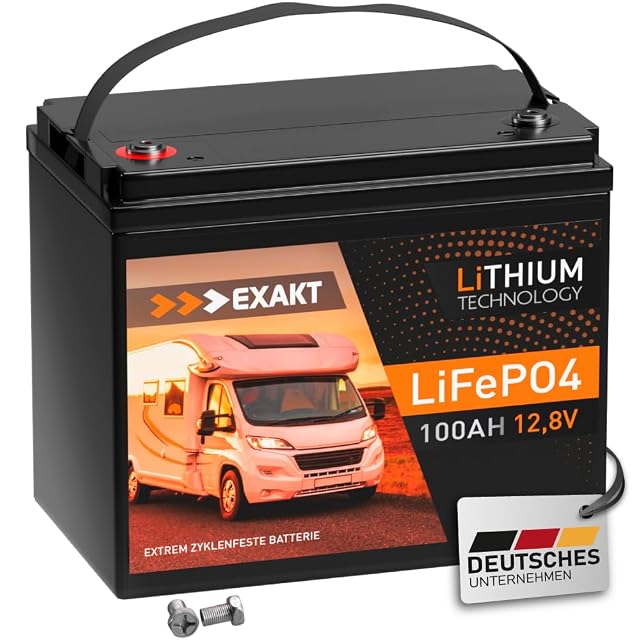
100 Ah at 12 V · 100 A BMS, 100 A continuous charge and discharge · charge stops at −7 °C, resumes at ≥0 °C, discharge stops below −20 °C · 15000 cycles · Bluetooth · 10.5 kg
A 12 V 100 Ah LiFePO4 battery with a 100 A BMS, Bluetooth monitoring, and published low-temperature thresholds for both charging and discharging.
Best for: A van or boat that will see freezing mornings, where the charging threshold is the specification that matters.
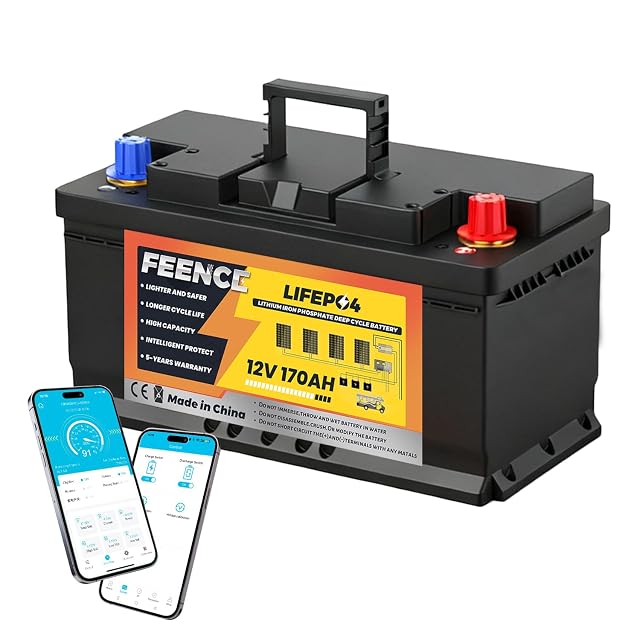
170 Ah at 12 V, 2176 Wh · 150 A BMS · charge stops below 0 °C, resumes at 5 °C; discharge stops below −20 °C · up to 15000 cycles · Bluetooth 5.0 · 352 × 174 × 190 mm · 14.5 kg
A 12 V 170 Ah LiFePO4 battery with a 150 A BMS and Bluetooth 5.0, published with charging and discharging temperature thresholds and stated not to be suitable as a starter battery.
Best for: A converted van or a fishing boat where the battery goes in sideways and the state of charge needs checking from a phone.