One inverter per panel, and one shaded panel stops costing the others · review
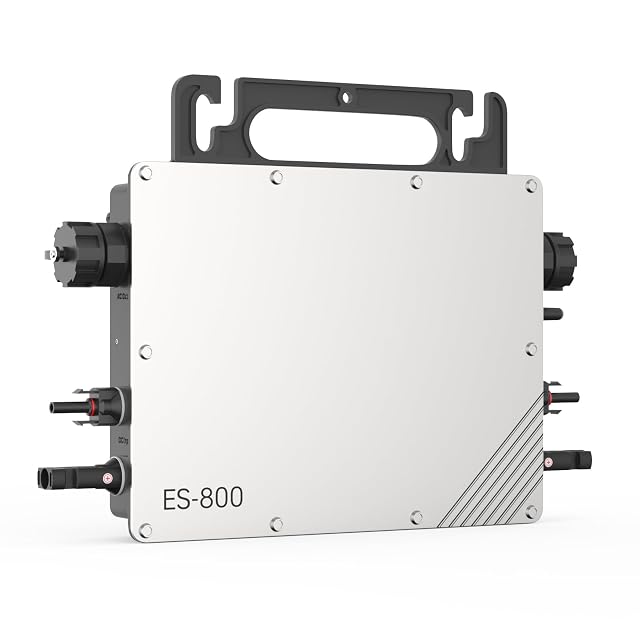
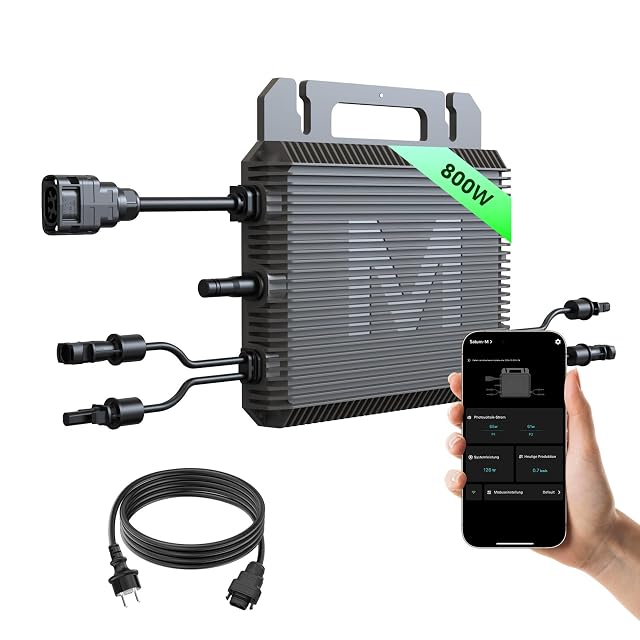
DEYE SUN-M80G4-EU-Q0, 800 W, two MPPT review
An 800 W micro-inverter with two independent MPPT inputs, a stated peak efficiency of 96.5 % and MPPT efficiency above 99 %, in an IP67 fanless housing.
The bottom line A well-specified converter sold by a reseller whose listing omits the two things that decide whether it can be installed: a grid standard and an input window. The efficiency figures are published properly and the fanless IP67 housing is the right construction.
An 800 W micro-inverter from a maker whose name appears only in the title.
What the sheet gets right
Two independent MPPT channels, so two panels facing different ways each run at their own best point. A peak conversion efficiency of 96.5 % and a separate MPPT efficiency above 99 %. IP67 with passive cooling — no fan, which on a device bolted behind a panel for a decade is the right decision.
What it never states
Any grid standard. A micro-inverter is the one product on this shelf whose legality depends on how it behaves when the mains misbehaves, and that behaviour is defined by a national grid code. Three of the seven micro-inverters here name one; this is not among them.
Nor any input voltage window. Without a range, the panels that will actually start it cannot be identified before purchase.
The naming
Amazon records VENDOMNIA as the brand. The title and every bullet describe a DEYE SUN-M80G4-EU-Q0. VENDOMNIA is the seller; this page carries DEYE.
Where it sits
Against the identical unit sold at a higher price with a 5 m cable, and against the Hoymiles and APsystems units that publish more. On specification alone it is mid-table; on price it is the entry point.
Availability
German Amazon store quoted about 64 € when this page was compiled.
American, British, French, Italian and Spanish Amazon stores returned nothing at all, so the buy button there runs a search instead of landing on an empty page.
These figures are what Keepa reported on the day this page was last updated. Availability and pricing move without notice.
Prices quoted in this text were read on 16 September 2026. The live price is at the top of the page.
What it gets right, and what it leaves out
Strengths
A peak conversion efficiency and a separate MPPT efficiency are both published
Fanless passive cooling in an IP67 housing, which removes the part most likely to fail outdoors
The lowest-priced micro-inverter in this family
Compromises
No grid standard named at all, on a device that connects to a household socket
No input voltage window, so panels cannot be matched to it before buying
No warranty term stated
Specifications
Rated output
800 W rated AC output, first bullet
Inputs
Two solar inputs feeding two independent trackers, first bullet; per-input limits are not published
Limits
Nowhere in the listing — no input voltage window, no maximum input current and no output cap are stated
MPPT channels
Two independent MPPT channels, first bullet, at a stated MPPT efficiency above 99 %
Certified grid standards
Nowhere in the listing — no grid code or standard is named
Monitoring
Integrated 2.4 GHz WiFi with an application and cloud platform, third bullet
Ingress rating
IP67 with passive fanless cooling, fourth bullet
Warranty
Nowhere in the listing
Amazon reference
B0CTCPSWKY (same reference on 1 Amazon marketplace)
EAN
4255656224041
Questions owners ask about this one
Why does a missing grid standard matter?
Because a micro-inverter must disconnect when the mains voltage or frequency leaves a permitted range, and that behaviour is defined by a grid code specific to each country. A unit that names none cannot be checked against the rules where you live.
What is the difference between 96.5 % and “over 99 %”?
The first is conversion efficiency — how much of the DC becomes AC. The second is MPPT efficiency — how close the tracker gets to the panel’s best operating point. They multiply rather than compete, and publishing both is more honest than publishing either alone.
800 W · 2 independent MPPT at 400 W each · limits not published · 2 MPPT · VDE and EMC certified · app monitoring · IP67 · warranty not stated
An 800 W grid-tied micro-inverter with two 400 W MPPT channels, VDE and EMC certification, lightning protection and an 800 V supercapacitor, at a stated 96 % conversion efficiency.
Best for: A two-panel installation where each panel is around 400 W and the per-channel limit is the deciding figure.
800 W maximum output · 2 input channels · 16–60 V operating, 60 V maximum, 2 × 20 A maximum input · 2 independent MPPT · VDE certified with an integrated relay · WiFi and Bluetooth · ingress rating not published · warranty not stated
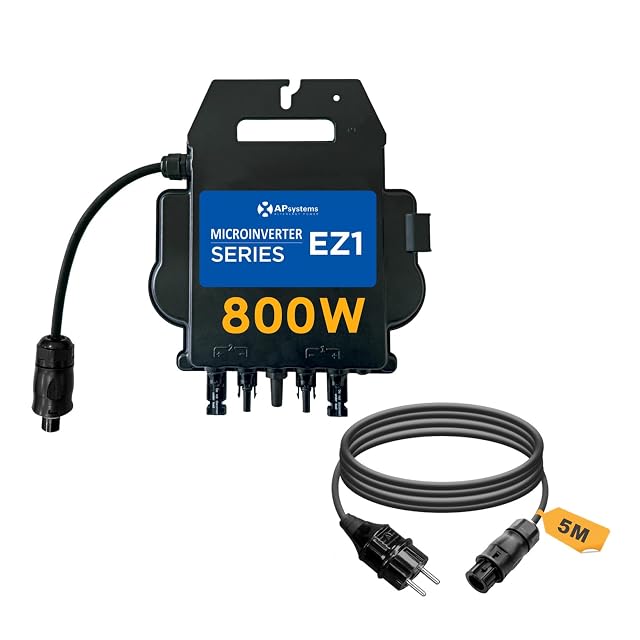
An 800 W APsystems micro-inverter and the only one in this family to publish its input window: 28 to 45 V at the maximum power point, 16 to 60 V operating, 60 V maximum.
Best for: Anyone who wants to check their panels against the inverter before buying either.
800 W · 2 MPPT inputs · limits not published · MPPT efficiency 99.8 %, peak 96.5 % · grid standard not named · monitoring not described · IP67 · MC4 plug and play
An 800 W micro-inverter with two independent MPPT channels quoted at 99.8 % tracking efficiency and 96.5 % peak conversion, with MC4 connectors and IP67 protection.
Best for: A straightforward two-panel balcony where monitoring is not wanted and MC4 is what the panels have.