Watt-hours say how long, watts say what you can plug in · review
OUPES Exodus 2400, 2232 Wh, 2400 W with a 4500 W peak review
A 2232 Wh LiFePO4 station rated 2400 W continuous with a 4500 W peak, thirteen outputs, a 20 ms uninterruptible switchover and a choice of fast or slow charging.
The bottom line The largest station here and the only one that lets its owner choose a gentler charge — a decision that matters more over ten years than any of the headline figures. Its three output numbers, none with a duration, are the weakest part of an otherwise unusually complete sheet.
A 2.2 kWh station built for household backup, with the most complete charging section of the nine.
Charging, four ways, each with its time
Hybrid mains-plus-solar at 2200 W reaches 80 % in 50 minutes. Mains alone at 1400 W takes 1.2 hours to the same point. Solar at 800 W takes two to four hours. A vehicle socket takes about fifteen. Publishing all four separately is what makes the sheet usable for planning rather than for comparing.
The choice most makers do not offer
Two charging speeds, 1400 W and 700 W, with the listing stating that the slower one preserves the pack. That is the single most consequential setting on a station kept for emergencies, and it is rare to see it published.
Where the numbers blur
2400 W continuous, 2600 W boost, 4500 W peak — three figures, no durations, and no definition of what boost means between the other two. And the capacity is 2232 Wh while the model is called 2400: the name refers to the output.
The cycle figure, done right
Over 3500 cycles at 80 % capacity. The count and its percentage together, which is what makes it comparable with the two other stations here that publish both.
Availability
German Amazon store quoted about 594 € when this page was compiled.
American, British, French, Italian and Spanish Amazon catalogues carry an entry for it, with nobody selling.
These figures are what Keepa reported on the day this page was last updated. Availability and pricing move without notice.
Prices quoted in this text were read on 16 September 2026. The live price is at the top of the page.
What it gets right, and what it leaves out
Strengths
A slow charging rate is offered explicitly, and the listing says it preserves battery life — the only unit here to publish that choice
The cycle count carries its capacity percentage
Four charging routes are quoted with a separate time for each, rather than one headline figure
Compromises
The model name says 2400 and the capacity is 2232 Wh — a 2400 in the name refers to the output, not the pack
Three output figures are published and none has a duration
The weight is given in pounds on a German listing, which makes it easy to misread
Specifications
Capacity
2232 Wh, fourth bullet — the model name says 2400 and the capacity says 2232; no usable figure is published
Continuous and surge output
2400 W continuous, 2600 W boost and 4500 W peak, second and third bullets; none of the three carries a duration
Chemistry
LiFePO4, fourth bullet, with a BMS named against over-charge, deep discharge, short circuit and over-heating
Cycle life
Over 3500 cycles at 80 % capacity, fourth bullet — the count carries its percentage
Recharge time
0 to 80 % in 50 minutes at a 2200 W hybrid input; mains alone 1.2 hours at 1400 W; solar 2 to 4 hours at 800 W; vehicle about 15 hours, fifth bullet
Output sockets
4× 230 V mains, 2× USB-C PD 140 W, 4× USB-A QC3.0 18 W, 2× DC5521, 1× vehicle socket, third bullet — thirteen in total
Published thermal limits
Absent as a figure; over-heating protection is named in the fourth bullet
Amazon reference
B0H19XCWHK (same reference on 6 Amazon marketplaces)
EAN
0717929573316
Questions owners ask about this one
Why offer a slower charging rate?
The first bullet states that slow charging preserves battery life and is more energy-efficient. Heat and high charge rates are what age lithium cells, so a published choice between 1400 W and 700 W is a genuine feature rather than a limitation.
What is the difference between boost and peak here?
The listing gives 2400 W continuous, 2600 W boost and 4500 W peak without defining the middle term or attaching a duration to any of them. Three figures and no conditions is less informative than one figure with its seconds.
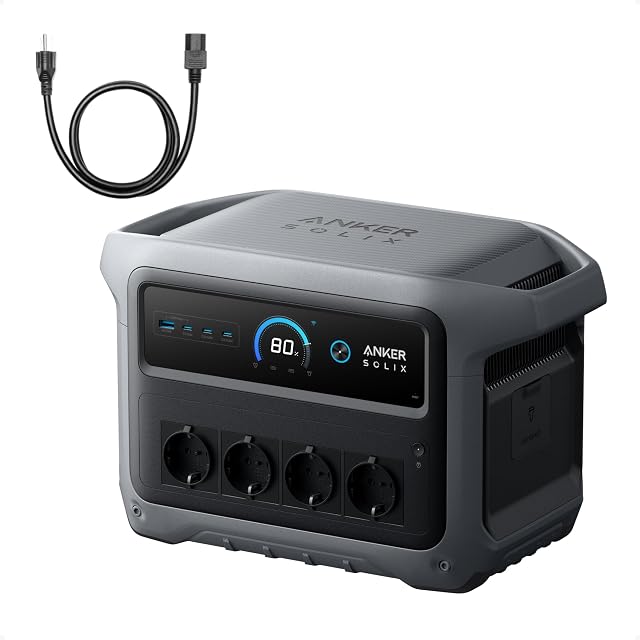
1024 Wh nominal · 2000 W continuous, 3000 W peak · 4000 cycles to 80 % · full in 49 min at 1600 W · 600 W solar at 60 V max · 10 ms UPS · 9 ports
A 1024 Wh station rated 2000 W continuous and 3000 W peak, charged in a stated 49 minutes at 1600 W, with a 600 W solar input capped at 60 V and a 10 ms switchover.
Best for: A household that will pair the station with panels and wants the input window published rather than guessed.
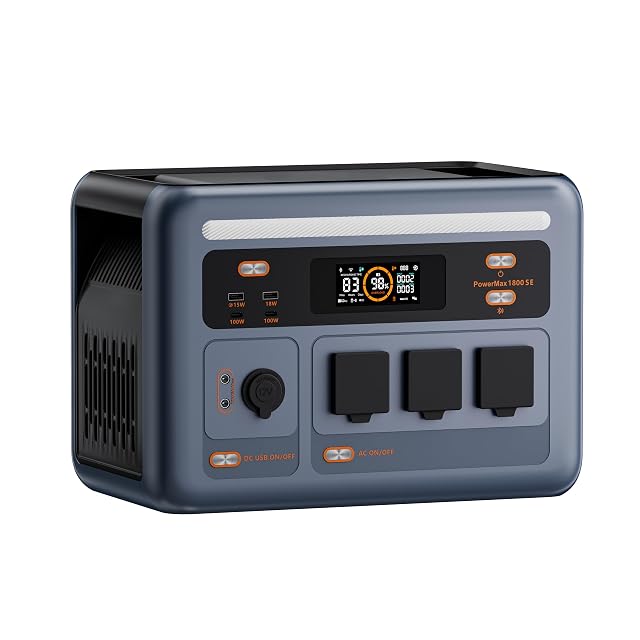
1024 Wh nominal · 1800 W · LiFePO4, 3500+ cycles · 0–80 % in 1 h at 800 W · 11 outputs · 14 kg · app control
A 1024 Wh LiFePO4 station rated 1800 W with eleven outputs, charged from 0 to 80 % in a stated hour at 800 W, and controllable from a phone application.
Best for: A household that wants three mains sockets and app monitoring rather than the lightest unit on the shelf.
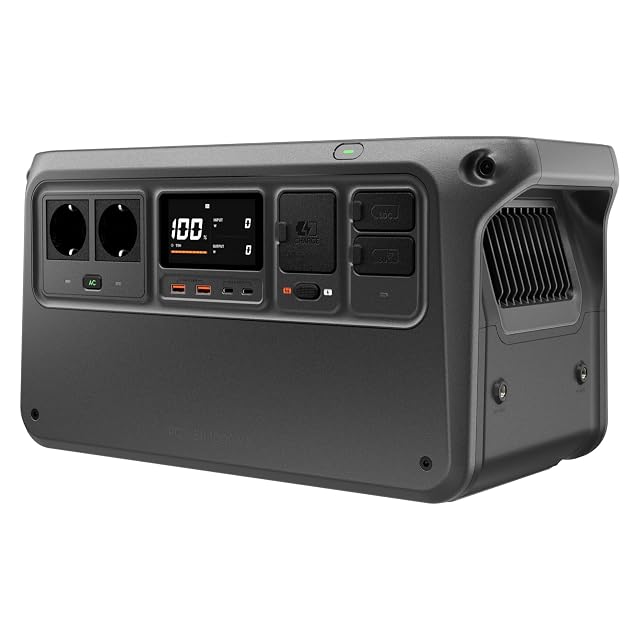
1024 Wh nominal LFP · 2600 W · 0–80 % in 37 min · 10 ms UPS switchover · 26 dB stated · 2× 140 W USB-C · 5-year warranty
A 1024 Wh LFP station rated 2600 W that reaches 80 % in a stated 37 minutes, switches to battery in 10 ms, and carries two 140 W USB-C ports and a five-year warranty.
Best for: Someone already inside the DJI ecosystem, or anyone who needs the shortest recharge and a documented switchover time.