Watt-hours say how long, watts say what you can plug in · review
OUKITEL P800E, 512 Wh, 800 W with a 1600 W peak review
A 512 Wh LiFePO4 station rated 800 W continuous and 1600 W peak, charged to full in a stated 60 minutes at 500 W, with an uninterruptible switchover quoted under 10 ms.
The bottom line The best-specified mid-size station in this group on the two figures that decide an outage: a published time to full rather than to 80 %, and a switchover time in milliseconds. Its cycle count is the usual unqualified figure, and its noise claim has no distance.
A 512 Wh station aimed squarely at short outages rather than at camping.
The two figures that matter here
A full charge in 60 minutes at 500 W, published as a time to 100 % rather than to 80 % — which is the comparison most of this shelf avoids. And a switchover under 10 ms, which is the number that decides whether a computer or a router rides through a mains failure.
What 800 W covers and what it does not
Eight outputs, with 800 W continuous and a 1600 W peak. That runs a fridge, a router, lights and a laptop comfortably. A kettle or a heater is a different arithmetic: at that draw, 512 Wh is measured in minutes.
The naming problem
Amazon records the brand as ROTKUSZ. The title and every bullet describe an OUKITEL P800E, and the part number is P800E. This page carries OUKITEL, and says so here rather than leaving the discrepancy to be noticed.
What the sheet leaves open
The 4000+ cycle count has no percentage attached. The 29 dB claim has no distance. And, as everywhere on this shelf, the 512 Wh is nominal rather than usable.
Availability
German, Italian and Spanish Amazon stores quoted 239 € to 269 € when this page was compiled.
American Amazon catalogue carries an entry for it, with nobody selling.
British and French Amazon stores returned nothing at all, so the buy button there runs a search instead of landing on an empty page.
These figures are what Keepa reported on the day this page was last updated. Availability and pricing move without notice.
Prices quoted in this text were read on 16 September 2026. The live price is at the top of the page.
What it gets right, and what it leaves out
Strengths
A time to FULL is published rather than a time to 80 %, which makes it comparable with a mains charger
Switchover under 10 ms is stated, which is the figure that decides whether a computer restarts
800 W continuous covers most household appliances that are not heating elements
Compromises
The brand on the listing and the brand in the title disagree — sold under ROTKUSZ, described throughout as OUKITEL
The 4000+ cycle count has no capacity percentage beside it
The 29 dB noise figure is quoted without a distance, so it compares to nothing
Specifications
Capacity
512 Wh, second bullet; no usable figure is published
Continuous and surge output
800 W continuous with a 1600 W peak, second bullet; the peak carries no duration
Chemistry
LiFePO4, second and fourth bullets
Cycle life
4000+ cycles, fourth bullet, stated as a life of up to 10 years; no capacity percentage accompanies the count
Recharge time
100 % in 60 minutes at a stated 500 W input, third bullet, with mains and solar combinable
Output sockets
1× 800 W AC, 1× USB-C PD 100 W, 2× USB-A 12 W QC3.0, 1× USB-C 18 W, 2× DC5521, 1× vehicle socket, second bullet
Published thermal limits
Absent as a figure; over-heating protection is named in the sixth bullet, with a stated noise level of ≤ 29 dB and no distance
Amazon reference
B0H73N6Y6L (same reference on 4 Amazon marketplaces)
EAN
0701151512021
Questions owners ask about this one
Does the 10 ms switchover make this a UPS?
The listing describes it as automatic switching to battery in under 10 ms and names computers, servers, fridges and aquariums. Whether that suits a particular device is a question for that device’s own tolerance, and the manual is where the behaviour is specified.
Why does the recorded brand differ from the title?
Amazon records ROTKUSZ as the brand while the title and all six bullets describe an OUKITEL P800E. The seller and the maker are different parties here, and this page carries the maker’s name.
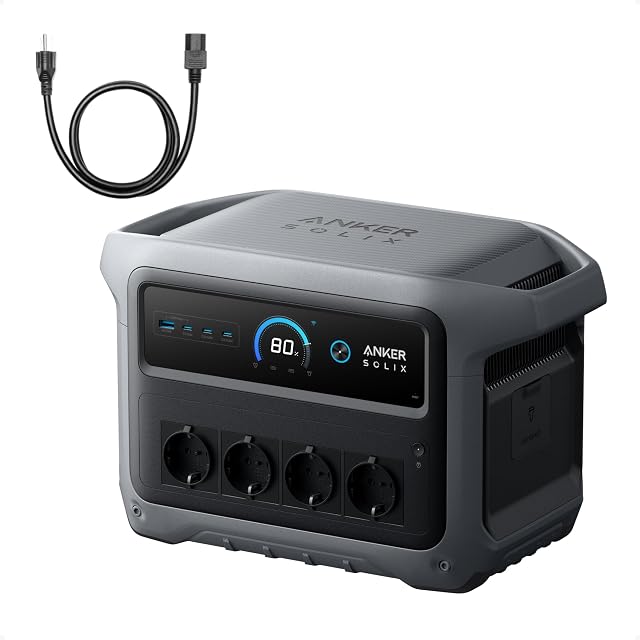
1024 Wh nominal · 2000 W continuous, 3000 W peak · 4000 cycles to 80 % · full in 49 min at 1600 W · 600 W solar at 60 V max · 10 ms UPS · 9 ports
A 1024 Wh station rated 2000 W continuous and 3000 W peak, charged in a stated 49 minutes at 1600 W, with a 600 W solar input capped at 60 V and a 10 ms switchover.
Best for: A household that will pair the station with panels and wants the input window published rather than guessed.
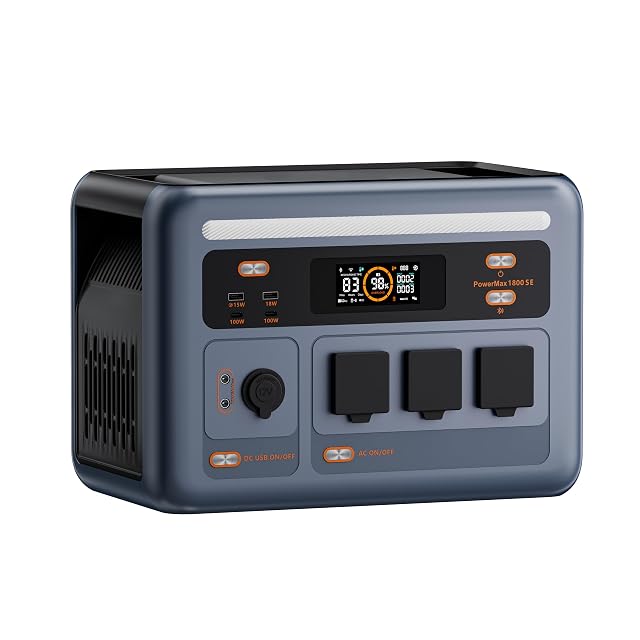
1024 Wh nominal · 1800 W · LiFePO4, 3500+ cycles · 0–80 % in 1 h at 800 W · 11 outputs · 14 kg · app control
A 1024 Wh LiFePO4 station rated 1800 W with eleven outputs, charged from 0 to 80 % in a stated hour at 800 W, and controllable from a phone application.
Best for: A household that wants three mains sockets and app monitoring rather than the lightest unit on the shelf.
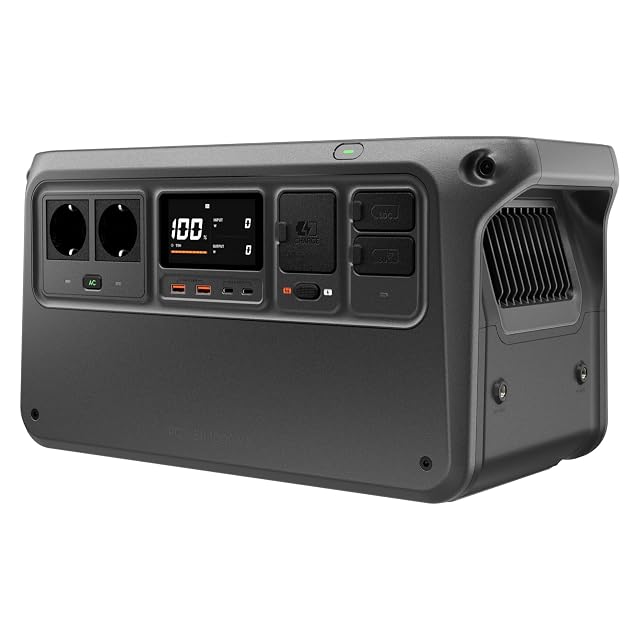
1024 Wh nominal LFP · 2600 W · 0–80 % in 37 min · 10 ms UPS switchover · 26 dB stated · 2× 140 W USB-C · 5-year warranty
A 1024 Wh LFP station rated 2600 W that reaches 80 % in a stated 37 minutes, switches to battery in 10 ms, and carries two 140 W USB-C ports and a five-year warranty.
Best for: Someone already inside the DJI ecosystem, or anyone who needs the shortest recharge and a documented switchover time.