The bottom line The only inverter here with a remote control and a published fan threshold, both of which matter when the unit is mounted out of sight. Its certification list is market access rather than performance, and it publishes neither idle draw nor efficiency.
A 1000 W inverter designed to be installed where you cannot reach it.
The remote
A wired remote control with its own display, mirroring input voltage, output power and status. That is what makes an under-seat or locker installation practical — the inverter goes where the cable is short and the control goes where you are.
The fan threshold
40 °C, published. Below it the fan does not run. That is the difference between a quiet cabin and a constant hum, and it is the only fan specification in this family with a number attached.
The certifications, read properly
CE, ISO and RoHS are named. CE is a manufacturer’s declaration of conformity with EU market access requirements. RoHS restricts hazardous substances. ISO without a number identifies nothing. None of the three describes conversion quality, and this page does not present them as though they did.
The eight protections
Counted in the fourth bullet, with over-voltage and under-voltage named. The other six are not identified.
What is absent
Idle consumption and efficiency — the two figures that describe what it costs to own rather than what it can do.
Availability
German, French, Italian and Spanish Amazon stores quoted 144 € to 170 € when this page was compiled.
British Amazon store carries it too, priced in its own currency, which the euro range above deliberately omits.
American Amazon store returned nothing at all, so the buy button there runs a search instead of landing on an empty page.
These figures are what Keepa reported on the day this page was last updated. Availability and pricing move without notice.
Prices quoted in this text were read on 16 September 2026. The live price is at the top of the page.
What it gets right, and what it leaves out
Strengths
A remote control with its own display, so the inverter can be mounted out of reach
The fan threshold is published — 40 °C — which nothing else in this family gives
Both displays show input voltage and output power, which makes the battery state visible
Compromises
CE and RoHS are market access and materials rules rather than performance certifications
No idle consumption and no efficiency
Eight protections are counted and only two are named
Specifications
Waveform
Pure sine, first bullet
Continuous and surge output
1000 W continuous with 2000 W peak, first bullet; the peak carries no duration
Idle consumption
Nowhere in the listing
Efficiency
Nowhere in the listing
Input range
12 V DC, first bullet; no voltage range is published
Protections
Eight built-in protections including over-voltage and under-voltage, with CE, ISO and RoHS named, fourth bullet
Cooling
Intelligent fan starting only when the case exceeds 40 °C, fifth bullet, in a robust metal case
Amazon reference
B0FGJ9HKCS (same reference on 5 Amazon marketplaces)
EAN
0700433790393
Questions owners ask about this one
Why does a published fan threshold matter?
Because a fan that runs constantly is noise and a small standing draw; one that starts at 40 °C is silent most of the time. Publishing the temperature turns “intelligent fan” into something checkable, and no other inverter here does it.
Is CE certification a quality mark?
No. CE is a manufacturer’s declaration that the product meets the EU requirements applying to it — market access rather than performance. RoHS restricts hazardous substances. Neither describes how well the inverter converts.
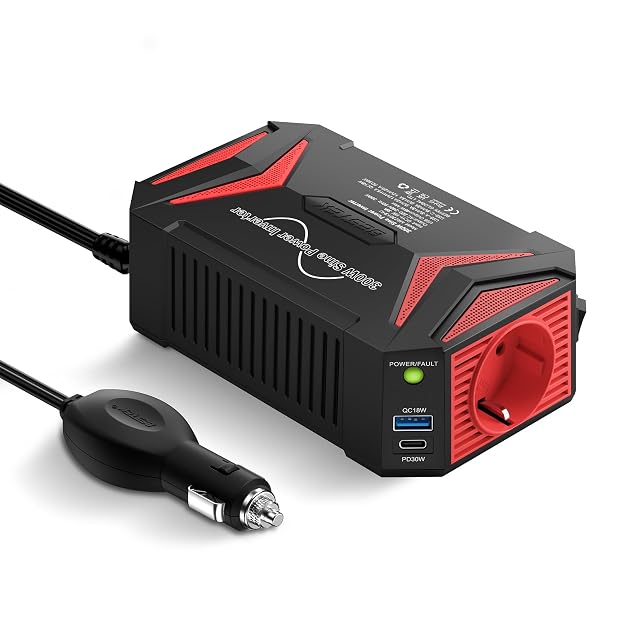
pure sine · 300 W continuous, 700 W peak, duration not stated · idle consumption not published · efficiency not published · 12 V input with a 40 A fuse · short circuit, temperature, under and over-voltage · variable-speed cooling fan
A 300 W pure sine inverter with a 700 W peak, a built-in 40 A fuse, a 38 W USB-C fast-charging port and a variable-speed cooling fan.
Best for: A car where the load is a laptop and phones, and where the cigarette lighter socket rating has been checked first.
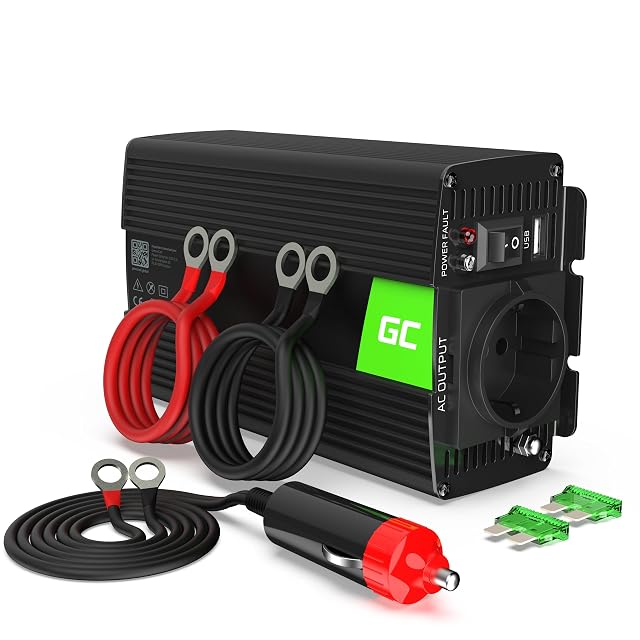
pure sine · 300 W continuous, 600 W peak, duration not stated · idle consumption not published · efficiency not published · 12 V input · protections named without a list · cooling not described
A 300 W pure sine inverter with a 600 W short-term peak, mains sockets and a USB port for small devices, sold with safety certifications named but not identified.
Best for: Occasional use from a car battery where the loads are small and the inverter is switched off between them.
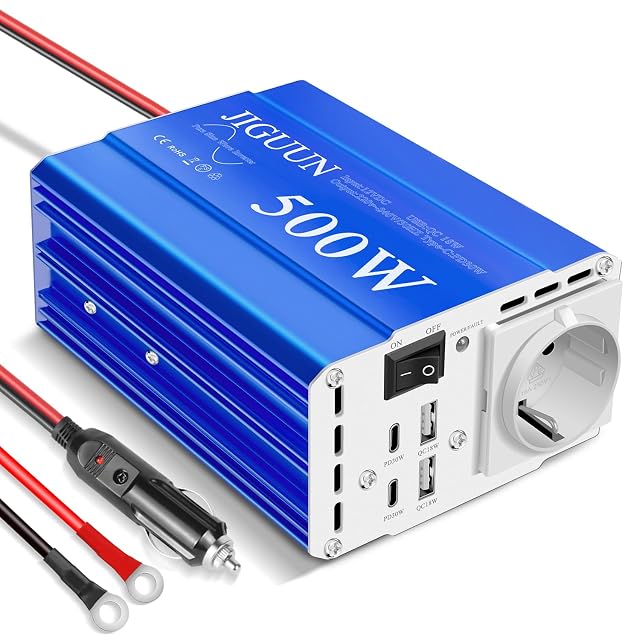
pure sine · 500 W continuous, 1000 W peak, duration not stated · idle consumption not published · conversion efficiency above 92 % · 12 V input · overload, over-voltage, under-voltage, short circuit, over-heating · quiet high-speed fan, soft start
A 500 W pure sine inverter with a 1000 W peak, two 30 W USB-C PD ports and two QC 3.0 ports, quoted at above 92 % conversion efficiency with soft-start technology.
Best for: A van or a car where laptops and phones are the main loads and the USB ports do most of the work.