Modified sine is cheaper, and some appliances refuse it outright · review
JIGUUN 500 W pure sine, 12 V to 230 V, 1000 W peak review
A 500 W pure sine inverter with a 1000 W peak, two 30 W USB-C PD ports and two QC 3.0 ports, quoted at above 92 % conversion efficiency with soft-start technology.
The bottom line The best USB provision in this family and one of only two inverters here to publish an efficiency. It omits idle consumption, which on a unit with a fan is the number that quietly empties a battery.
A 500 W pure sine inverter built around its USB ports.
The ports
Two USB-C PD at 30 W and two QC 3.0, alongside the mains socket. Everything charged through those skips the 230 V conversion, which is where the losses are. For a van running laptops and phones, that is most of the daily load handled efficiently.
The efficiency, published
Above 92 % conversion. Only the Victron in this family also publishes a figure. What is missing is the load it was measured at — efficiency is a curve and this is one point on it.
Soft start
Named in the fourth bullet. It ramps the output rather than applying it instantly, which is what allows a motor to start on a modest inverter. More useful than a peak figure with no duration, which is what every inverter here offers instead.
The blank that matters
Idle consumption. This unit has a fan and control electronics, and both draw current with nothing plugged in. Left switched on overnight in a van, that draw is the largest single line in the budget, and it is not published.
Availability
German, French, Italian and Spanish Amazon stores quoted 60 € to 70 € when this page was compiled.
American and British Amazon stores returned nothing at all, so the buy button there runs a search instead of landing on an empty page.
These figures are what Keepa reported on the day this page was last updated. Availability and pricing move without notice.
Prices quoted in this text were read on 16 September 2026. The live price is at the top of the page.
What it gets right, and what it leaves out
Strengths
A conversion efficiency is published, which six of the eight inverters here omit
Two 30 W USB-C PD ports and two QC 3.0 ports, which is the best USB provision in this family
Soft-start technology is named, which is what eases a motor onto the output
Compromises
No idle consumption, which on a fan-cooled inverter is the figure that matters overnight
The 1000 W peak carries no duration
No input voltage range, so the low-voltage cut-off is unknown
Specifications
Waveform
Pure sine, first bullet, described as cleaner, more stable and quieter
Continuous and surge output
500 W continuous with a 1000 W peak, first bullet; the peak carries no duration
Idle consumption
Nowhere in the listing
Efficiency
Conversion efficiency above 92 %, first bullet — one of only two in this family to publish a figure
Input range
12 V DC, first bullet; no voltage range is published
Protections
Overload, over-voltage, under-voltage, short circuit and over-heating, fourth bullet, with soft-start technology
Cooling
Quiet high-speed fan, fourth bullet
Amazon reference
B0GYDPL7L4 (same reference on 4 Amazon marketplaces)
EAN
0694743219791
Questions owners ask about this one
What does soft start do?
It ramps the output up rather than applying it instantly, which reduces the current spike when a motor or a transformer is switched on. It is the feature that decides whether a given appliance starts on a modest inverter, and naming it is more useful than a larger peak figure without a duration.
Is “above 92 %” a good efficiency?
It is a plausible figure for a small inverter, and it is published, which two of the eight here manage. What it does not say is at which load it was measured — efficiency is a curve, and 92 % at full output tells you nothing about 10 W.
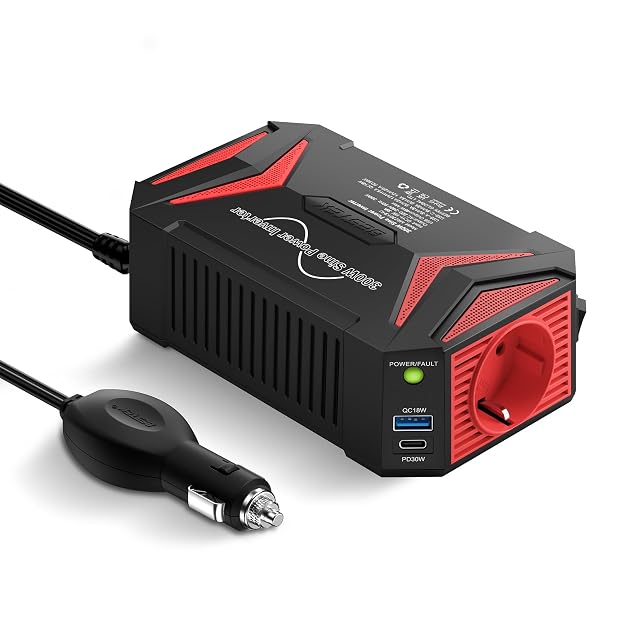
pure sine · 300 W continuous, 700 W peak, duration not stated · idle consumption not published · efficiency not published · 12 V input with a 40 A fuse · short circuit, temperature, under and over-voltage · variable-speed cooling fan
A 300 W pure sine inverter with a 700 W peak, a built-in 40 A fuse, a 38 W USB-C fast-charging port and a variable-speed cooling fan.
Best for: A car where the load is a laptop and phones, and where the cigarette lighter socket rating has been checked first.
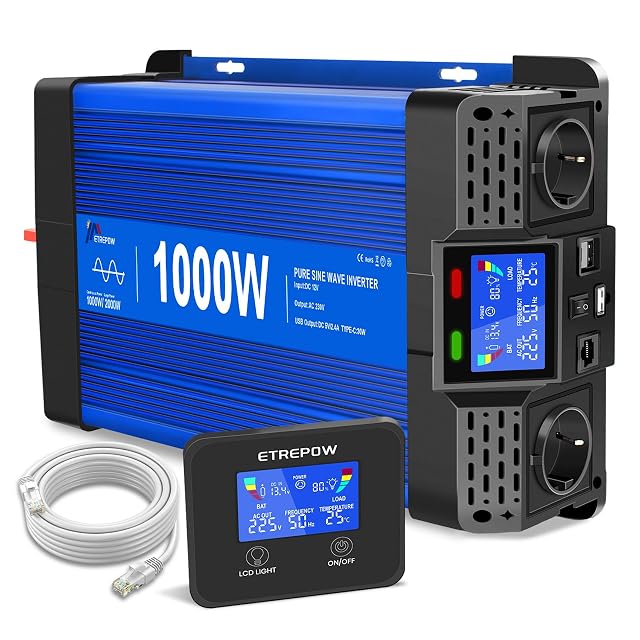
pure sine · 1000 W continuous, 2000 W peak, duration not stated · idle consumption not published · efficiency not published · 12 V input · eight protections named · fan starts above 40 °C, metal case
A 1000 W pure sine inverter with a wired remote control, dual displays showing input voltage and output power, and a fan that starts only above 40 °C.
Best for: An installation where the inverter lives under a seat or in a locker and has to be switched from the cabin.
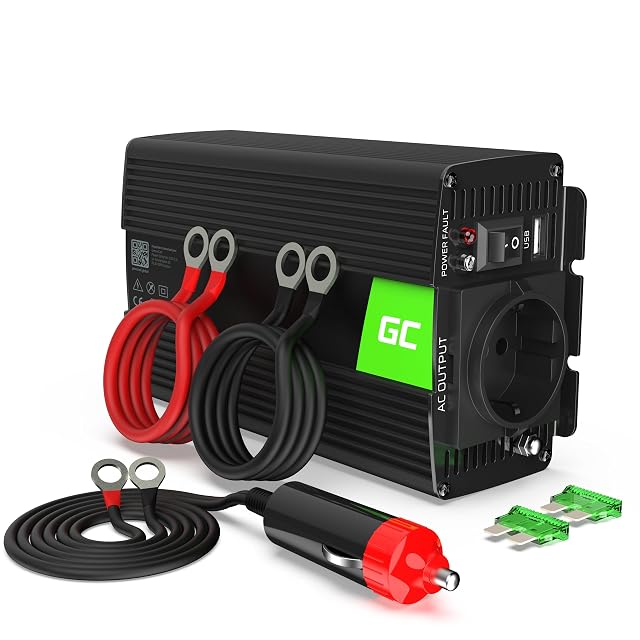
pure sine · 300 W continuous, 600 W peak, duration not stated · idle consumption not published · efficiency not published · 12 V input · protections named without a list · cooling not described
A 300 W pure sine inverter with a 600 W short-term peak, mains sockets and a USB port for small devices, sold with safety certifications named but not identified.
Best for: Occasional use from a car battery where the loads are small and the inverter is switched off between them.