Modified sine is cheaper, and some appliances refuse it outright · review
Renogy 2000 W pure sine, 12 V to 230 V, 4000 W peak, with mains priority review
A 2000 W pure sine inverter with a built-in mains priority changeover, two European sockets, a self-diagnosis system and published dimensions and weight.
The bottom line The only inverter here with a mains priority changeover and the only one to publish its dimensions. It publishes no transfer time for that changeover, which is the number the feature turns on.
A 2000 W inverter that stays between the shore supply and the equipment.
The changeover
Built-in mains priority: the shore supply passes through while it is present, and the inverter takes over when it is not. For a motorhome that moves between hookups, that means the fridge and the router never see a break.
Except that the figure describing the break is not published. Transfer time is what decides whether a computer restarts, and three power stations in this catalogue publish theirs in milliseconds. This inverter publishes none.
The dimensions
48.2 × 22 × 9.2 cm, 4.8 kg. The only inverter in this family to publish them, and the first thing an installation needs to know about a box this size.
The distortion claim
The fifth bullet describes high-quality waveforms with almost no harmonic distortion. Total harmonic distortion is a measured percentage, and no figure appears. It is the specification that distinguishes a good pure sine output from an adequate one.
The two blanks that run through this whole family
Idle consumption and efficiency. Eight inverters, one idle figure between them, two efficiency figures. On a 2000 W unit left switched on, the first is what empties a battery overnight.
Availability
German, French and Spanish Amazon stores quoted 209 € to 323 € when this page was compiled.
British and Italian Amazon catalogues carry an entry for it, with nobody selling.
American Amazon store returned nothing at all, so the buy button there runs a search instead of landing on an empty page.
These figures are what Keepa reported on the day this page was last updated. Availability and pricing move without notice.
Prices quoted in this text were read on 16 September 2026. The live price is at the top of the page.
What it gets right, and what it leaves out
Strengths
A mains priority changeover is built in, so connected equipment is never interrupted
Dimensions and weight are published — 48.2 × 22 × 9.2 cm, 4.8 kg — which nothing else here gives
A self-diagnosis system is named alongside the indicator lights
Compromises
No transfer time for the changeover, which is the figure that decides whether equipment restarts
Harmonic distortion is described as almost nil without a figure
No idle consumption and no efficiency, on the largest inverter here
Specifications
Waveform
Pure sine, second bullet, described as matching mains quality with almost no harmonic distortion
Continuous and surge output
2000 W continuous with a 4000 W peak at load start, first bullet; the peak carries no duration
Idle consumption
Nowhere in the listing
Efficiency
Nowhere in the listing
Input range
12 V DC, first bullet; no voltage range is published
Protections
Under-voltage, over-voltage, over-temperature, overload and short circuit with LED indicators and a self-diagnosis system, third bullet
Cooling
Cooling fan named in the third bullet; no threshold is published
Amazon reference
B07PXK2L83 (same reference on 5 Amazon marketplaces)
EAN
0810009711841
Questions owners ask about this one
What does mains priority actually do?
It passes the shore supply through while it is present and switches to the battery when it is not, so connected equipment stays live. The figure that decides whether a computer or a router rides through that switch is the transfer time, and this listing does not publish one.
Why publish dimensions on an inverter?
Because a 2000 W inverter is a large box that has to go under a seat or in a locker, with clearance for its fan. This is the only inverter in this family to publish its size and weight, and it is the first question an installation asks.
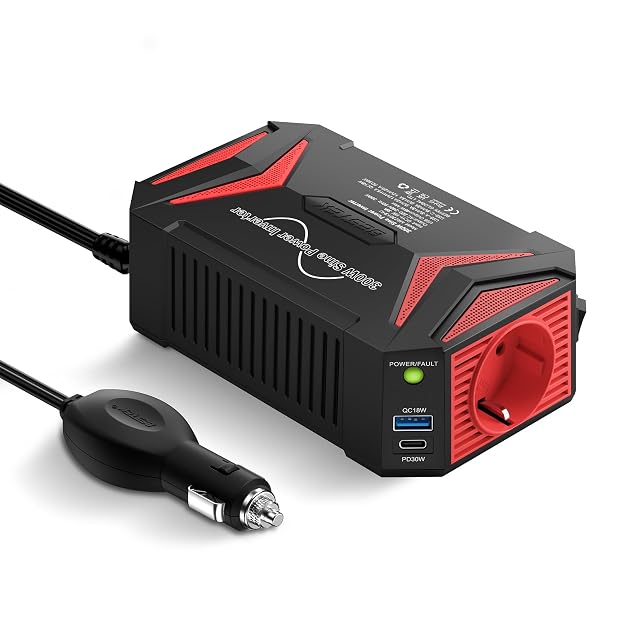
pure sine · 300 W continuous, 700 W peak, duration not stated · idle consumption not published · efficiency not published · 12 V input with a 40 A fuse · short circuit, temperature, under and over-voltage · variable-speed cooling fan
A 300 W pure sine inverter with a 700 W peak, a built-in 40 A fuse, a 38 W USB-C fast-charging port and a variable-speed cooling fan.
Best for: A car where the load is a laptop and phones, and where the cigarette lighter socket rating has been checked first.
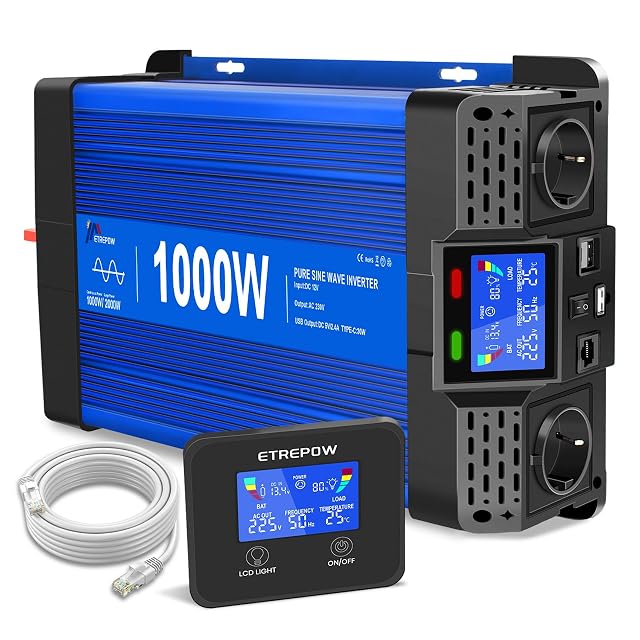
pure sine · 1000 W continuous, 2000 W peak, duration not stated · idle consumption not published · efficiency not published · 12 V input · eight protections named · fan starts above 40 °C, metal case
A 1000 W pure sine inverter with a wired remote control, dual displays showing input voltage and output power, and a fan that starts only above 40 °C.
Best for: An installation where the inverter lives under a seat or in a locker and has to be switched from the cabin.
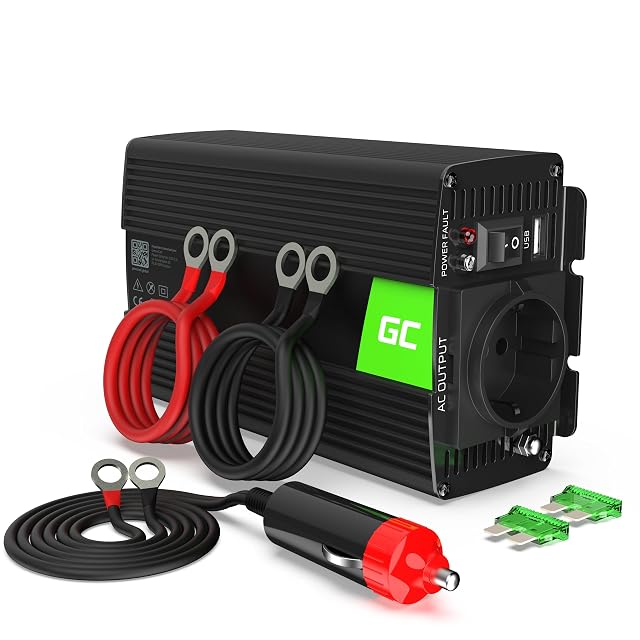
pure sine · 300 W continuous, 600 W peak, duration not stated · idle consumption not published · efficiency not published · 12 V input · protections named without a list · cooling not described
A 300 W pure sine inverter with a 600 W short-term peak, mains sockets and a USB port for small devices, sold with safety certifications named but not identified.
Best for: Occasional use from a car battery where the loads are small and the inverter is switched off between them.