Modified sine is cheaper, and some appliances refuse it outright · review
technaxx 2000 W pure sine, 12 V to 230 V, 4000 W peak, TÜV Rheinland review
A 2000 W pure sine inverter certified by TÜV Rheinland, with two mains sockets, USB-A QC 3.0 and USB-C, an LCD display and automatic shutdown at low battery voltage.
The bottom line The only inverter in this family with a named certification body, two mains sockets and a proper display. Its low-voltage shutdown threshold is cut off in its own listing, and it publishes neither idle draw nor efficiency on a 2000 W unit.
A 2000 W inverter with a certificate you can ask to see.
The body, named
TÜV Rheinland. Across eight inverters in this family, one identifies the organisation that tested it. That matters because a certificate from a named body can be requested and verified, while an unattributed claim cannot.
The outputs
Two Schuko sockets, USB-A with QC 3.0, and USB-C at 3 A. An LCD showing input voltage, output power and status. For a motorhome running two things at once, the second socket is the practical difference.
The figure that is cut off
Automatic shutdown at low battery voltage, with the threshold truncated in the listing text. That threshold is what protects the battery from being taken too far down, and it is the specification a lead-acid or lithium bank is matched against. It exists and it is not readable here.
The loads it names
Laptops, coffee machines, CPAP machines, audio systems, fridges. The CPAP is the one to pause on: medical devices specify their own supply, and that requirement comes from the device maker rather than from an inverter listing.
The two blanks
Idle consumption and efficiency, on a 2000 W unit that will spend most of its life delivering far less than that.
Availability
German, French, Italian and Spanish Amazon stores quoted 166 € to 207 € when this page was compiled.
American Amazon store carries it too, priced in its own currency, which the euro range above deliberately omits.
British Amazon store returned nothing at all, so the buy button there runs a search instead of landing on an empty page.
These figures are what Keepa reported on the day this page was last updated. Availability and pricing move without notice.
Prices quoted in this text were read on 16 September 2026. The live price is at the top of the page.
What it gets right, and what it leaves out
Strengths
TÜV Rheinland certification is named with the body identified, the only one in this family
Two mains sockets plus USB-A QC 3.0 and USB-C at 3 A
The LCD shows input voltage, output power and status together
Compromises
The low-voltage shutdown threshold is cut off mid-figure in the listing
No idle consumption and no efficiency, on the next-biggest inverter here
CPAP machines are named among suitable loads, which is a medical device decision the listing is not placed to make
Specifications
Waveform
Pure sine, first bullet
Continuous and surge output
2000 W continuous with 4000 W peak, first bullet; the peak carries no duration
Idle consumption
Nowhere in the listing
Efficiency
Nowhere in the listing
Input range
12 V DC with automatic shutdown at low battery voltage, fourth bullet; the threshold is cut off in the listing text
Protections
Overload, over-heating, short circuit, over-voltage and under-voltage, fourth bullet, with TÜV Rheinland certification named
Cooling
Integrated fan for active cooling, fourth bullet
Amazon reference
B09968J6TD (same reference on 5 Amazon marketplaces)
EAN
4260358124544
Questions owners ask about this one
What does a named certification body add?
It identifies who tested the product. TÜV Rheinland is a specific organisation whose certificate can be requested and checked; “certified” without a body cannot. Seven of the eight inverters in this family name no body at all.
Should a CPAP machine be run from this?
That is a question for the CPAP maker, not for an inverter listing. Medical devices specify their own supply requirements, and this page reports that the listing names them without endorsing the pairing.
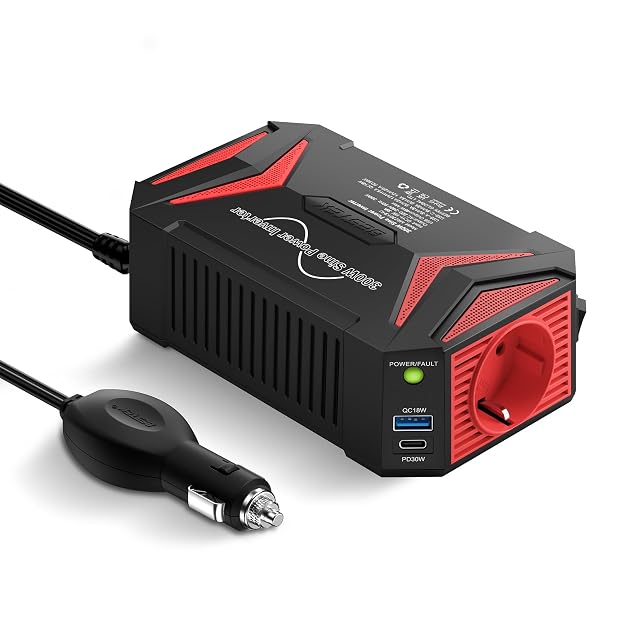
pure sine · 300 W continuous, 700 W peak, duration not stated · idle consumption not published · efficiency not published · 12 V input with a 40 A fuse · short circuit, temperature, under and over-voltage · variable-speed cooling fan
A 300 W pure sine inverter with a 700 W peak, a built-in 40 A fuse, a 38 W USB-C fast-charging port and a variable-speed cooling fan.
Best for: A car where the load is a laptop and phones, and where the cigarette lighter socket rating has been checked first.
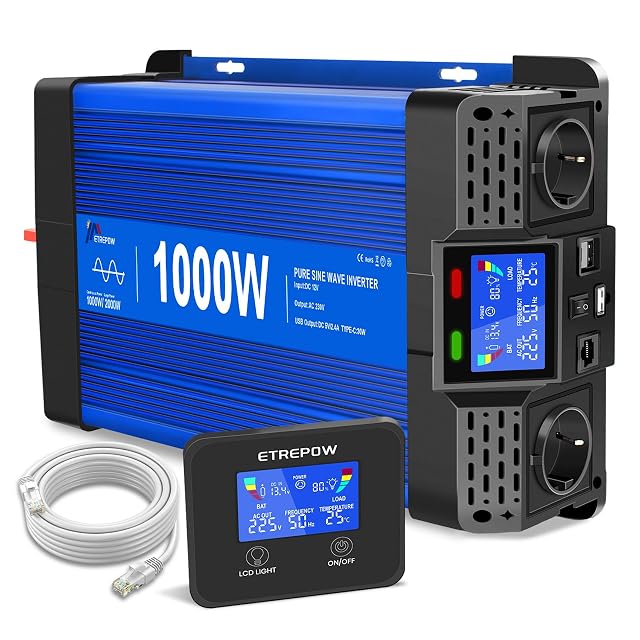
pure sine · 1000 W continuous, 2000 W peak, duration not stated · idle consumption not published · efficiency not published · 12 V input · eight protections named · fan starts above 40 °C, metal case
A 1000 W pure sine inverter with a wired remote control, dual displays showing input voltage and output power, and a fan that starts only above 40 °C.
Best for: An installation where the inverter lives under a seat or in a locker and has to be switched from the cabin.
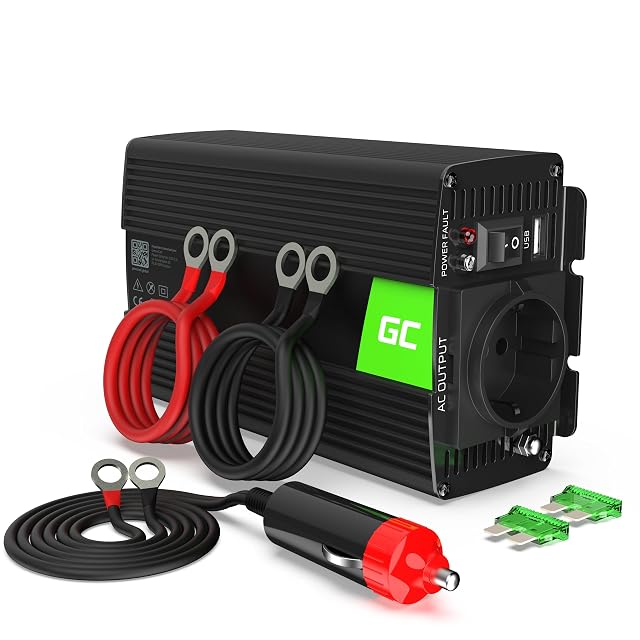
pure sine · 300 W continuous, 600 W peak, duration not stated · idle consumption not published · efficiency not published · 12 V input · protections named without a list · cooling not described
A 300 W pure sine inverter with a 600 W short-term peak, mains sockets and a USB port for small devices, sold with safety certifications named but not identified.
Best for: Occasional use from a car battery where the loads are small and the inverter is switched off between them.