Modified sine is cheaper, and some appliances refuse it outright · review
Victron Energy 500 VA pure sine, 12 V to 230 V, 900 W peak review
A 500 VA pure sine inverter drawing a stated 1 W in zero-load ECO mode, with a VE.Direct communication port and a high starting capability for motor loads.
The bottom line The only inverter in this family that publishes what it costs to leave switched on, which on a small system is the figure that decides the daily budget. It is rated in volt-amperes, lists no protections, and its communication cables are a separate purchase.
A 500 VA inverter whose most important number is the smallest one on the page.
One watt
In zero-load ECO mode. Across eight inverters in this family, one publishes an idle consumption and this is it. An inverter left switched on draws that current continuously, and over a night in a van the difference between 1 W and a typical unpublished figure is measured in amp-hours.
The rating convention
500 VA continuous, 900 W peak. Volt-amperes describe what the inverter must supply; watts describe what a resistive load consumes. The two are quoted in different units on the same line, which makes a direct comparison with a watt-rated competitor impossible without the power factor.
The communication port
VE.Direct, for operation and monitoring from a computer, tablet or phone. The third bullet states that cables and dongles are sold separately — an honest line, and a second purchase to budget for.
The starting capability
Described specifically: LED lamp drivers and power tools. Those are the loads that fail on a small inverter, and naming them is more useful than a peak figure.
What is absent
A protection list. An efficiency percentage. Any cooling description.
Availability
German, French, Italian and Spanish Amazon stores quoted 120 € to 169 € when this page was compiled.
British Amazon store carries it too, priced in its own currency, which the euro range above deliberately omits.
American Amazon catalogue carries an entry for it, with nobody selling.
These figures are what Keepa reported on the day this page was last updated. Availability and pricing move without notice.
Prices quoted in this text were read on 16 September 2026. The live price is at the top of the page.
What it gets right, and what it leaves out
Strengths
The only inverter in this family to publish an idle consumption — 1 W in ECO mode
A VE.Direct communication port for operation and monitoring from a computer, tablet or phone
High starting capability is described specifically for LED lamp drivers and power tools
Compromises
Rated in volt-amperes while its peak is in watts, which makes the two hard to compare
Cables and dongles for VE.Direct are sold separately, which the third bullet states
No protection list and no efficiency percentage
Specifications
Waveform
Pure sine, second bullet
Continuous and surge output
500 VA continuous with a 900 W peak, second bullet; the peak carries no duration
Idle consumption
1 W in zero-load ECO mode, second bullet — the ONLY inverter in this family to publish an idle figure
Efficiency
Described as high in the second bullet; no percentage is published
Input range
12 V DC from leisure or vehicle batteries, first bullet; no voltage range is published
Protections
Nowhere in the listing as a list
Cooling
Absent as a description; Hybrid HF technology is named in the fifth bullet as giving compact dimensions and low weight
Amazon reference
B01M159467 (same reference on 6 Amazon marketplaces)
EAN
8719076023616
Questions owners ask about this one
Why is 1 W idle so important?
Because an inverter left on draws that current all night. At 1 W the overnight cost is negligible; at ten or twenty times that — which is ordinary on this shelf — it becomes the largest single line in a small system’s daily budget. This is the only listing here that publishes the figure at all.
What is the difference between 500 VA and 500 W?
Volt-amperes describe what the unit must supply, watts what a resistive load consumes. For motors and transformers the two differ, and this inverter is rated in the first and quotes its peak in the second. Comparing it with a watt-rated competitor is not a like-for-like comparison.
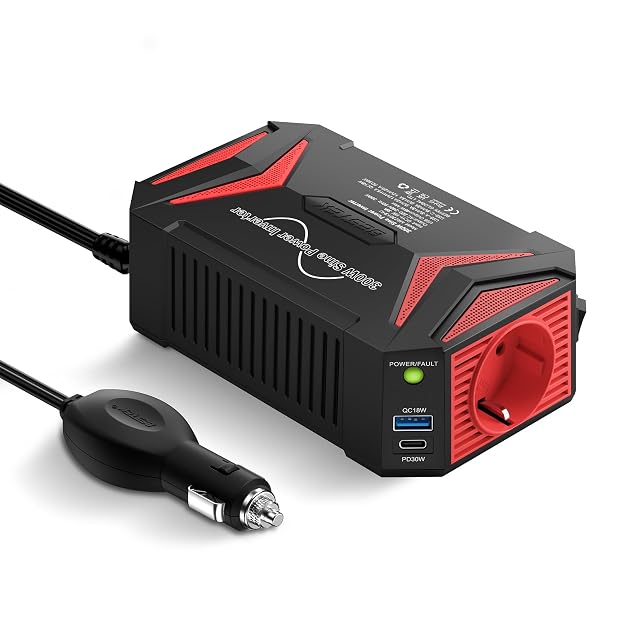
pure sine · 300 W continuous, 700 W peak, duration not stated · idle consumption not published · efficiency not published · 12 V input with a 40 A fuse · short circuit, temperature, under and over-voltage · variable-speed cooling fan
A 300 W pure sine inverter with a 700 W peak, a built-in 40 A fuse, a 38 W USB-C fast-charging port and a variable-speed cooling fan.
Best for: A car where the load is a laptop and phones, and where the cigarette lighter socket rating has been checked first.
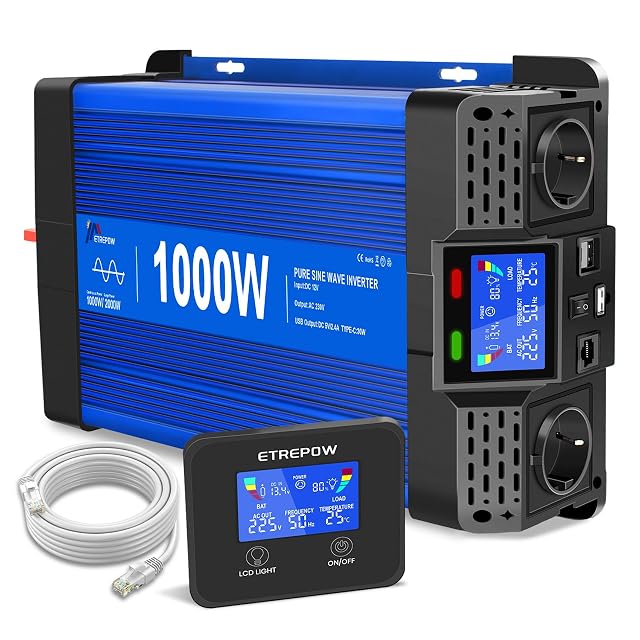
pure sine · 1000 W continuous, 2000 W peak, duration not stated · idle consumption not published · efficiency not published · 12 V input · eight protections named · fan starts above 40 °C, metal case
A 1000 W pure sine inverter with a wired remote control, dual displays showing input voltage and output power, and a fan that starts only above 40 °C.
Best for: An installation where the inverter lives under a seat or in a locker and has to be switched from the cabin.
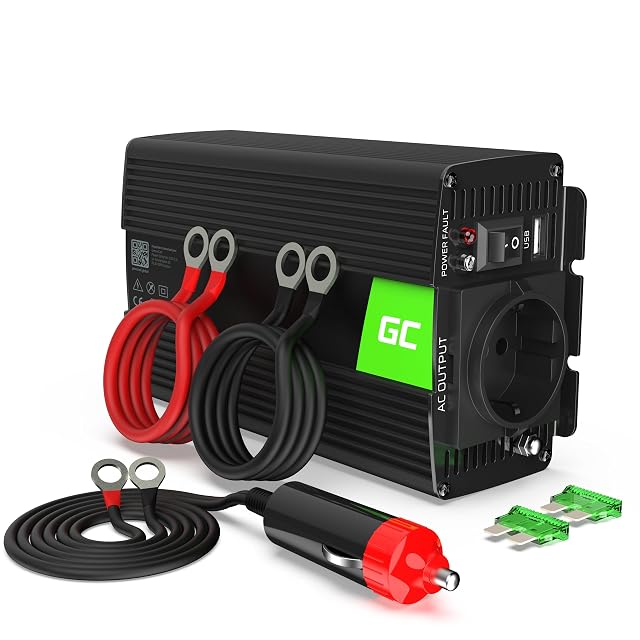
pure sine · 300 W continuous, 600 W peak, duration not stated · idle consumption not published · efficiency not published · 12 V input · protections named without a list · cooling not described
A 300 W pure sine inverter with a 600 W short-term peak, mains sockets and a USB port for small devices, sold with safety certifications named but not identified.
Best for: Occasional use from a car battery where the loads are small and the inverter is switched off between them.