The bottom line The only charger in this family that publishes its dimensions and puts a cable in the box, which together settle the two things a specification usually leaves open. The display is the distinctive part: temperature and per-port output on the charger itself rather than inferred from how hot it feels. What it shares with the other six is the gap that runs through the whole shelf — no Power Delivery profiles enumerated and no PPS statement, so which voltages it actually negotiates has to come from the maker.
A hundred watts, with the two missing pieces supplied.
The cable
1.5 m USB-C to USB-C, in the box.
Seven chargers in this family. Six leave the cable to the buyer, and the cable is exactly where a 100 W rating disappears without anybody noticing — a 60 W cable on a 100 W charger delivers 60 W, silently.
The dimensions
6.9 × 5.5 × 3.4 cm, with a folding plug. Published, which no other charger here does — they all say compact.
For something that goes in a bag, the three numbers are the specification.
The display
Charge state, temperature and per-port output, on the charger.
Temperature is the interesting one. A charger that runs hot is a charger working at its limit, and normally the only way to know is to touch it.
A hundred watts per port
The first bullet says the full 100 W is available over any USB-C port, and that peak output holds up to twice as long as conventional 100 W chargers. The first half is a specification; the second is a comparison without a named comparator.
The low-current mode
USB-C2 or USB-A drop to a 95 W + 5 W split when draw stays at or below 5 W for a minute. That is for earbuds and watches, which some fast chargers handle badly.
The trigger is published — a level and a duration — which is more than a mode name.
And the gap the whole shelf shares
No Power Delivery profiles enumerated. No PPS statement. Which voltages it negotiates, and whether it can track a phone’s battery voltage continuously, is not on this page or on any other in this family.
Availability
German, French, Italian and Spanish Amazon stores quoted 46 € to 57 € when this page was compiled.
American and British Amazon catalogues carry an entry for it, with nobody selling.
These figures are what Keepa reported on the day this page was last updated. Availability and pricing move without notice.
Prices quoted in this text were read on 16 September 2026. The live price is at the top of the page.
What it gets right, and what it leaves out
Strengths
It publishes its dimensions and supplies a cable, and nothing else in this family does either
A display showing temperature as well as output, which turns a charger into something observable
The low-current mode is described with its trigger: 5 W or below for one minute
Compromises
No Power Delivery profiles and no PPS, like every charger in this family
A display is another thing that can fail on a device meant to be ignored
A folding plug is a mechanism, and mechanisms wear
Specifications
Total output
100 W, from the title and first bullet
Per-port wattage
A full 100 W over ANY USB-C port, first bullet — stated per port rather than as a single maximum
Sharing
Three ports; USB-C2 or USB-A switch automatically into a 95 W + 5 W low-current mode when draw stays at or below 5 W for one minute, fourth bullet
Power Delivery profiles
Nowhere in the listing
PPS
Nowhere in the listing
Construction
GaN with a folding plug, second and third bullets; a high-resolution smart display shows charge state, temperature and port output
Dimensions
6.9 × 5.5 × 3.4 cm, described as a 30 % smaller housing, third bullet — the only charger in this family to publish its size
Cable requirements
A 1.5 m USB-C to USB-C cable is supplied in the box, fifth bullet — the only charger in this family to include one
Amazon reference
B0FG77P8RR (same reference on 6 Amazon marketplaces)
EAN
0194644245115
Questions owners ask about this one
Why does a supplied cable matter so much?
Because a 100 W charger with a 60 W cable delivers 60 W and says nothing about it. Seven chargers in this family; six leave the cable to the buyer, and the cable is where the rating quietly disappears.
What is the low-current mode for?
Small devices — earbuds, a watch, a tracker — that some fast chargers refuse to charge or charge erratically. Dropping to 5 W after a minute of low draw is the charger noticing what is plugged in and behaving accordingly.
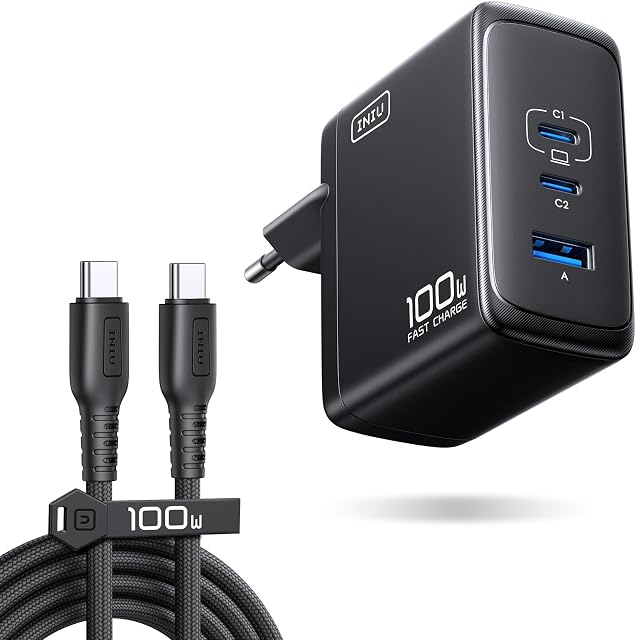
100 W total · per-port wattage not published · three devices simultaneously, split not published · Power Delivery profiles not enumerated · PPS not stated · construction not described · 30 % smaller than the original, no dimensions · 100 W USB-C cable included
A three-port 100 W charger supplied with a 1.5 m 100 W USB-C cable, described as 30 % smaller than an original laptop power supply.
Best for: Someone who wants one box that works out of it, cable included, without reading a specification.
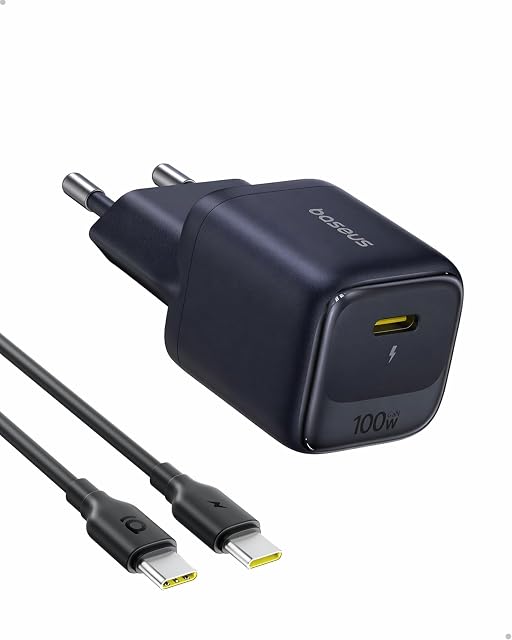
100 W total · strong single-port output, figure not published · sharing not published · PD 3.0 and QC 5.0 named · PPS supported · GaN with multi-stage protection · ultra-compact, no dimensions · cable not mentioned
A compact 100 W GaN charger supporting PD 3.0, QC 5.0 and PPS, with a multi-stage protection system described as keeping the case cool under load.
Best for: A traveller with a mixed set of devices spanning several charging standards.
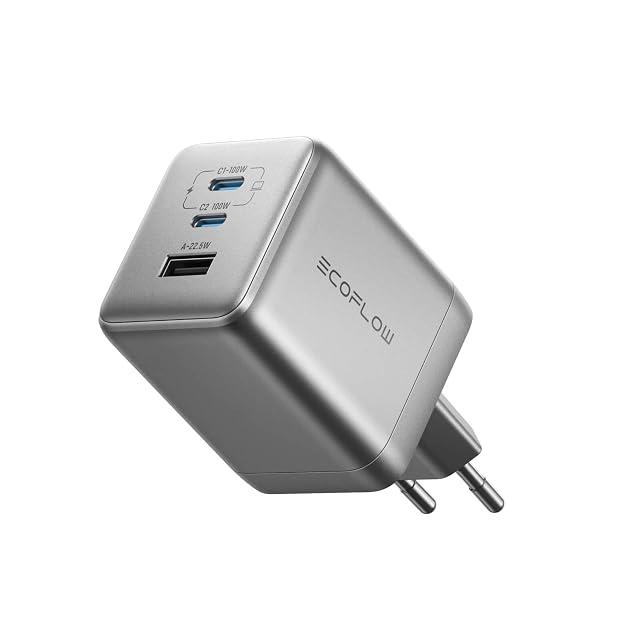
100 W total · per-port wattage not published · shared intelligently, split not published · Power Delivery profiles not enumerated · PPS not stated · GaN with a gravity-lock plug tested to 25 000 insertions · dimensions not published · cable not mentioned
A three-port 100 W GaN charger with a gravity-lock plug rated for 25 000 insertions and stated to hold 0.6 kg without slipping from the socket.
Best for: A desk or a hotel room where the charger has to stay in a loose socket.