Skip to content

Jackery Explorer 300D, 288 Wh, 300 W DC output vs Anker SOLIX C1000 Gen 2, 1024 Wh, 2000 W with a 3000 W peak

A station you carry, or a station that runs the house for an evening?

These two are not really competing for the same buyer, and the comparison is useful precisely because of that. One holds 288 Wh and weighs about two and a half kilos. The other holds 1024 Wh and delivers 2000 W continuous. The first goes in a rucksack; the second sits on a floor and runs a fridge. What makes them worth putting side by side is how differently they document themselves. Both publish a cycle count of 4000, and only one attaches a remaining-capacity figure to it — which is the difference between a number and a specification.

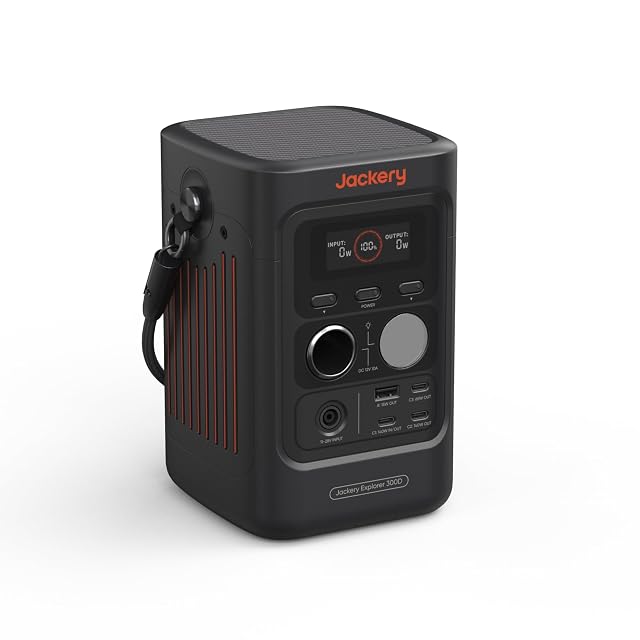
Jackery Explorer 300D power station standing upright with its integrated USB-C cable handle

Jackery Explorer 300D, 288 Wh, 300 W DC output

Wins 3 of 7

Check price

≈ £149 / €159

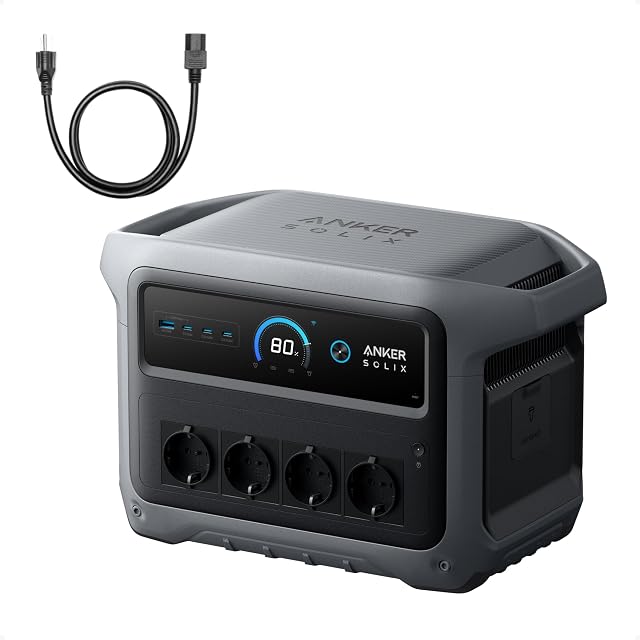
Anker SOLIX C1000 Gen 2 power station with nine ports across its front panel

Anker SOLIX C1000 Gen 2, 1024 Wh, 2000 W with a 3000 W peak

Wins 4 of 7

Check price

≈ $599 / £499 / €600

Line by line

Compared on Explorer 300D, 288 Wh, 300 W DC output SOLIX C1000 Gen 2, 1024 Wh, 2000 W with a 3000 W peak
Capacity 288 Wh, second bullet, also written as 90 000 mAh; no usable figure is published 1024 Wh, second bullet; no usable figure is published
Continuous and surge output 300 W DC, second bullet; no surge figure is published 2000 W continuous and 3000 W peak, second bullet; the peak carries no duration
Chemistry LiFePO4, fifth bullet Not named in the bullets; the fourth bullet describes the pack only as “InfiniPower”
Cycle life Up to 4000 charge cycles, fifth bullet, stated as “designed for up to 10 years”; no capacity percentage accompanies the count 4000 cycles with at least 80 % capacity remaining, fourth bullet — the count carries its percentage
Recharge time Up to 80 % in about 70 minutes with USB-C and solar combined, fourth bullet; no full-charge time is given Full in 49 minutes at 1600 W, activated through the application, first bullet; solar 1.8 hours at up to 600 W and 60 V maximum, fifth bullet
Output sockets 1× USB-A at 15 W, 3× USB-C (two at 140 W, one at 65 W), 1× 12 V vehicle port at 120 W, second bullet Nine ports serving up to nine devices at once, second bullet; the individual types are not enumerated
Published thermal limits −15 °C to 45 °C operating range, fifth bullet, with a stated 0 dB operation Nowhere in the listing

A tick means one listing published something the other did not, or published a better figure. It does not mean the product is better, and the column is not a score out of anything: a maker who says less loses lines here without losing a comparison. The two verdicts below are where the page is settled.

Which one, for whom

Buy the Jackery Explorer 300D, 288 Wh, 300 W DC output

The smaller station wins the lines where a specification was written down rather than a total: it names its chemistry, it publishes a temperature range at both ends, and it enumerates every socket with its wattage. For a rucksack, a tent or a desk, that is a complete picture of a modest machine.

Buy the Anker SOLIX C1000 Gen 2, 1024 Wh, 2000 W with a 3000 W peak

The larger station wins on every figure of scale, and it wins the cycle-life line for a different reason — it is the one that says 4000 cycles to 80 % capacity rather than 4000 cycles to nowhere in particular. What it will not tell you is what is in the pack. “InfiniPower” is a name, not a chemistry, and on a battery that is the specification that decides whether it is still useful in five years.

Questions this pairing raises

Why does the smaller station win the chemistry line?

Because it names one. LiFePO4 and NMC age very differently, tolerate heat differently and behave differently when left partly charged. One listing states which it is; the other gives a marketing name for the pack. A named chemistry beats an unnamed one regardless of which is bigger.

Is 4000 cycles the same figure on both?

Not quite. One states 4000 cycles with at least 80 % capacity remaining; the other states up to 4000 cycles and adds a ten-year design life. A cycle count without an end-of-life capacity does not say what condition the battery is in when it gets there.

Does 300 W mean it cannot run much?

It means it cannot run much at once. Three hundred watts covers laptops, lights, phones, a small fridge compressor. It does not cover a kettle, a heater or a microwave, and no amount of stored energy changes that — the output rating is a separate ceiling from the capacity.

The full reviews

  • Jackery Explorer 300D, 288 Wh, 300 W DC output

    288 Wh nominal · 300 W DC · LiFePO4, 4000 cycles · 80 % in about 70 min on USB-C plus solar · 5 outputs · about 2.5 kg

    A 288 Wh LiFePO4 station rated 300 W, charged over USB-C, solar or a car socket, with three USB-C ports of which two are rated 140 W and an integrated cable that doubles as the handle.

    Best for: Someone charging laptops and cameras rather than running mains appliances, who wants a published temperature range.

    ≈ £149 / €159

  • Anker SOLIX C1000 Gen 2, 1024 Wh, 2000 W with a 3000 W peak

    1024 Wh nominal · 2000 W continuous, 3000 W peak · 4000 cycles to 80 % · full in 49 min at 1600 W · 600 W solar at 60 V max · 10 ms UPS · 9 ports

    A 1024 Wh station rated 2000 W continuous and 3000 W peak, charged in a stated 49 minutes at 1600 W, with a 600 W solar input capped at 60 V and a 10 ms switchover.

    Best for: A household that will pair the station with panels and wants the input window published rather than guessed.

    ≈ $599 / £499 / €600

A price quoted in the text of a PowerVerdict page dates from the day that page was written; the live figure beside each product is fetched while you read and replaces it.