Skip to content

Victron Energy SmartSolar MPPT 100/20, 20 A, 100 V PV maximum, 12/24/48 V vs Y&H 40 A, 12 V/24 V, dual USB, LCD

Is twice the current worth half the documentation?

One of these controllers is rated for half the current of the other and costs considerably more. That is the whole argument, and it is settled by one missing figure. A charge controller has two limits: how much current it can pass to the battery, and how much voltage it can take from the panels. Exceeding the first makes it get hot. Exceeding the second destroys it. One of these publishes both. The other publishes the first.

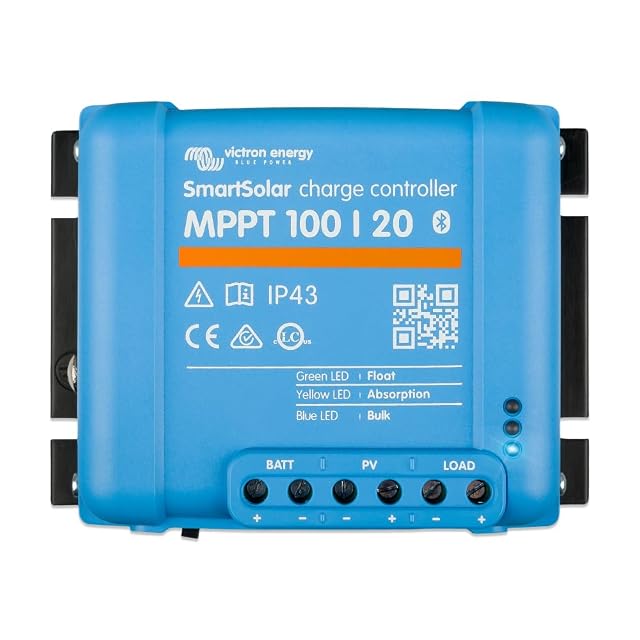
Victron Energy SmartSolar MPPT 100/20 charge controller

Victron Energy SmartSolar MPPT 100/20, 20 A, 100 V PV maximum, 12/24/48 V

Wins 3 of 7

Check price

≈ $79 / £70 / €71

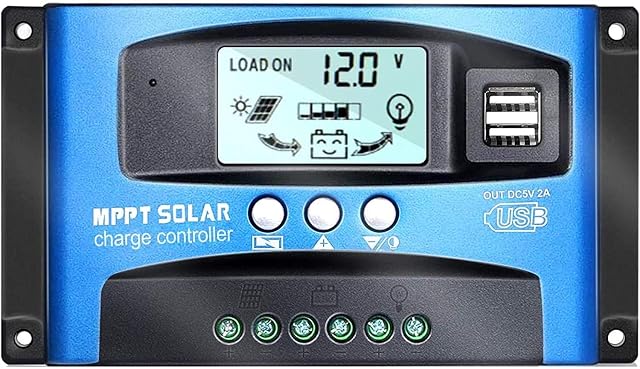
Y&H Wanderer BL912 40 A solar charge controller with LCD

Y&H 40 A, 12 V/24 V, dual USB, LCD

Wins 1 of 7

Check price

≈ €18

Line by line

Compared on SmartSolar MPPT 100/20, 20 A, 100 V PV maximum, 12/24/48 V 40 A, 12 V/24 V, dual USB, LCD
Charge current 20 A, stated in the model designation 100/20 40 A, from the title
Maximum PV voltage 100 V, stated in the model designation — the limits are in the product name itself Nowhere in the listing — no input voltage ceiling is published
Efficiency Absent as a figure; a multi-stage adaptive charging algorithm is named in the first bullet Nowhere in the listing
Battery profiles Presets for common battery types plus fully custom profiles, third bullet — the only controller here to offer user-defined profiles The first bullet says the controller is only for lead batteries — open, AGM, gel — and then that it is also suitable for NiMH, Li-ion and other cells. The two statements contradict each other and are reported as published.
Monitoring Integrated Bluetooth with the VictronConnect application, and connection to a Victron GX device, fourth bullet LCD display with two USB charging ports, from the title
Wiring sizes Nowhere in the listing Nowhere in the listing
Enclosure Nowhere in the listing Nowhere in the listing

A tick means one listing published something the other did not, or published a better figure. It does not mean the product is better, and the column is not a score out of anything: a maker who says less loses lines here without losing a comparison. The two verdicts below are where the page is settled.

Which one, for whom

Buy the Victron Energy SmartSolar MPPT 100/20, 20 A, 100 V PV maximum, 12/24/48 V

Half the current, and both of its limits printed in its own model number. A hundred volts of panel, twenty amps of battery — you cannot buy it without knowing what it takes. It also offers custom battery profiles rather than presets, which is what a lithium bank with an unusual charging voltage actually needs.

Buy the Y&H 40 A, 12 V/24 V, dual USB, LCD

Twice the charge current at a fraction of the price, and no published ceiling on what the panels may deliver into it. That is the figure that destroys a controller rather than merely overloading it, and cold weather pushes panel voltage above its rated value. Its battery-type bullet also contradicts itself within one sentence, which is reported here rather than resolved.

Questions this pairing raises

Why is maximum PV voltage the decisive line?

Because exceeding it is not a warning, it is a failure. Panel open-circuit voltage rises as temperature falls, so a string that is comfortable in August can be over the limit on a cold clear morning. A controller with no published ceiling cannot be sized against that.

Does the monitoring line really tie?

Yes, because they solve the same problem differently. A screen on the unit tells you what is happening while you are standing in front of it; Bluetooth tells you from indoors. In a loft or under a bench, the second is more useful; on a bench, the first needs no phone. Neither is better in general.

What is a custom battery profile for?

Setting absorption and float voltages that no preset covers. A LiFePO4 bank from a maker with its own recommended charging voltages needs those numbers, and a controller with four fixed presets either fits or does not. Custom profiles remove the question.

The full reviews

  • Victron Energy SmartSolar MPPT 100/20, 20 A, 100 V PV maximum, 12/24/48 V

    20 A charge · 100 V maximum PV input, in the model name · multi-stage adaptive algorithm · presets for common types plus fully custom profiles · Bluetooth with VictronConnect and GX compatibility · wiring sizes not published · enclosure not rated

    A 20 A SmartSolar controller whose model number states its limits — 100 V input, 20 A output — with a multi-stage adaptive algorithm, battery presets and integrated Bluetooth.

    Best for: A system that will grow, where the controller has to fit into a wider monitoring installation later.

    ≈ $79 / £70 / €71

  • Y&H 40 A, 12 V/24 V, dual USB, LCD

    40 A charge · maximum PV voltage not published · efficiency not published · lead-acid only, described also as suitable for NiMH and Li-ion · LCD with dual USB · wiring sizes not published · enclosure not rated

    A 40 A controller for 12 V and 24 V systems with an LCD and two USB ports, whose own listing describes its MPPT technology as detecting maximum charge current rather than tracking a power point.

    Best for: Nothing this page can recommend with confidence, given the contradiction on its own first line.

    ≈ €18

A price quoted in the text of a PowerVerdict page dates from the day that page was written; the live figure beside each product is fetched while you read and replaces it.